Mould Removal and Remediation Pentonville
Expert mould remediation and treatment solutions designed to remove mould from walls, ceilings, and floors while preventing future growth and moisture issues.

Expert mould remediation and treatment solutions designed to remove mould from walls, ceilings, and floors while preventing future growth and moisture issues.
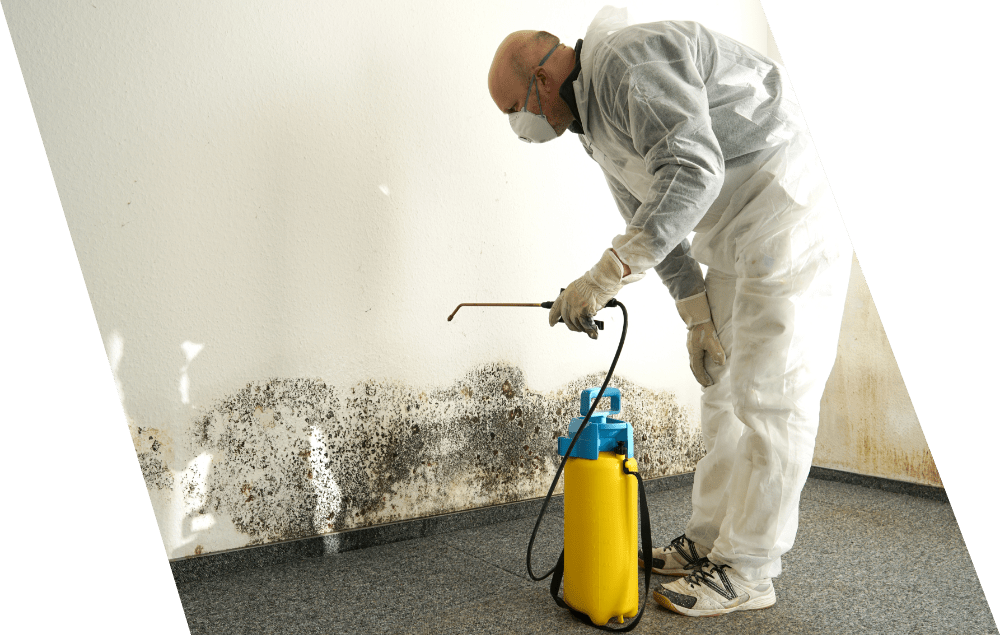
The cost of mould removal depends on the size of the affected area and the type of treatment required. After a detailed inspection a clear, personalised quote is provided based on the scope of work.
| Small mould area (e.g. around a window or corner) | Medium mould area +£100 (large section of a wall affected) | Large mould area +£150 (more than one wall or ceiling) | ||||
|---|---|---|---|---|---|---|
| Room | Standard | Fantastic Club* | Standard | Fantastic Club* | Standard | Fantastic Club* |
| Bedroom | £350 | £320 | £450 | £420 | £500 | £470 |
| Bathroom | £350 | £320 | £450 | £420 | £500 | £470 |
| Kitchen | £350 | £320 | £450 | £420 | £500 | £470 |
| Living / Dining room | £350 | £320 | £450 | £420 | £500 | £470 |
| Hallway / Landing | £350 | £320 | £450 | £420 | £500 | £470 |
| Utility room | £350 | £320 | £450 | £420 | £500 | £470 |
| Paid inspection | £50 | |||||
| *Price for members of the Fantastic Club. The Fantastic Club is a yearly subscription of £89. | ||||||

Our comprehensive mould removal services in Pentonville begin with an extensive inspection and moisture assessment, necessary for determining the level of mould contamination and revealing its root cause. Common triggers for mould growth include high humidity, condensation, poor ventilation, or water damage. Identifying these sources is paramount for long-lasting mould solutions. Our mould cleaning Pentonville service effectively treats structural surfaces such as walls, ceilings, and floors, but we do not service soft furnishings like carpets or upholstered items.
When it comes to professional mould remediation in Pentonville, we emphasize a thorough approach that includes airborne mould spores removal and prevention of future growth. This ensures not only a cleaner surface but also significant improvements in indoor air quality. Our specialised damp and mould removal services safeguard your health and protect your property from structural deterioration. With meticulous mould inspections and detailed remediation strategies, we’re committed to creating and maintaining a healthy living environment.
Mould remediation in Pentonville initiates with a thorough inspection and moisture assessment, employing professional hygrometers to uncover hidden damp areas. This critical first step allows for the identification and remediation of excess moisture that can lead to further mould issues. By addressing moisture problems, technicians can effectively prevent recurrence. HEPA filtration systems and air scrubbers are then utilized during the remediation process to capture and manage airborne mould spores, ensuring a safe and healthy indoor environment.
Next, the application of HOCl (Hypochlorous Acid) comes into play, delivering a non-toxic, professional-grade treatment that neutralizes mould, bacteria, and mycotoxins at a microscopic level. Utilizing ULV (Ultra-Low Volume) fogging technology enables the even distribution of treatment throughout the space, reaching accessible areas effectively. The physical removal of mould is conducted with top-of-the-line equipment featuring H-Class filtration to safely contain harmful materials. Finally, the process wraps up with a thorough air purification method to reduce airborne spores and enhance indoor air quality, securing lasting protection from damp and mould in Pentonville.

Booking mould cleaning is quick and designed to get results without unnecessary delays.
Share what you’re dealing with, whether it’s visible mould, damp patches, or a recurring problem. This helps determine the right approach, from mould cleaning to full mould remediation.
A specialist checks the affected areas and identifies what’s causing the mould, such as excess moisture, condensation, or poor ventilation. This ensures the issue is treated properly, not just on the surface.
You’ll get a straightforward quote based on the level of contamination and the type of mould removal required. The service is tailored to ensure effective results and long-term protection.
The treatment removes mould and improves indoor air quality, helping to prevent future growth and create a healthier living space. It also targets the root cause of the problem for longer-lasting results.
Mould removal requires more than basic cleaning, which is why it’s handled by trained mould remediation specialists experienced in treating both visible and hidden contamination. Each specialist assesses the full extent of mould growth, including underlying causes such as excess moisture, condensation, and ventilation issues, ensuring the problem is addressed properly rather than just on the surface.
Number of bookings: 298
With Fantastic Services for: 3 years
Other specialities:
Number of bookings: 139
With Fantastic Services for: 2 years
Other specialities:
Number of bookings: 8301
With Fantastic Services for: 6 years
Other specialities:
What the reviews say
"Quick and effective rodent control service. Their timely response and efficient methods resolved the problem with expertise."
Alongside professional mould removal and mould cleaning, a range of additional property care services is available to help maintain a healthier indoor environment.
Mould can spread quickly and impact both health and property if not treated in time. Book a service today to remove mould, improve indoor air quality, and restore a cleaner and healthier living environment.

A leak in a block does not stay in one flat. Water that escapes from a failed flexible tap connector, a washing machine hose or a split radiator valve on an upper floor travels along joists, through service penetrations and down riser voids, and the dwelling that reports the damage is frequently two floors below the one where it started. Pentonville is dense with flats stacked above flats, both purpose-built and converted, and escape of water is behind a large share of the mould found here — mould that could have been avoided almost entirely by what happened in the first few days.
Growth does not need weeks. Given wet plaster, wet timber, wet paper-faced board or damp insulation at normal room temperature, colonisation begins within a day or two and is well established inside a week. That makes speed the single most important factor, ahead of any product applied afterwards. A room that is dried properly and quickly may need no remediation at all, while the same room left to dry on its own behind a closed door will need plaster off, boards out and treatment throughout. The distinction between a fast response and a slow one is the difference between a decorating job and a strip-out. the mould removal and remediation service sets out how the two paths diverge.
The visible wet patch is almost never the boundary of the problem. A proper assessment maps moisture across the whole affected area: readings at several heights on each wall, along the base of partitions, into the floor build-up, and behind kitchen and bathroom units. Non-invasive meters are used first to find where moisture is present, then resistance readings at depth confirm how wet the material actually is, since a surface can read dry while a screed or a stud void behind it holds a great deal of water. Insulation inside a stud partition and chipboard flooring are the two materials most often missed. Comparable work in the adjoining districts is covered by North London mould removal service.
Turning the heating up and opening a window is not a drying regime. Controlled drying pairs a dehumidifier suited to the conditions — refrigerant units in a warm room, desiccant where temperatures are lower or where deep materials must be pulled dry — with air movers that break the still layer of air against wet surfaces so moisture can leave them. The room is closed rather than ventilated, so the machines work on the building instead of on outside air. Progress is judged on repeated readings in the same positions, and drying stops when the materials reach a target moisture content, not when the surfaces look dry.
Some materials dry in place and some never do. Laminate and its underlay come up, because water sits beneath them indefinitely. Wet mineral wool inside a partition is removed rather than dried. Paper-faced plasterboard that has wicked water is cut back to a line above the highest reading, which is neater and quicker than trying to dry a full sheet. Skirtings come off so the wall behind them can dry and be treated. Solid plaster on masonry usually dries and can be kept. Opening up a wet floor void frequently reveals older evidence of activity as well, and where droppings or runs are found, what the service covers deals with that.
In a block the paperwork matters as much as the drying. The flat where the leak originated, the managing agent and both insurers generally need the same things: dated photographs, a schedule of readings, a note of what was removed and why, and drying records showing the regime and its results. Getting that recorded from the first attendance avoids the common outcome in which a claim stalls for weeks and the building gets wetter. Soft furnishings, carpets and belongings caught in the flow are handled separately, and professional cleaners in Islington covers that side.
The initial visit locates the source if it is still running, maps the moisture, sets up equipment, and produces a drying plan with an expected duration. Drying is charged by the equipment on site and the period it runs, with monitoring visits at intervals, so the cost is driven by how wet the building is rather than by the size of the flat. Making good afterwards — plasterboard, skirtings, flooring reinstated once the readings allow — is quoted separately and is covered by professional shelf and curtain fitting in Islington.
Skip the line, request and
book a service online