The detail in a period conversion is what makes it lettable and what makes it slow to hand back. Deep cornice, a ceiling rose, panelled doors with four mouldings apiece, original shutters folded into their casings, stripped boards with open gaps - none of it is difficult to clean, but all of it is fiddly, and a schedule of condition written by a good clerk will name every element separately. In N1 that is where the hours go.
Cornice, rose and the ledge above the picture rail
Plaster mouldings have a profile, and a profile means dozens of small horizontal surfaces at ceiling height that are never touched from one year to the next. The dust on them is dry and holds together, so it is brushed and extracted rather than wiped, because a damp cloth on a painted moulding turns dust into a grey streak that follows the line of the detail and is far more conspicuous than what was there before. Distemper and old limewash will come away entirely if worked wet.
Shutters and panelled doors
Original shutters fold back into a boxed reveal that most tenants never open. A clerk will open them, and what emerges is a line of debris along the hinge knuckle and in the base of the box. The work is dry first, then a barely damp cloth on the painted faces. Panelled doors have the same problem in miniature: the top edge of the door, the horizontal of each moulding and the top of the architrave, all of which read instantly from the doorway.
Cast iron fire surrounds
Original grates and surrounds are cast iron, usually blacked rather than painted, and they rust the moment they are left damp. They are brushed out dry, the interior of the opening vacuumed, and the ironwork wiped and dried immediately. Tiled slips at the sides are glazed and can be cleaned normally; the hearth stone frequently cannot, since a stone hearth is porous and takes a strong cleaner permanently. Soot marks the plaster above an opening and is best recorded rather than smeared.
Stripped boards and their gaps
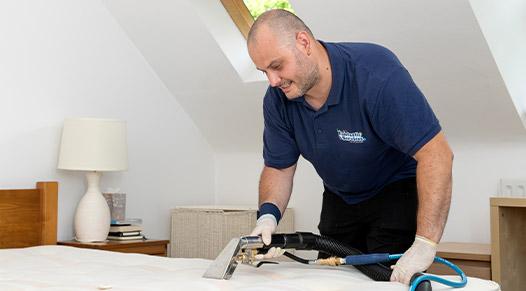
Sanded and sealed floorboards are standard in these flats, and the gaps between them are a reservoir. Vacuuming runs along the joints with a narrow tool rather than across them, and washing uses a barely damp mop so that nothing runs into the void and reappears on the ceiling of the flat below. Where a room is carpeted instead, extraction over old boards has the same risk and a comparable job in the next district is described on trusted rug cleaning in Hoxton.
Small kitchens fitted into old rooms
A galley kitchen built into a former scullery or the end of a reception room has junctions no fitted kitchen designer would choose: a chimney breast in the middle of a run, a boxed soil pipe in a corner, a worktop that stops short of a bay. Those gaps hold grease and crumbs and are worked with a narrow tool. The tops of wall units and the underside of an extractor canopy are the two places an inspection reliably checks. That fitted-into-an-old-room problem repeats right across North London pre-tenancy cleaning, where conversion flats are the dominant rental type rather than the exception.
Moving day and cleaning day
A conversion flat with a turned staircase is slow to empty, and furniture and cleaning equipment cannot share the stair. Booking fully insured house removals in Islington for the day before leaves the flat genuinely empty for the clean, and for a move out of the borough removals for landlords in Finchley or removals prices in Highbury covers the same ground further north. Anything left in a shared hallway draws a complaint from the freeholder rather than the agent.
What the appointment includes
Pricing follows the number of rooms and bathrooms and the specification of the flat rather than time on site, with a cooker strip and internal glazing added separately. Everything personal must be out and the utilities live. Where a household is staying on in the area, a lighter recurring arrangement is available through the cleaning services team in Islington, and the national room-by-room scope is set out on end of tenancy cleaning services nationwide.