


Mould Removal and Remediation Services in Whitechapel
Expert mould removal and treatment using non-toxic solutions to neutralise spores and prevent future growth.

Expert mould removal and treatment using non-toxic solutions to neutralise spores and prevent future growth.
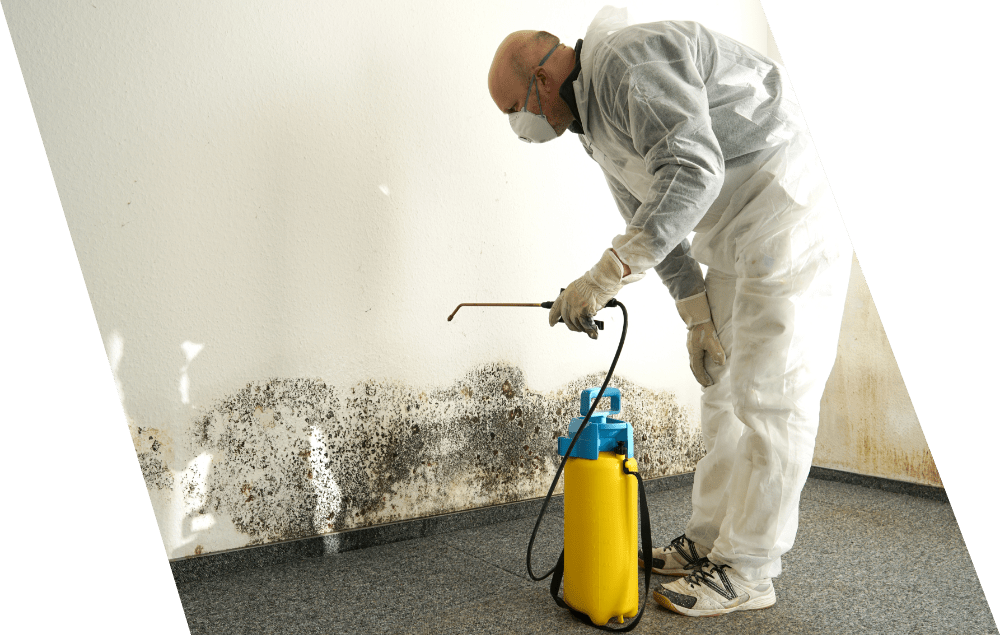
The cost of mould removal depends on the size of the affected area and the type of treatment required. After a detailed inspection a clear, personalised quote is provided based on the scope of work.
| Small mould area (e.g. around a window or corner) | Medium mould area +£100 (large section of a wall affected) | Large mould area +£150 (more than one wall or ceiling) | ||||
|---|---|---|---|---|---|---|
| Room | Standard | Fantastic Club* | Standard | Fantastic Club* | Standard | Fantastic Club* |
| Bedroom | £350 | £320 | £450 | £420 | £500 | £470 |
| Bathroom | £350 | £320 | £450 | £420 | £500 | £470 |
| Kitchen | £350 | £320 | £450 | £420 | £500 | £470 |
| Living / Dining room | £350 | £320 | £450 | £420 | £500 | £470 |
| Hallway / Landing | £350 | £320 | £450 | £420 | £500 | £470 |
| Utility room | £350 | £320 | £450 | £420 | £500 | £470 |
| Paid inspection | £50 | |||||
| *Price for members of the Fantastic Club. The Fantastic Club is a yearly subscription of £89. | ||||||

In Whitechapel, our mould removal services are carried out by qualified local specialists who perform comprehensive inspections and moisture assessments to pinpoint the root causes of mould growth, such as condensation, damp conditions, and inadequate ventilation. Our mould cleaning service in Whitechapel targets walls, ceilings, and floors—areas that are prone to mould contamination. It's essential to understand that soft furnishings are outside the scope of this treatment, focusing instead on structural surfaces that contribute to a healthier home environment.
Our mould remediation process in Whitechapel goes the extra mile by addressing not only visible mould but also airborne spores that can affect your health. Utilizing advanced HEPA filtration to eliminate these spores from the air, we apply HOCl (Hypochlorous Acid) for microscopic neutralisation of mould and bacteria, coupled with ULV fogging technology to access hard-to-reach areas. This all-encompassing strategy guarantees your home remains mould-free, enhancing indoor air quality and preventing any future issues.
In Whitechapel, the mould remediation process starts with an exhaustive inspection and moisture assessment, performed using cutting-edge equipment to pinpoint visible and concealed dampness. This crucial step helps mitigate the potential for repetitive mould issues by identifying excess moisture sources. Subsequently, HEPA filtration systems and air scrubbers are implemented to eliminate airborne mould spores, preserving a safe indoor atmosphere during the entire remediation process.
After managing airborne spores, a non-toxic solution of Hypochlorous Acid (HOCl) is applied to effectively neutralize mould, bacteria, and mycotoxins at a molecular level. Furthermore, Ultra-Low Volume (ULV) fogging technology guarantees complete coverage, accessing hard-to-reach areas such as cracks and corners. Professional equipment with H-Class filtration is employed for physical mould removal, ensuring contaminants remain contained. The process concludes with comprehensive air purification and long-term protective measures, significantly boosting indoor air quality and decreasing future contamination risks in Whitechapel.

Booking mould cleaning is quick and designed to get results without unnecessary delays.
Share what you’re dealing with, whether it’s visible mould, damp patches, or a recurring problem. This helps determine the right approach, from mould cleaning to full mould remediation.
A specialist checks the affected areas and identifies what’s causing the mould, such as excess moisture, condensation, or poor ventilation. This ensures the issue is treated properly, not just on the surface.
You’ll get a straightforward quote based on the level of contamination and the type of mould removal required. The service is tailored to ensure effective results and long-term protection.
The treatment removes mould and improves indoor air quality, helping to prevent future growth and create a healthier living space. It also targets the root cause of the problem for longer-lasting results.
Mould removal requires more than basic cleaning, which is why it’s handled by trained mould remediation specialists experienced in treating both visible and hidden contamination. Each specialist assesses the full extent of mould growth, including underlying causes such as excess moisture, condensation, and ventilation issues, ensuring the problem is addressed properly rather than just on the surface.
Number of bookings: 214
With Fantastic Services for: 3 years
Other specialities:
Number of bookings: 205
With Fantastic Services for: 3 years
Other specialities:
Number of bookings: 298
With Fantastic Services for: 3 years
Other specialities:
Alongside professional mould removal and mould cleaning, a range of additional property care services is available to help maintain a healthier indoor environment.








Mould can spread quickly and impact both health and property if not treated in time. Book a service today to remove mould, improve indoor air quality, and restore a cleaner and healthier living environment.

Mould is a surface temperature problem before it is anything else. Growth needs a surface that spends long enough sitting at or below the dew point of the air touching it, which is why two identical flats in the same E1 block can have completely different outcomes with the same number of occupants. Guessing at that from a single glance at a wall is unreliable, and the guess is usually what leads to a repainted room and a repeat visit the following winter. Measuring it changes the conversation.
Three readings interact. Air temperature and relative humidity in the room give the dew point, the temperature at which the air's moisture will start to condense. A surface thermometer gives the actual temperature of the wall, reveal or ceiling in question. Where surface temperature falls below dew point, condensation is inevitable there and nowhere else, which is precisely why growth is confined to one corner while the rest of the wall stays clean.
A single set of readings captures one moment. A small data logger left in the affected room for a week or two records temperature and humidity continuously, and the resulting pattern is far more informative: humidity spiking each evening points to cooking and laundry, a steady overnight rise with the heating off points to under-heating and poor ventilation, and a climb that tracks rainfall points to water entering the fabric. In a disputed case that record is also the most persuasive evidence available.
A thermal camera shows cold areas of a wall quickly and makes cold bridges, missing insulation and wet patches obvious at a glance. It has to be read with care, though, because it shows surface temperature rather than moisture, and a cold area may be a draught, a steel lintel, a chimney breast or simply a wall in shade. Imaging is used to decide where to take contact readings, not as a conclusion in itself.
Not all dark growth is mould and not all of it is internal. Green and black algal growth on external render, brickwork and paving is a different organism living on a permanently damp external surface, usually where a downpipe leaks, a shaded elevation never dries, or a gutter overflows. Treating the outside face has no effect on a bedroom wall, and treating the bedroom has no effect outside. Where the external face is the issue, cleaning and correcting the water source is the job, and Whitechapel pressure washing team covers that work.
Air and surface sampling can identify what is growing, and it has genuine value in a few situations: where an occupant has a diagnosed respiratory or immune condition, where growth is suspected inside a construction and cannot be seen, or where a dispute needs independent confirmation. In an ordinary case of visible growth on a cold wall, sampling adds cost without changing the remedy, and an honest assessment will say so rather than sell it.
Readings produce a specific instruction rather than general advice: insulate this reveal, fit extract of this capacity in that room, repair that gutter, raise the background temperature in the unheated bedroom. Fitting and repair work of that kind is handled by trusted TV wall mounting in Whitechapel, and doing it while the findings are fresh is what stops the cycle repeating. Warm, humid service risers in dense blocks also sustain cockroach populations that move between flats through those same voids, which is why Tower Hamlets cockroach control is sometimes instructed alongside. Adjoining streets are covered by mould removal services across Stepney, and the treatment side is described on the Fantastic Services page.
An assessment of this kind takes longer than a look round, because readings have to be taken in several places and compared. Where a logger is left in place, there is a second short visit to collect it and the report follows that. Rooms need to be in normal use during the logging period rather than specially ventilated, since the point is to capture how the home actually behaves. The survey is charged as its own visit, and any treatment or remedial work is quoted afterwards against the findings rather than in advance of them.
Skip the line, request and
book a service online


















