On a deck-access block, the weather gets a second chance at the wall. Bermondsey has a substantial stock of post-war estate housing where flats are reached along open external walkways, and that arrangement puts a hard, draining surface directly outside the living rooms and kitchens of the homes behind it. Where the deck no longer sheds water properly, the wall it abuts stays wet, and the growth that follows inside is almost always blamed on the occupants rather than on the drainage a metre outside their front door.
What the deck does when its outlets block
A walkway is laid to a shallow fall towards outlets or a channel at its edge. Leaves, grit and general debris fill those outlets, the fall is often marginal to begin with, and after rain a shallow film of water sits across the deck instead of leaving it. That water is then in permanent contact with the base of the wall and with the threshold of every door along the run. Masonry takes it up, the internal face of that wall never dries, and the pattern indoors is a low band that tracks the length of the deck rather than a patch around a window.
Upstands, thresholds and the height of the waterproofing
Where the deck surface has been overlaid at some point — an asphalt or resin covering added over the original — the finished level rises towards the threshold and the waterproofing upstand against the wall gets shorter. A few centimetres lost there is the difference between water being held out and water being able to run in behind the covering at the wall junction. Thresholds that were adequate become marginal, and driving rain along an open walkway does the rest. The internal symptom is a damp floor edge just inside the door, with growth on the skirting and the bottom of the frame.
The soffit and the flat below
Every walkway is also a ceiling. Water crossing a deck and finding a route at a joint, an outlet collar or a movement gap ends up on the soffit above the flat below, and from there in the ceiling and wall head of that home. Staining on a top corner of a ceiling immediately below a walkway is usually this and not condensation, and no treatment applied inside will do anything while the route above is open. The order of work is fixed: the deck first, then drying, then finishes.
Ventilating a flat whose windows face a public walkway
The other half of the problem is that a kitchen or bedroom window opening onto a shared walkway is not a window anyone leaves open. Privacy, security and passing conversation all argue against it, so those rooms run closed in practice whatever the guidance says. Ventilation in this layout has to come from mechanical extraction in the wet rooms and a clear internal air path — undercut doors, unobstructed transfer between rooms — rather than from an openable window that will stay shut.
Removal where two causes are present
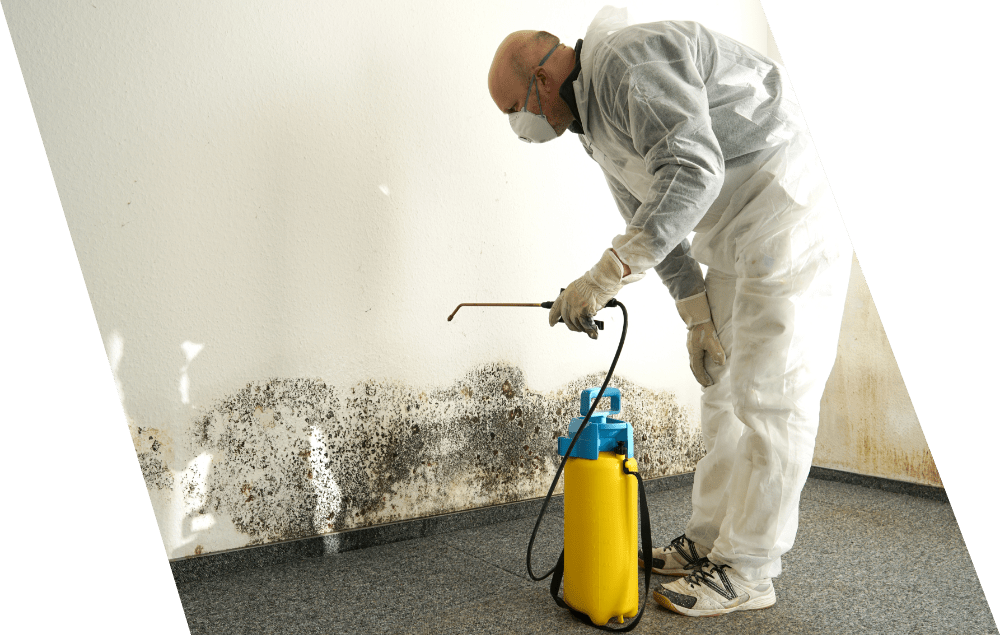
Deck-access flats commonly have both external water and internal condensation at once, in different rooms. They are separated by pattern and by season: an area that stays damp in mild dry weather is liquid water, one that appears in cold weather and fades in summer is condensation. Removal is the same either way — unsound plaster and board taken off damp with extraction at the working face, substrate cleaned, biocide left for its dwell, drying monitored to a stable reading — but the repair that has to accompany it is completely different, and both get identified before work starts.
Booking, and what the block controls
Work on a walkway surface, its outlets and its waterproofing usually belongs to the building's owner or managing agent, so part of a first visit is establishing which side of the boundary the cause sits on and producing something the household can pass on. Inside the flat, pricing follows the area of finish removed, the drying equipment and the number of visits. Access along a walkway means materials are carried, so parking and lift arrangements matter on the day. Adjusting doors, restoring undercuts and refitting skirtings is work for handyman throughout Bermondsey; insects established in permanently damp floor edges are dealt with by experienced pest control services in Bermondsey; concealed pipework or waste faults found during the strip-out go to our nearby specialists. Comparable work nearby is covered by experienced mould remediation in Waterloo, and the general method appears on trusted black mould removal.