Telling somebody in SE1 to sleep with a window open is not advice, it is a request they will refuse. Bankside sits among railway viaducts, arterial routes and late-night activity, and the honest position is that a great many flats here cannot be ventilated by opening windows at night without making the bedroom unusable. The moisture has to leave somehow, though, and when the only route offered is one the occupants cannot take, growth appears in the same corners year after year and the advice gets repeated year after year.
Noise changes the moisture balance of a flat
A household produces the same moisture whether its windows open or not. In a quiet street some of that leaves through habit — a window ajar while the kettle boils, a bedroom vented overnight. Where noise rules that out, the flat runs at a higher humidity all year, and every cold surface in it collects moisture for longer. It is not carelessness on the occupants' part and it does not respond to being told to air the place; the ventilation route simply has to be one that works with the windows shut.
Sealed up, and then sealed up again
The usual sequence makes it worse. Glazing gets upgraded for sound, gaps get filled, any ventilators that came with the old frames are taped over because they let noise in, and the last accidental air paths disappear. A flat treated that way is quieter and holds considerably more moisture than it did. Where an internal secondary system has been added inside the existing window, the cavity between the two can collect condensation of its own and grow mould on the inner faces and the sill between them.
Ventilation that does not import noise
There are routes that work. Acoustically attenuated ventilators run a labyrinth of absorbent material between outside and inside, so air passes and much of the sound does not. Continuous low-rate mechanical extraction from the wet rooms, running quietly all the time rather than in bursts when somebody remembers, moves air through the flat on a path that does not depend on windows at all. Single-room heat recovery in a bathroom achieves something similar without dumping warmth. The right answer depends on the layout, the facade and what the building's management permits, but in every case it is a designed route rather than a behavioural instruction.
Where the growth actually sits in this stock
Around Bankside the affected surfaces are typically window heads and the internal corners either side of them, the wall behind a bed against the facade, and the inner face of a bathroom wall that backs onto a colder space. In converted upper floors the highest surfaces go first, because warm moist air collects there and stays. Growth on a facade wall in a flat that never opens its windows should be read as a ventilation failure, not as water coming in — though confirming that means ruling the other out properly.
Ruling out water before blaming air
Some of it is not condensation. A slow leak on a concealed pipe run, a failed waste connection in a service void, or a shared drainage stack with a weeping joint will produce a persistent damp area that no amount of ventilation improves. The pattern is the test: an area that stays wet through mild weather and does not vary with the seasons is liquid water, and that investigation and repair belongs with weekend plumbing in Brockley. It is worth settling first, because the remedy is entirely different.
How the work runs in a city flat
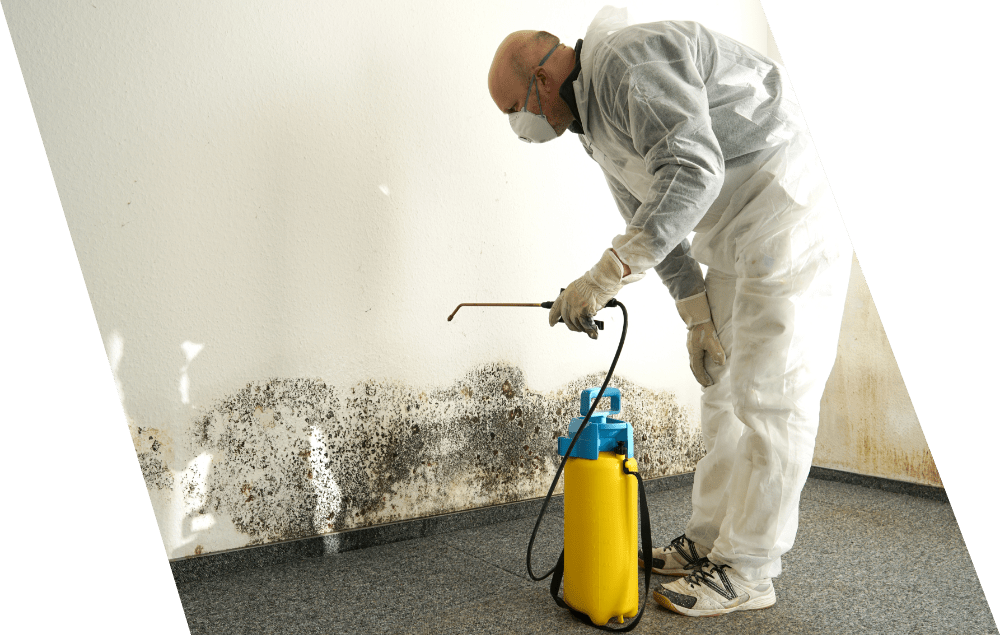
Once the route is clear, unsound finish is removed damp with extraction at the working face, surfaces that are staying are treated with a biocide left for its full dwell, and drying is monitored until readings stop moving. Waste leaves in sealed bags under duty of care rather than through a communal refuse room. Fitting ventilators, adjusting doors and making good after a new extraction route is joinery covered by handyman cover across Waterloo, and high humidity in a closed-up flat frequently brings insects that are dealt with by pest control throughout Southwark. Pricing follows the area of finish removed, the equipment on site and the drying period, and access hours in a managed building are worth confirming at the point of booking. The same work a short distance west is covered by fully insured mould removal in Waterloo, and the underlying sequence is on the mould removal and remediation service.