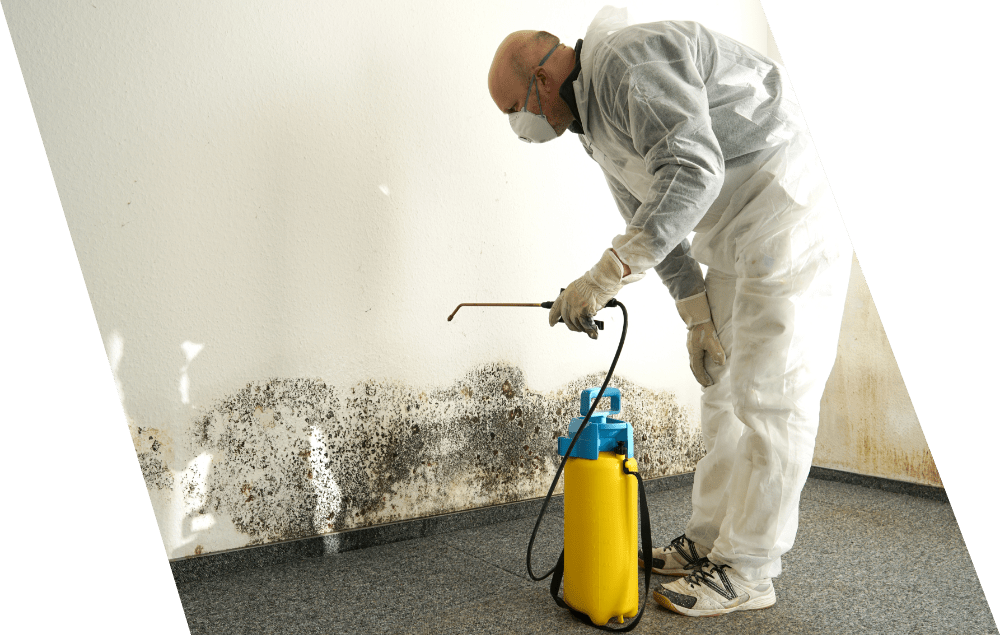
The giveaway in a Canning Town flat is the shape of the growth. Mould that runs in a straight vertical band two-thirds of the way along a wall, or draws a neat rectangle around a window opening, is not a reflection of how the home is lived in. It is tracing a piece of structure that runs colder than the plaster around it: a concrete column, the edge of a floor slab, a lintel over the glazing. E16 carries a large stock of post-war framed and panel-built blocks where exactly that detail sits a few millimetres behind the paint.
What a cold bridge does to a wall
Concrete conducts heat far better than the masonry or insulation beside it, so a structural element bridging from outside to inside pulls the internal surface temperature down locally. Once that surface drops below the dew point of the room air, moisture lands on it every evening and sits there through the night. The plaster never dries out fully, and germination follows within weeks in the heating season. Because the cold element has a defined shape, so does the colony, which is why a geometric pattern is diagnostically useful before anything is opened up.
Reading surface temperatures
Diagnosis here relies on paired readings rather than impressions. Air temperature and relative humidity in the room give a dew point. A contact or infrared thermometer then gives surface temperature at the suspect line and at a control point a metre away on the same wall. A difference of several degrees between the two, with the cold reading at or under the dew point, confirms a thermal bridge. Thermal imaging makes the extent obvious but needs a real temperature difference between inside and out to show anything, which is why this work is more informative in January than in June. A leak, by contrast, gives high readings that do not track a structural line and do not vary with the weather.
Detailing internal insulation properly
Lining the cold element is the usual remedy and the usual failure. An insulated board fixed over a column or a reveal has to be continued past the junction and returned along the reveal and into the ceiling and floor lines, otherwise the cold point simply relocates to the edge of the board and the mould reappears in a thin line alongside it. Vapour control has to suit the build-up, or moisture accumulates behind the board instead of on the face of it. Mechanical fixings that pass straight through to the concrete create small bridges of their own. Well-detailed, the treatment lasts; badly detailed, it buys a year.
When a whole block shares one defect
Where several flats in a block report the same pattern in the same position, the problem belongs to the building rather than to any household, and that changes who should be doing the work. A set of recorded readings across more than one flat is a far stronger case to a landlord or a managing agent than a single complaint. Finishing work sits alongside the technical side: reboxing a service pipe, refitting skirting and easing a door that no longer clears a thicker lining is covered by Canning Town odd jobs. Refuse rooms and warm service voids in these blocks are also a standing pest question, and vetted pest control services in Canning Town deals with activity found during an inspection.
Nearby work and reinstatement
The same approach applies across the district, and Silvertown mould removal service covers the riverside side of E16. Lining and making good generate a great deal of fine dust in an occupied flat, and a local professional is the usual follow-on before rooms are brought back into use. Full method and guarantee detail sits on professional mould removal and remediation.
What the written findings contain
An assessment here produces a schedule of readings rather than a description. Each affected wall is listed with surface and air readings, the dew point calculated at the time of the visit, the position and likely nature of the cold element, and photographs keyed to the readings. Recommended works are set out in priority order, separating what stops the growth from what merely improves comfort, which matters when a leaseholder or a housing team is scoping a budget. Remediation is priced by the number of walls or reveals treated and by whether insulated lining forms part of the job, with the assessment bookable on its own.