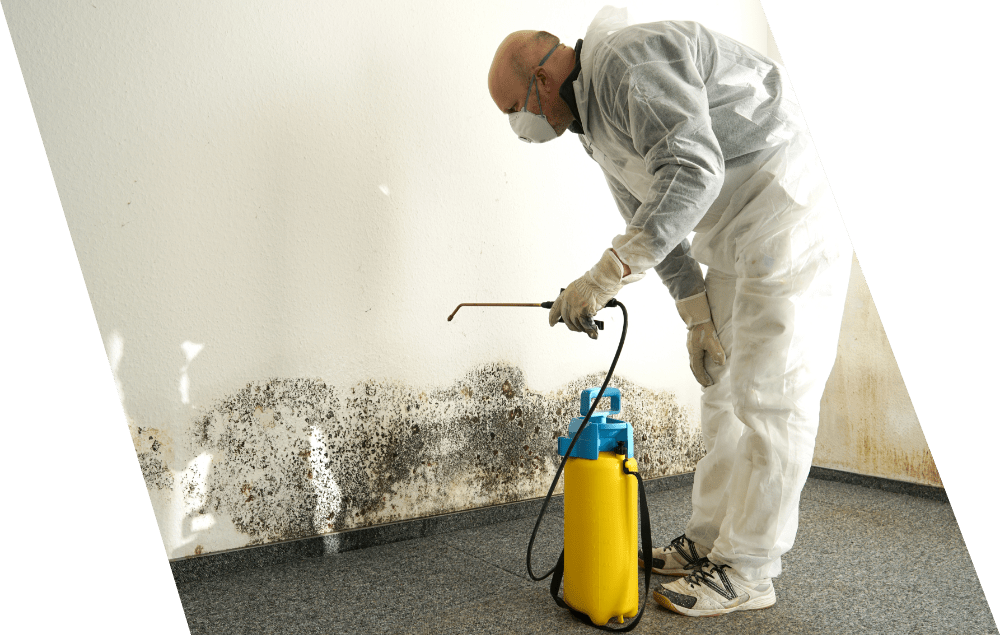
Killing growth takes an afternoon. Drying the wall behind it can take a fortnight, and that is the part that decides whether the repair holds. Plaster, brick, screed and timber all hold water in their pores and release it slowly, and until they have released it the surface stays cool and damp enough for a new colony to establish. In the dense converted housing around Finsbury Park, most of the repeat visits we see are drying failures rather than treatment failures.
What is actually wet, and how wet
Before any machine is switched on, the extent of moisture is mapped. Surface readings tell you very little on their own, because a wall can read damp at the skim and be sound two centimetres in, or read acceptable at the surface and be saturated at depth. Readings are taken at several depths, at intervals across the affected area and beyond it, and compared with an unaffected wall in the same property as a control. The result is a boundary: this much of the fabric is wet, this much is not, and the drying plan is sized to the former.
Choosing between the two kinds of dehumidifier
Refrigerant machines pull moisture out by chilling air below the point where it releases water, and they work well in a warm, occupied room. Desiccant machines use an absorbent wheel and keep working at lower temperatures and lower humidities, which makes them the right choice for an unheated flat, a hallway or the tail end of a dry-down where the easy moisture has already gone. Putting a refrigerant unit into a cold room in February and expecting progress is a common and expensive mistake. Machine choice is decided by the conditions in the room, not by what happens to be on the van.
Moving air, not just conditioning it
A dehumidifier lowers the humidity of the air it processes. It does nothing for a wall unless air is being moved across that wall, because a stagnant layer of saturated air clings to a wet surface and slows evaporation to a crawl. Small air movers directed along the face of the wall at a shallow angle break that layer up and speed the whole process, which is why a proper set-up has both types of equipment working together. Furniture is pulled clear, floor coverings are lifted at the perimeter, and the room is kept closed so that the machines are working on the same air repeatedly rather than on the whole flat.
Drying too fast and drying too slowly
Aggressive drying has its own consequences. Timber that loses moisture quickly at the surface and slowly at the core will cup and split, joinery shrinks away from its joints, and lime-based plaster can craze. Where original features are involved, the target is steady progress rather than speed, and the equipment is throttled back accordingly. Drying too slowly is the more common fault: plant left running unattended for weeks without readings, in a room nobody enters, proves nothing and often achieves little. The staged assessment behind these decisions is covered under flexible mould removal and remediation.
Running plant in a converted flat
N4 is mostly Victorian terraces divided into flats, reached by a single staircase, in streets with permit parking and no loading space. That shapes the practical side. Equipment has to be carried up, condensate needs a route to a waste rather than a bucket somebody has to empty, machines draw current continuously and should not share a socket circuit with a kitchen, and noise in a converted house carries through floors to neighbours. Discharging condensate into a waste pipe properly, rather than into a basin somebody needs, is a small piece of work for Crouch End plumbing team.
Signing the drying off, and what follows
A dry-down is finished when readings taken on separate days agree, not when the plant has been in place for a set period. Only then does making good start. Households are asked to keep the room closed, leave the machines running rather than switching them off overnight, and not to move the air movers, since their angle matters. Charges for this stage follow the number of machines and the number of days they are on site, so the honest answer to how much drying costs is that it depends on how wet the wall was. Refitting skirting and trims afterwards is a job for trusted handyman in Finsbury Park, and where a void has shown signs of activity, local pest control across Finsbury Park deals with it before anything is sealed. The neighbouring streets behave much the same way, and mould removal services across Harringay is worked to the same standard.