Some flats have only one wall that faces outside, and that single fact determines everything about how they handle moisture. Single-aspect layouts are common around Elephant and Castle, in both the post-war blocks and the newer towers built off central corridors: a run of rooms along one facade, a deep plan behind them, and a kitchen or bathroom set into the middle of the flat with no external wall at all. Air cannot cross such a flat, because there is nowhere for it to cross to, and no amount of window-opening changes that geometry.
Cross ventilation needs two openings
Air moves through a home because there is a pressure difference between one side and another. With openings on two facades, even a light breeze produces a steady exchange that carries moisture out. With openings on one facade only, opening a window produces local mixing near that window and very little movement at the back of the plan. The far end of the flat — often a bedroom, a store or an internal bathroom — stays at whatever humidity the household has produced, and the surfaces there collect it.
The internal bathroom as the whole problem
A windowless bathroom in the middle of a deep flat has exactly one route for its moisture: the extraction. If that extraction is weak, discharges into a void, is switched on the light and runs for two minutes, or has never been cleaned, then every shower puts several litres of water vapour into the flat's air with nowhere to go. It then migrates outwards towards the coolest surfaces at the facade end and condenses there. The growth appears in a bedroom corner, the bathroom looks fine, and the connection is missed.
Air paths inside the flat matter more than usual
Because the ventilation has to be mechanical and has to work along the depth of the plan, the internal route becomes part of the design. Doors need a gap beneath them or transfer openings, wardrobes and shelving must not block the path, and the extraction in the wet rooms has to run at a low rate continuously rather than in short bursts, so that there is always a direction of flow from the habitable rooms towards the wet rooms. Where corridors are pressurised for fire safety, the flat's entrance door is not part of the ventilation strategy and cannot be relied on.
Reading a single-aspect flat on a first visit
The diagnosis usually comes from the plan rather than the instruments. Growth concentrated at the facade end, worst in the room furthest from the extraction, on the coldest external corners and behind furniture, in a flat with an internal wet room, is a ventilation-geometry case. Where instead the growth is around the wet room itself, or on a wall shared with a riser, the likelihood is liquid water from pipework and that is investigated before anything else. Both patterns occur here and they lead in opposite directions.
What gets removed and what stays
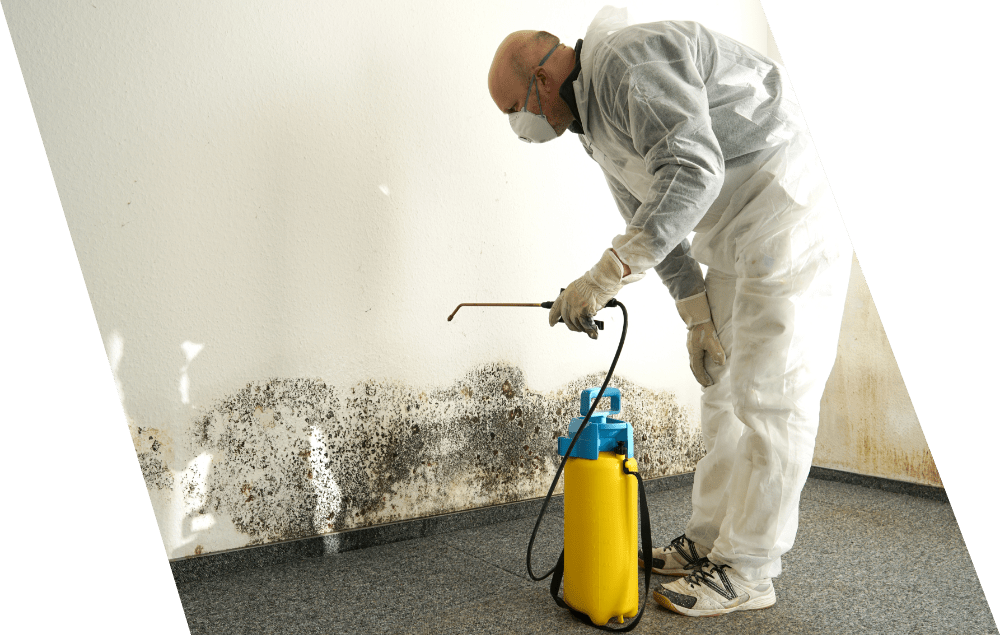
Painted plaster with surface growth is cleaned wet, treated with a biocide left for its full dwell time and left to dry before redecoration. Plasterboard that has been wet from behind, wallpaper with growth through the paste layer and any soft or blown plaster come off, cut back to sound material, with extraction at the working face and waste bagged as it comes out. Growth inside a wardrobe against the facade wall means the joinery is pulled away and the wall behind it treated, not just the visible face.
Arranging the work in a managed building
Most flats here sit in blocks with their own rules about working hours, lifts and waste, so those are worth settling when booking rather than on the morning. Costs follow the area of finish removed, the drying equipment and the length of the drying period, with any change to extraction quoted separately as its own job. The flat will be noisy while equipment runs and the wet rooms may be unavailable for part of it. Extraction alterations, transfer openings and door adjustments are handled by furniture assembly services in Elephant and Castle; damp internal rooms that have attracted insects are dealt with by a local pro near you; a suspected leak in a riser or under a bath goes to plumbing across Camberwell. The same service a short way north is covered by mould removal specialists in Waterloo, and the general sequence is set out on damp and mould treatment.