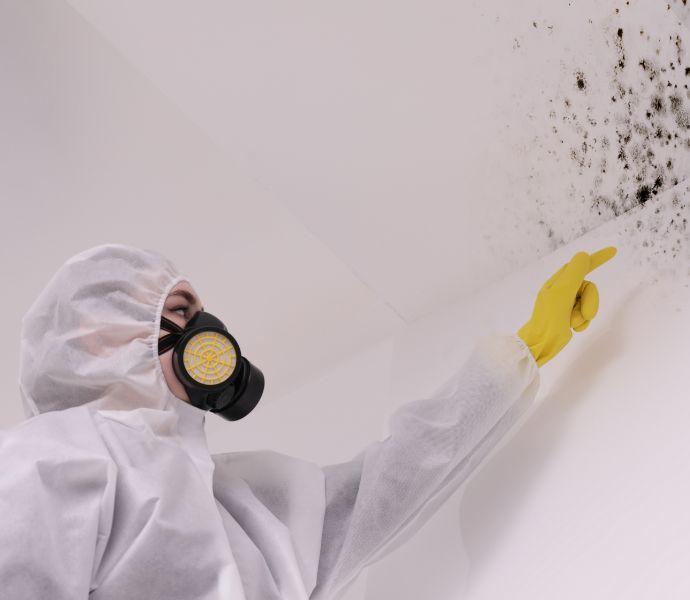
Cleaning mould off a flat painted ceiling is straightforward. Cleaning it out of a run cornice is not. Plenty of the Victorian and Edwardian houses in Enfield still carry their original moulded plasterwork, and in a room that has suffered damp the growth almost always settles in exactly the parts that cannot be scrubbed: the top bed of the cornice, the hollows of an enrichment, the undercut behind a ceiling rose. Getting it out without losing the detail is a slow, dry, patient job, and it is the part of the work most often done badly.
Why the moulding collects it
Three things meet at the top of a wall. The surface there is colder than the middle of the wall because the structure changes and the corner loses heat in two directions. Air movement is at its lowest, so nothing sweeps the surface. And the profile itself traps dust, which gives spores something to settle in and feed on. Add the moisture that rises to the top of a room and a cornice becomes the most reliable indicator in the house of a damp problem that has been running for some time.
What the plasterwork is made of
It matters. A run cornice formed in place on lath is a lime-based material, soft, absorbent and held by a key behind the laths. A fibrous cast is plaster reinforced with hessian and timber laths, fixed with wads. Both are far more vulnerable to water than the modern gypsum below them. Soaking either one to clean it can soften the material, dissolve the key, stain the face and bring the stain back through any paint applied afterwards. A great deal of ruined plasterwork was ruined by cleaning.
Dry methods first
The order of work is dry to damp, never wet to dry. Loose growth and dust come off with soft brushes and a vacuum fitted with fine filtration, worked into the profile a short length at a time so nothing is driven into the surface. Only then is a treatment applied with a cloth or a fine spray, kept to the minimum, with the liquid controlled rather than allowed to run down the wall. Working in small sections and letting each dry avoids saturating the whole run.
Paint layers and what they hide
A cornice in an older house may carry a century of distemper, oil paint and modern emulsion. Thick build-up blurs the detail but also protects the plaster beneath. Stripping is rarely worth the risk and usually damages arrises. Where staining persists through a treated surface, a sealing coat applied sparingly before redecoration is the sensible compromise. Where a length has broken down entirely, it is cut out and a new section cast from a squeeze taken off the sound profile, then fixed and stopped in.
The rest of the room
Decorative plasterwork is a symptom, not a cause, and the reason the room was damp still has to be found and dealt with or the whole exercise repeats. Picture rails, dado rails and skirtings in the same room usually need attention at the same time, and joinery repairs of that sort are handled by handyman team in Enfield. Voids behind fibrous casts and above lath ceilings are also a well-known refuge for insects and rodents, which is covered by pest control services in Enfield.
What a booking looks like
An inspection assesses the type of plasterwork, its condition and how much can be cleaned rather than replaced, before anything is quoted. Charges follow the length and complexity of the profile, the number of rooms and whether casting and replacement are involved, so this is not work priced by the square metre over the phone. Comparable period properties nearby are covered by mould removal team in Cockfosters, the fine dust left afterwards is dealt with by experienced home cleaning in Cockfosters, and the general method is set out on local black mould removal.