A room built to keep sound in keeps everything else in as well. Home studios, podcast rooms, drum rooms and treated home offices have become common in the houses and converted premises around Hayes, and the standard recipe for making one quiet is also a recipe for making it damp. Mass, isolation and airtightness are exactly what acoustic performance needs. They are also, without a deliberate ventilation strategy, the conditions under which moisture accumulates in a small occupied space and condenses somewhere nobody can see.
What acoustic work does to a wall
Typical treatment adds resilient bars or an independent frame, dense mineral slabs in the gap, two or more layers of board, and a continuous bead of flexible sealant at every edge and around every socket. The original external wall is now behind several new layers, further from the heat of the room and colder than it was. Unless a vapour control layer was included on the warm side, moist air from the room migrates into the build-up and condenses on the cold face of the old wall, inside the construction.
The sealed door and the blocked window
Acoustic doors are heavy, closely fitted and often given a drop seal at the threshold, which removes the gap that normally lets air into and out of a room. The window is frequently boarded over or given a heavy secondary panel that is never opened. The result is a space with no air exchange at all, occupied for hours at a time by people and equipment that produce heat and water vapour continuously. Humidity climbs through a session and does not fall much afterwards.
Finding the problem without wrecking the work
Growth inside a build-up is invisible, and the first evidence is usually a smell that intensifies when the room warms up. Investigating means small, carefully chosen inspection openings, ideally in a low-impact position such as behind an equipment rack or below the line of a panel, checked with a borescope and a moisture probe rather than by opening the whole wall. Readings taken on the room face will look reassuring; what matters is the moisture content of the timber and board behind the lining.
Ventilating a quiet room
The fix is ventilation that does not carry noise. Ducted supply and extract can be run through an attenuator, a lined bend or a lobby so that air moves while sound does not, and a continuous low rate is far better here than an occasional boost. A room used for long stretches needs air brought in as well as taken out, since extract alone against a sealed envelope achieves very little. Where plumbing has been boxed inside an acoustic lining, a slow leak can run unnoticed for months, and tracing that sits with local plumbing across Chislehurst.
Stripping back and rebuilding
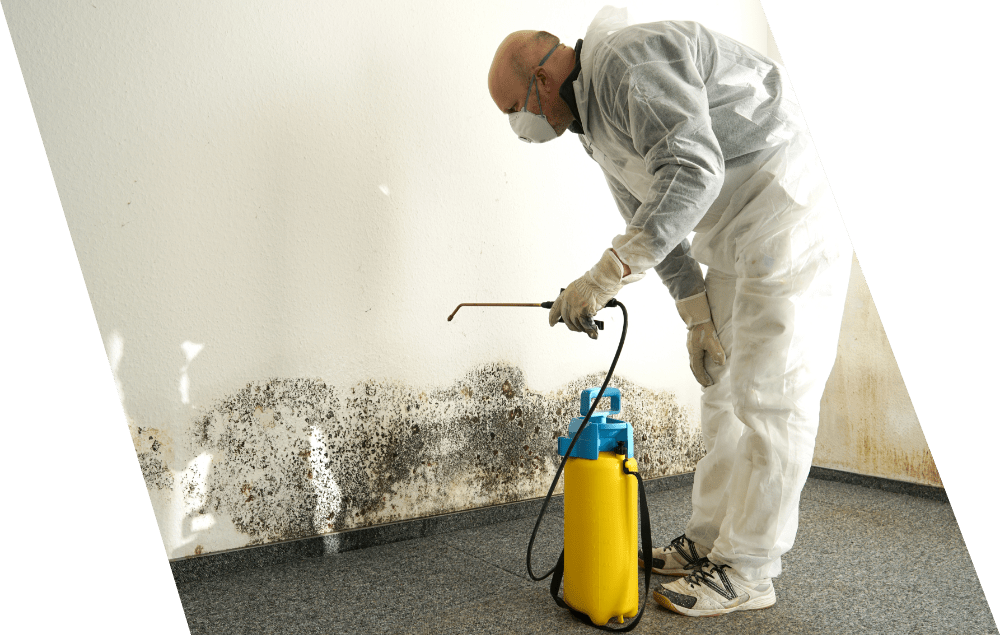
Where growth has taken hold in the insulation and on the board, the affected layers come out. Mineral slabs that have been wetted are not dried and reused. The structure behind is cleaned, treated and dried to a measured level, a vapour control layer is installed properly with taped laps, and the acoustic build-up is reinstated in the correct order. Containment matters more than usual because dense insulation releases a great deal of fine material when it is pulled out.
Arranging the work
An inspection covers the treated room, the spaces around it and any adjoining wall that shares the construction. Charges follow the area opened, the amount of lining replaced and whether ventilation work is included, so the scope is set after the visit. Comparable jobs in the surrounding area are covered by flexible mould removal in Elmers End. Reinstating trims, fixings and a door that no longer closes cleanly is handled by handyman team in Hayes, and voids packed with soft insulation are a known harbour for rodents, dealt with by what the service covers. The general method is described on our mould removal and remediation service.