Mould Removal in Wembley: Professional Mould Remediation Services You Can Rely On

  • Tailored mould solutions for Wembley homes and rental properties
  • Full-property treatment with controlled application methods
  • Detection of hidden moisture and mould-prone areas
  • Advanced treatment for visible mould and airborne spores
Featured logos

Mould removal costs in Wembley

Mould removal in Wembley is calculated per room, with the total cost depending on how many areas of the property require treatment and the extent of mould growth. Each mould removal service in Wembley begins with an inspection to assess the condition of the property, identify sources such as damp or condensation, and determine the most suitable treatment approach.

Average service cost in this area is:
£350-£700
Calculate cost

How to Book Mould Removal in Wembley

1. Book online

Use our straightforward online form to schedule your service.

2. Expert assessment

A skilled mould removal specialist will inspect the affected areas in your property.

3. Effective treatment

We’ll remove the mould completely and apply preventative treatments.

4. Restore your home

Enjoy a safer and healthier living space.

Why Choose Us for Mould Removal in Wembley?

Our team in Wembley has the expertise and training to handle any mould problem, providing professional advice and complete mould eradication, regardless of severity.

Complete Mould Removal Service in Wembley

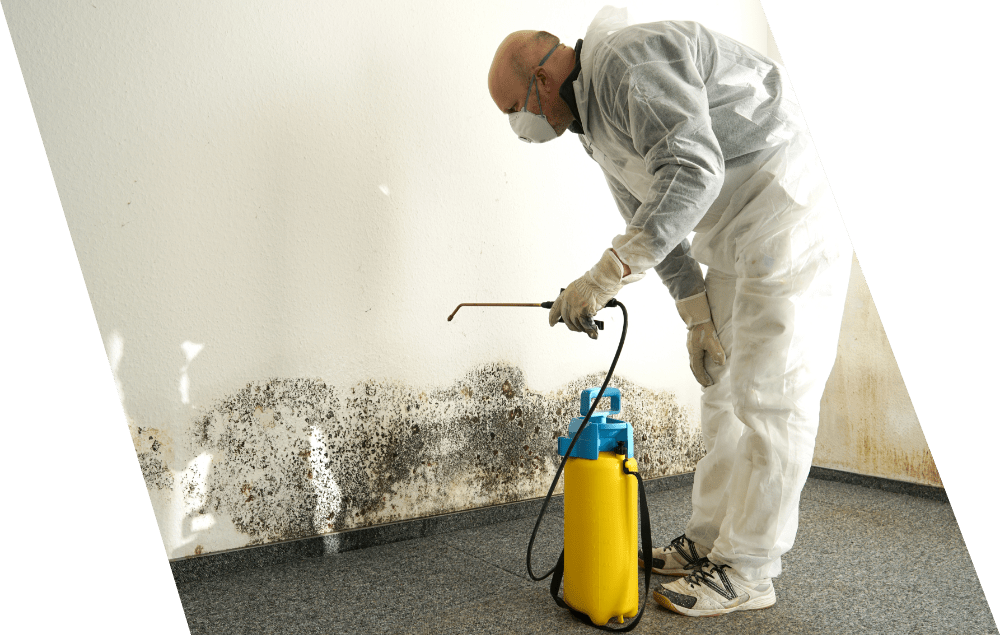
Our black mould removal service in Wembley is thorough and efficient. We begin with a detailed inspection to assess the extent and type of mould problem. Advanced equipment is used to isolate the affected areas and prevent the spread of mould spores. We also use mould testing tools to ensure accurate identification and effective treatment. Air purification is a key part of our process, reducing the spore count to safe levels.

High-Quality Mould Remediation in Wembley

Our remediation service in Wembley offers more than just mould removal. It’s an extensive approach where a technician will inspect the infested areas, remove all mould-affected materials, and provide a customised prevention plan. This plan includes comprehensive treatment to ensure long-term protection against mould growth.

A white wall with serious mould infestation

Industrial-Grade Chemicals for Mould Removal in Wembley

a wall next to a window infested with mould

Our certified mould removal experts in Wembley use only top-quality industrial-grade chemicals. These products are chosen for their effectiveness in eliminating mould and preventing future growth, ensuring your environment stays safe and mould-free.

Total Mould Elimination

Our industrial-grade chemical mould removal solution offers a fast, effective and permanent solution to mould problems. The product evaporates quickly after application, ensuring no harmful residue is left behind on your property. All areas of your property are handled by our highly skilled and knowledgeable professionals. The result will be your property being restored to a safe and clean condition once again after the affected areas have been thoroughly treated.

Lasting Mould Protection

As a result of a chemical bond formed with surfaces, our mould treatment product prevents further mould growth. Furthermore, this solution is 100% non-toxic and completely safe for use around children and pets. Mould spores are destroyed immediately, and the surfaces are protected. As a result of its unique ability to attract and destroy mould spores, this solution guarantees a long-term mould-free property.

Check What People Have to Say About our Mould Removal and Remediation Service in Wembley

Frequently Asked Questions

Q: Can I remove mould myself, or do I need professional help?
A: Small patches of mould can be removed with household cleaners, but larger infestations or recurring mould problems should be handled by professionals to ensure complete removal and prevent future growth.
Q: What does a professional mould inspection involve?
A: A professional inspection includes identifying the extent of the mould infestation, determining the cause of mould growth, and testing the air quality to detect mould spores.
Q: How is mould removal different from mould remediation?
A: Mould removal involves physically removing the mould, while mould remediation includes both removal and addressing the underlying cause to prevent future growth.
Q: How long does mould remediation take?
A: The duration of mould remediation depends on the extent of the infestation. Small areas may take a few hours, while larger or more severe cases could take several days.

Can't find the answer you're looking for?
Visit our Help Center.

Arrange mould removal in Wembley!

A flat that is eighteen months old should not have mould in it, and yet recently completed apartments make up a growing share of the calls in HA9. The reasons have nothing to do with age or neglect. A new building arrives full of water, its envelope is sealed far more tightly than anything built before it, and it depends on a mechanical ventilation unit that most residents have never opened. Get any one of those three wrong and the flat behaves worse than a draughty Victorian house.

The water a new building starts with

Concrete, screeds, plaster and adhesives all go in wet. A sand and cement screed gives up moisture for months, and the first heating season drives that water out of the floor and into the air of the flat. In the first winter after completion, humidity in a new apartment can sit persistently high with nothing wrong at all, and growth appears in the coldest corner or on the reveal of a balcony door. Recognising construction moisture prevents an expensive misdiagnosis: the remedy is drying and ventilation, not lining.

An airtight envelope changes the rules

Older housing leaked air continuously and forgave a great deal. A flat built to current airtightness standards does not: there is no background leakage to dilute moisture, so every litre generated inside has to be removed by the ventilation system. When that system underperforms, humidity climbs steadily through the evening and stays high overnight. Single-aspect plans make this sharper still, because there is no possibility of cross-ventilation even with the window open.

The unit nobody has opened

Most of these flats have either continuous mechanical extract or a heat recovery unit, usually in a utility cupboard or a bathroom ceiling. The recurring findings are the same across blocks: the unit never commissioned to its design flow rates, filters left in since handover and completely blinded, boost not wired to the bathroom light or switched off at the isolator, flexible ducting kinked where it turns into a ceiling void, and valves adjusted or removed by residents who found them draughty. Checking flow rates at each terminal, cleaning or replacing filters, and reinstating the valve settings resolves a substantial proportion of these cases outright, and handyman for flats in Wembley covers the access panels, grilles and ducting work that goes with it.

Small plans and nowhere to dry washing

Compact flats rarely have space for a vented dryer, so washing goes on an airer in the living room or on the balcony in winter, where it dries slowly and mostly indoors. A single load puts a couple of litres of water into a space that may be a fraction of the volume of a house. Where the only route out is a window, it needs to be usable: a tilt-and-turn or a restricted opening that can be left secure overnight is worth far more than one that has to stay shut. Where the locking gear has failed and a window can no longer be left on a secure setting, locksmith cover across Preston deals with the mechanism.

Warranty, snagging and who to tell

A ventilation system that was never commissioned correctly is a construction defect, not a maintenance issue, and in a recently completed building there is usually a route to have it corrected under the developer's defects liability period or the build warranty. That route depends on evidence: measured flow rates against the design figures, dated readings of humidity in the affected rooms, and a written diagnosis. Reports are written with that use in mind, and what is covered by a remediation guarantee where a design fault remains uncorrected is set out on our national mould removal and remediation service.

Risers, bin stores and the rest of the block

New blocks concentrate services into vertical risers and put refuse and cycle stores at ground level, and both are warm, damp and rarely inspected. Rodent activity in a riser shows up as gnawed insulation and droppings on the cupboard floor, and it travels between floors. Where that is found alongside a moisture problem, the Wembley branch treats it at block level with the managing agent rather than flat by flat.

What an inspection covers

An inspection here is as much a ventilation commissioning check as a damp survey: flow rates at every terminal, filters inspected, unit settings recorded, humidity and surface temperatures logged, and the screed tested where the building is new enough to warrant it. Access to a service cupboard and to the ceiling hatch is needed, so anything stored in front of them is best moved beforehand. Pricing separates the commissioning check from any treatment and drying that follows. Older purpose-built stock nearby is covered under mould removal for rented homes in Preston.

Domestic clients 020 3318 5181
Business clients 020 3746 1062

Skip the line, request and
book a service online

Book a service