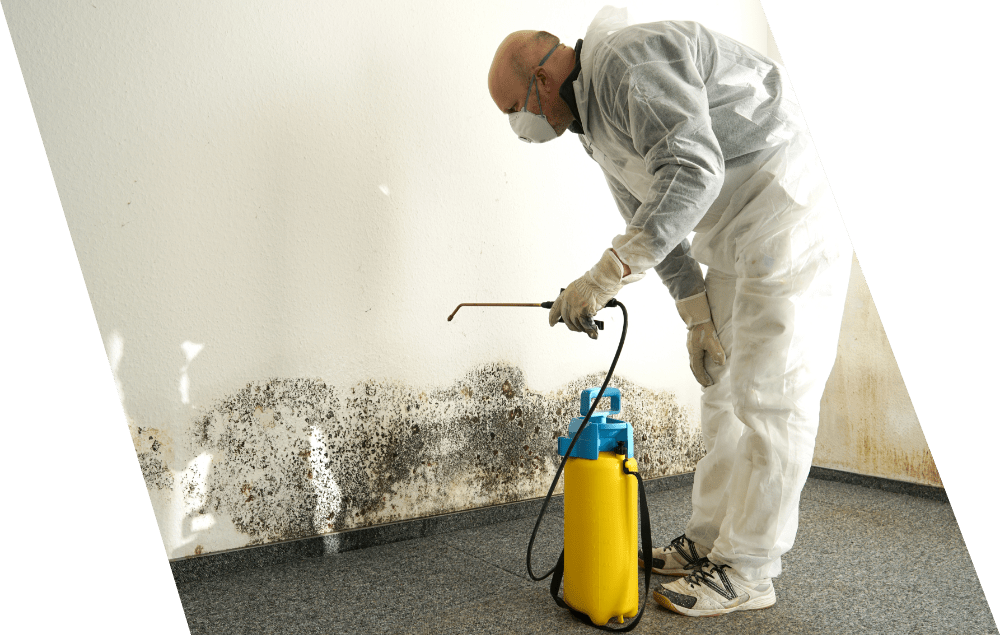
An empty house behaves nothing like a lived-in one. Nobody is running a bathroom fan, no windows are opened, and in a property with the heating turned off or set to a frost-protection setting, every internal surface sits close to the outside temperature for weeks at a time. What follows is not the neat corner patch of an occupied home but a bloom: a grey-green film across whole walls, ceilings, inside wardrobes, over leather and along the backs of pictures. DA6 sees a lot of it in probate sales, houses between tenancies and homes left while someone is in hospital or abroad.
Why an unheated house grows mould everywhere
Relative humidity rises as air cools, and in a cold house it can sit near saturation for weeks even with no obvious moisture source. Residual moisture in plaster, screeds and timber, a little ground moisture, a slow leak nobody has noticed, or simply damp air drawn in through vents is enough. With no heat and no air movement, the whole internal envelope becomes a viable surface, which is why the growth is uniform rather than localised. It is also why an occupied house that suddenly empties can be visibly affected within a single winter.
Reading the extent before touching anything
The first task in a void property is to establish how far it has gone, because that governs everything else. Wardrobes and drawers are opened, mattresses lifted, loft and cupboards checked, and readings taken in plaster and in timber joinery. Soft, porous and absorbent items are assessed separately from hard surfaces. Where the growth is heavy, walking through the rooms disturbing it without containment makes matters worse by distributing spores into every space including the ones that were still clean.
What can be saved and what cannot
Hard, non-porous surfaces clean well: glass, glazed tile, sealed timber, metal, painted plaster in sound condition. Upholstered furniture, mattresses, foam, cardboard storage and paper-faced plasterboard that has grown mould through its thickness generally cannot be restored to a reliable standard and are better removed. Clothing and textiles often can be, depending on fibre and how far the growth has penetrated. Being straight about that division early saves a lot of wasted cleaning.
Stabilising the building first
Remediation in an empty property starts with conditions, not with cleaning. Heat is restored to a modest steady level, air is moved, and dehumidification is used where the volume justifies it, so that surfaces come above dew point and stay there. Cleaning a cold, saturated house simply gives the mould a fresh substrate. Once the fabric is drying, growth is removed with filtered extraction and treated, working from the least affected rooms towards the worst to avoid carrying spores backwards.
Handover, sale and letting
A void property usually has a deadline attached: a completion date, a check-in, a viewing programme. A written record of what was found, what was removed, what was treated and what the readings were at completion is what satisfies a buyer's surveyor, an incoming tenant or an executor's solicitor. It also distinguishes historic staining that has been dealt with from an active problem, which is exactly the question a purchaser's surveyor will raise.
The practical trades and neighbouring cover
Heating recommissioned, a stop tap traced, a fan replaced, a vent unblocked, skirtings and plasterboard renewed, a window catch repaired so the house can be aired: shelf and curtain fitting in Bexleyheath covers the jobs that make a property habitable again. Long-empty houses are also where rodents settle in undisturbed and where clothes moths breed in stored textiles, so our pest control service in Bexleyheath is worth running in the same period rather than after furniture has been moved back. Similar riverside stock nearby falls under mould removal services in Erith, the full domestic clean that a re-let or a sale needs is handled by Erith cleaning services team, and the remediation method is on the nationwide mould removal and remediation services page.
What a first visit needs
Access arrangements are the main practical point: keys, a working meter and a supply of electricity, since drying equipment needs power. It is worth knowing how long the property has stood empty and whether the heating has been off entirely. Pricing follows the number of rooms affected, the volume of disposal involved and the length of the drying period, and where a completion or tenancy date is fixed the programme is set backwards from it.