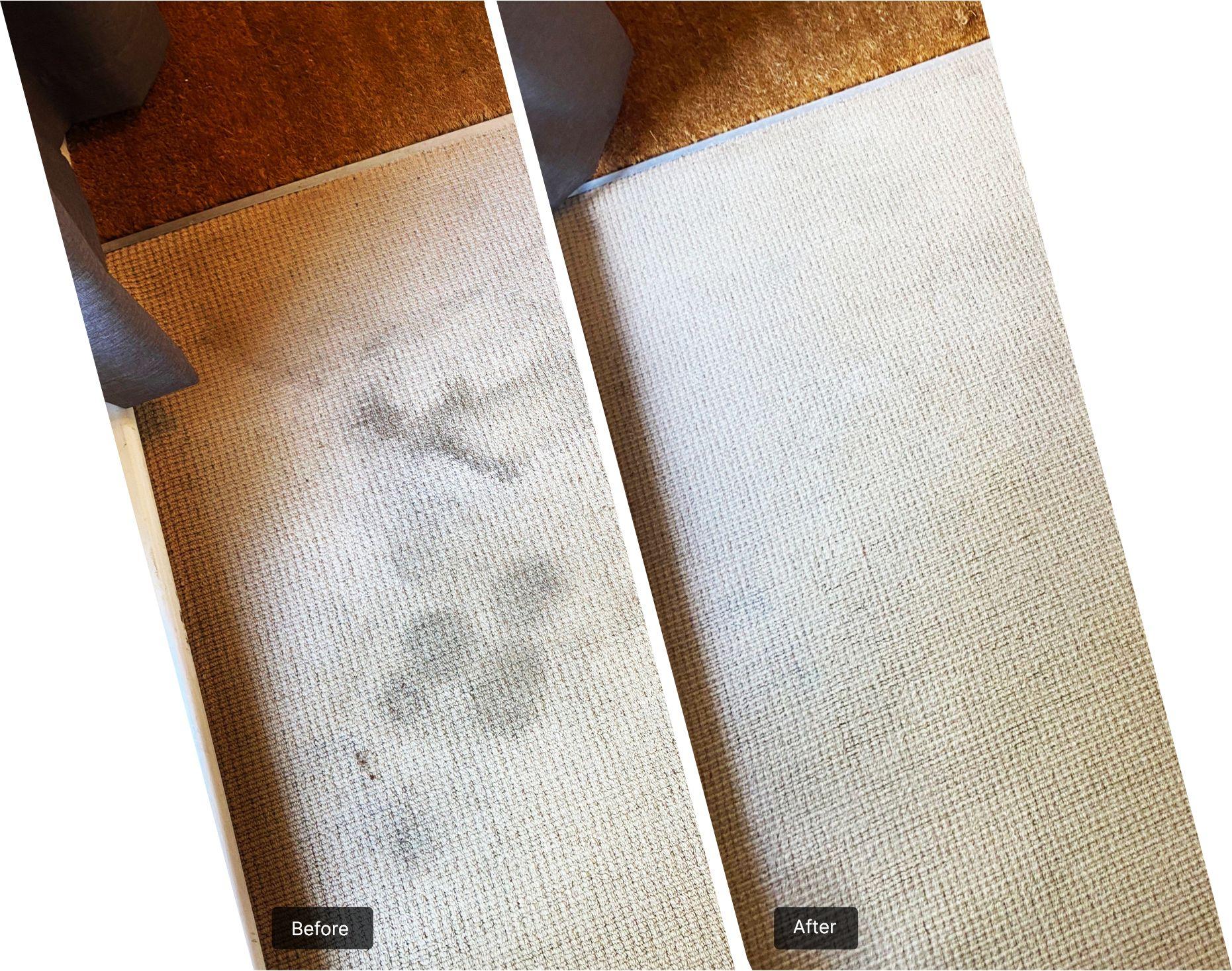
Sisal, seagrass, coir and jute look robust and are anything but. They are plant fibres, they absorb water greedily, and they shrink, ripple, brown and go stiff when wetted with the methods that suit a wool or nylon pile. E1 has more of them than most districts, because the natural-fibre look sits well with exposed brick and timber in converted warehouse flats, and a great many were laid by developers on large open floors where a single mistake is expensive.
Why water is the enemy of a plant fibre
Cellulose swells when it takes up moisture and does not return to its original dimension when it dries. On a fitted seagrass floor that means buckling across the room and a floorcovering that has pulled away from the edges. It also means cellulosic browning, where natural sugars and tannins in the fibre migrate to the surface as it dries and leave a yellow-brown bloom, usually in the exact shape of the wet area. Neither effect is reversible by cleaning again.
Dry compound and very low moisture instead
The workable method is an absorbent compound worked into the weave with a counter-rotating brush and then vacuumed out, taking soil with it. Where a liquid is needed for a specific area it is applied sparingly, worked in and extracted almost immediately, with air movement running before the operator has finished the pass. Spills on these floors are treated in minutes rather than days, since the fibre takes up a stain on contact and there is no protective coating to buy time.
Open-plan floors and the problem of one continuous space
A warehouse conversion often has a single floorcovering running from the front door through a living area to a sleeping space, with no doorway to break it. There is nowhere to stop a run, no natural boundary to work to, and no way to close off a drying area. Planning the pass sequence before starting matters more here than in a house of small rooms, and furniture is staged in halves so that the whole floor is never wet at the same time.
Loading bays, lifts and contractor hours
Converted buildings usually come with rules attached: a goods lift that has to be booked, a bay that can be occupied for a limited period, and contractor access restricted to weekday hours. Equipment is heavy and hose runs are long in these buildings, so the practical question at booking is not which day but which hour. Confirming the building's requirements in advance prevents a van arriving to find the bay in use.
Rugs, hides and the furniture on top
These interiors tend to run large rugs over boards or polished concrete, and they take all the traffic in the room. Seating collects the same load and needs different chemistry from the floor, since foam and fabric hold moisture far longer than a backing does; that work is covered by experienced mattress cleaning in Hackney. Both are quoted by the piece rather than by room.
What comes in from outside
On converted sites the shared external areas are where the soil originates: a brick forecourt, a service yard, a walkway that runs past bin stores. Grit off those surfaces is walked straight onto pale natural fibre, and cleaning the floor without dealing with the approach means repeating the work. External hard surfaces fall under pressure washing throughout East London, with the same equipment used on residential frontages through what the visit includes.
Arranging the work
A survey identifies the fibre first, because a seagrass floor and a wool loop can look similar under artificial light and behave in opposite ways. Test areas are always done, colour stability is checked, and the method is chosen from the result rather than in advance. Pricing follows measured area and method, as dry compound work takes longer per square metre than extraction. Wider household services are listed under the service in full and what the visit includes, the neighbouring district is covered by professional steam carpet cleaning in Tower Hamlets, and general fibre guidance is on the carpet and rug cleaning service.