The small bare patch that appears under a sofa or behind a wardrobe in an older Greenwich house is rarely wear. It is almost always carpet moth, and by the time the damage is visible the larvae have been feeding for months in exactly the conditions they prefer: wool pile, darkness, stillness and a little warmth. Period terraces with fitted wool carpet and heavy furniture that never moves give them everything they need.
What is actually eating the carpet
Adult moths do no damage at all. The larvae do, and they feed on keratin, which means wool, silk and any blend containing them — never pure polypropylene or nylon. They work from the base of the tuft upwards, so a pile can be severed at the backing while still looking intact from above until it is brushed and comes away in the hand. Skin cells, pet hair and food residue in the pile make an area more attractive to them.
The places to look first
Under and behind anything that has not been moved in a year: the sofa, the bed, a heavy chest, the run of floor behind a long curtain. Edges beneath radiators and the perimeter where carpet meets skirting are next, followed by the underside of a wool rug. Fine silky webbing, gritty frass and small cases attached to the pile are the giveaways rather than the insects themselves.
What cleaning can and cannot do
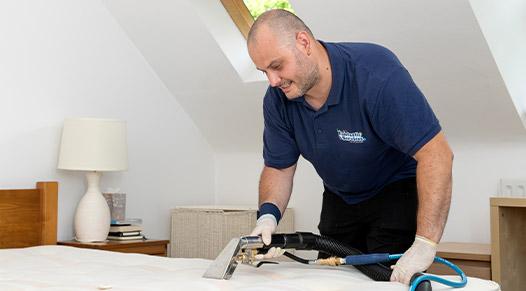
Hot water extraction removes eggs, larvae, frass and the organic residue that attracted them, and it makes an infested area far less hospitable. It is not, on its own, a pesticide treatment, and a serious established infestation needs a specific insecticidal programme alongside it. The honest sequence is thorough removal first, treatment second, and then a change in habits — moving furniture periodically and vacuuming the edges — to stop it recurring.
Sofas, curtains and everything else made of wool
Larvae do not confine themselves to the floor. Upholstered furniture with wool or wool-blend covers, particularly under the cushions and along the back where nobody looks, is frequently the reservoir that reinfests a floor after it has been treated. Dealing with both at once is the only approach that holds, and the fabric side of it is covered by sofa cleaning in Greenwich.
Hillside terraces, cold rooms and slow drying
Many houses in the older parts of the district have solid walls, cold north-facing back rooms and suspended timber floors with ventilated voids beneath. Those rooms dry slowly in winter, so moisture is kept deliberately low and air is moved across the surface rather than the heating simply being turned up. Damp wool left slow-drying invites the very conditions that caused the problem. Fibre notes are collected on our carpet and rug cleaning team.
The vacuuming routine that keeps them out
Larvae survive in the places a vacuum never reaches, so the routine that matters is the one nobody enjoys: a crevice tool worked along the perimeter where pile meets skirting, under the edges of heavy furniture, and behind long curtains. Pieces that cannot be moved every week should at least be shifted a few times a year. Whatever comes out is best emptied outside rather than into a kitchen bin. Where a property is being handed back and an inventory clerk finds damage of this kind, it becomes a dispute rather than a nuisance, and the full handover scope is covered by trusted check-out cleaning in Greenwich.
Arranging the work and what it includes
An inspection comes first, with furniture moved where it is safe to do so, since the diagnosis depends on seeing the floor that has been hidden for years. Pricing is by room and measured area, with edges and perimeters treated as part of the room rather than charged as an extra. Households across the water sometimes take a slot advertised for Kennington carpet cleaning service, and the broader range of domestic work nearby sits on cleaning services across Lambeth and nearby areas.