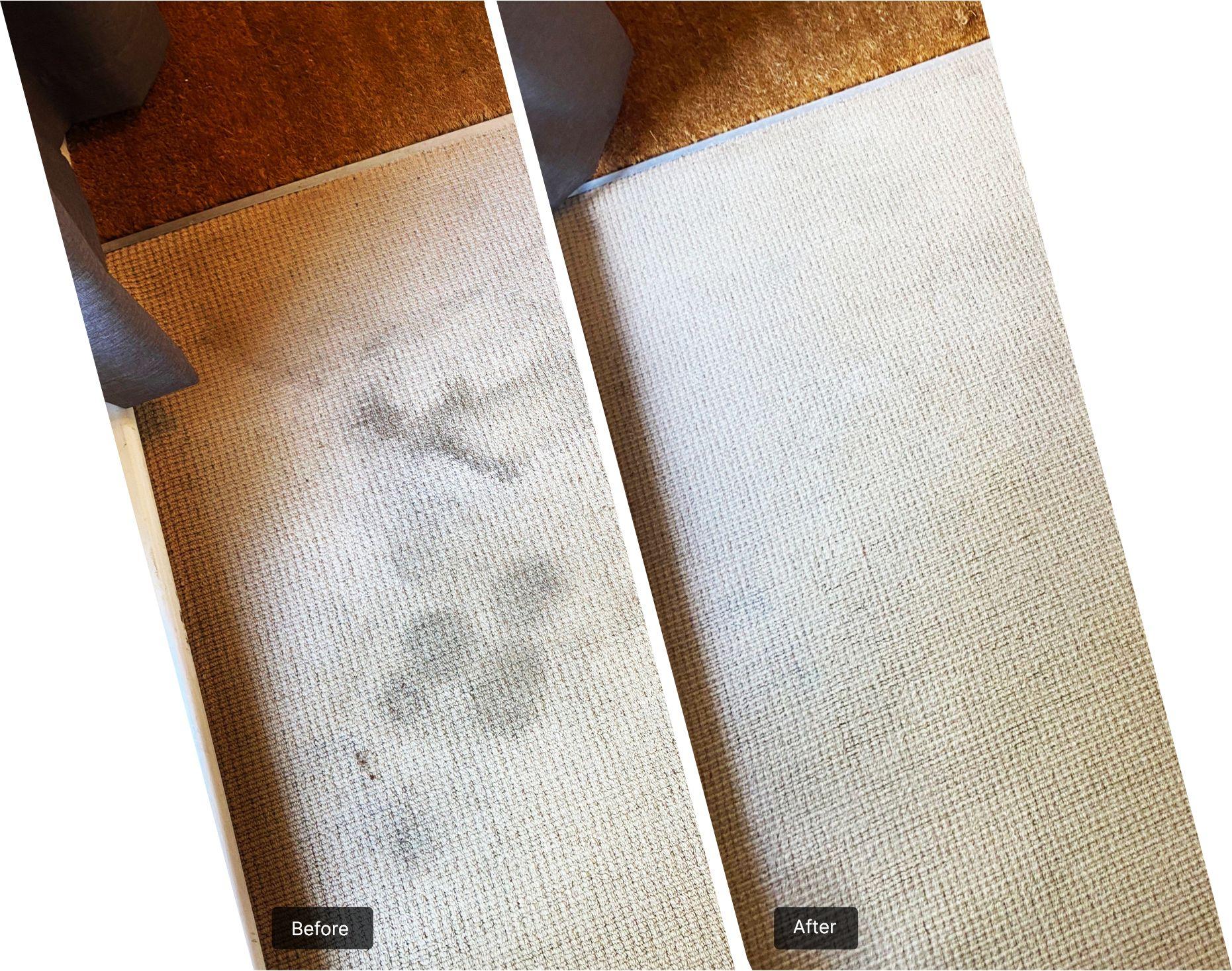
What happens in the ten minutes after a glass goes over decides almost everything about whether a mark ever comes out. SW4 has a high concentration of shared houses and flats where people entertain, and the calls that follow a weekend are rarely about general soiling — they are about a specific spill, and about what was done to it before anybody thought to ask.
Blot, do not rub
A spill sits on the surface briefly before capillary action draws it down the fibre and into the backing. Pressing a folded white towel onto it, working inward from the edge and replacing the towel as it loads, removes the great majority while it is still liquid. Rubbing achieves the opposite: it drives material deeper, fuzzes the fibre and leaves a distorted patch that stays visible afterwards. Standing on a towel to apply weight is more effective than any amount of scrubbing.
Red wine, tea and the tannin family
These are dye spills, and cold water plus blotting is the right immediate response, followed by a tannin-specific treatment rather than a general detergent. Salt achieves little beyond a gritty mess. White wine poured onto red is folklore. What matters most is time, because a tannin left to dry over a weekend bonds to the fibre and moves from the category that cleans out to the category that has to be reduced with controlled chemistry and sometimes cannot be fully cleared.
The greasy shadow that returns
Oil-based spills — dressing, butter, cooking fat, candle residue — produce the marks that reappear a few days after they were apparently removed. The mechanism is wicking: residue left in the backing travels back up the fibre as the area dries and redeposits at the tips. Preventing it means extracting fully rather than surface cleaning, then placing an absorbent pad under a weight over the spot while it dries so any remaining residue moves upward into the pad instead of into the pile.
Ink, make-up and other non-food spills
Ballpoint ink, nail varnish, lipstick and shoe polish share a trait that makes them dangerous to tackle at home: they dissolve readily in solvent, which means a careless application spreads a small concentrated mark into a wide diffuse one. The controlled approach applies a matched solvent to a cloth rather than to the carpet, works from the outside of the mark inward, and blots continuously so the dissolved colour transfers into the cloth instead of travelling sideways through the pile. Some pigments in cosmetics are effectively dyes and will only reduce rather than clear. As with everything else, the fibre is tested first, since several of the solvents involved will attack the latex in a tufted backing if they are used generously.
Mud and grass from the common
Wet mud should be left alone until it is completely dry, at which point most of it can be vacuumed away as loose solids. Working at it wet spreads a small mark into a large one. Grass is a different problem again, since chlorophyll behaves as a dye and responds to a solvent-based approach rather than to water and detergent, which is worth knowing before a summer of five-a-side has worked its way into a hall carpet.
A floor that takes a crowd
In a house where six people live and friends visit, the realistic strategy is frequent light maintenance with a good spotting kit to hand, and a deep clean booked at a sensible interval rather than only after a disaster. Households with a routine of professional cleaners services in Clapham often add the hall and lounge floors to that arrangement, and comparable terraced stock a short distance away is dealt with through a local professional.
Calling it in, and what happens then
The single most useful thing is to say what was spilled and when, and to resist experimenting in the meantime. Areas are counted rather than timed, with individual spot work assessed on arrival because the effort varies wildly between a fresh spill and a set one. Sofas that caught the same glass are covered by vetted upholstery cleaning services in Clapham, wider south London coverage sits on our team in the area, and the background to the chemistry is on local steam carpet cleaning.