


Mould Removal and Remediation in New Southgate
Certified mould removal specialists providing comprehensive inspection, remediation, and moisture control for long-term mould prevention.

Certified mould removal specialists providing comprehensive inspection, remediation, and moisture control for long-term mould prevention.
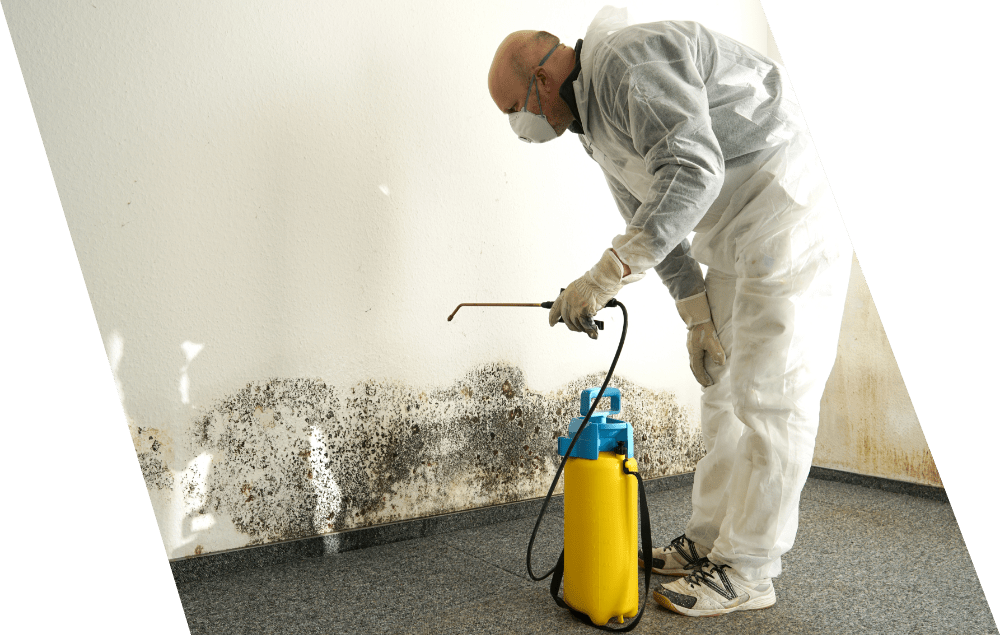
The cost of mould removal depends on the size of the affected area and the type of treatment required. After a detailed inspection a clear, personalised quote is provided based on the scope of work.
| Small mould area (e.g. around a window or corner) | Medium mould area +£100 (large section of a wall affected) | Large mould area +£150 (more than one wall or ceiling) | ||||
|---|---|---|---|---|---|---|
| Room | Standard | Fantastic Club* | Standard | Fantastic Club* | Standard | Fantastic Club* |
| Bedroom | £350 | £320 | £450 | £420 | £500 | £470 |
| Bathroom | £350 | £320 | £450 | £420 | £500 | £470 |
| Kitchen | £350 | £320 | £450 | £420 | £500 | £470 |
| Living / Dining room | £350 | £320 | £450 | £420 | £500 | £470 |
| Hallway / Landing | £350 | £320 | £450 | £420 | £500 | £470 |
| Utility room | £350 | £320 | £450 | £420 | £500 | £470 |
| Paid inspection | £50 | |||||
| *Price for members of the Fantastic Club. The Fantastic Club is a yearly subscription of £89. | ||||||

Our mould removal service in New Southgate starts with a detailed inspection and moisture assessment to assess contamination levels and understand root causes. Mould typically emerges due to condensation, excessive humidity, lack of proper ventilation, or water damage. Identifying these underlying causes is essential for effective mould remediation in New Southgate. Our service concentrates on structural surfaces such as walls, ceilings, and floors, the key areas where mould is commonly found. It’s crucial to note that while our approach excels in mould cleaning New Southgate, soft furnishings like carpets and sofas are not treated.
Moreover, our professional mould remediation service extends beyond just cleaning surfaces. We prioritize the elimination of airborne mould spores, effectively enhancing indoor air quality. Our process features black mould removal New Southgate, which reduces health risks by ensuring a cleaner environment. By also addressing condensation issues and ensuring thorough damp and mould removal, our mould inspection strategies play a key role in preventing future outbreaks. This comprehensive approach protects your health and mitigates potential structural damage for lasting results.
Mould remediation in New Southgate begins with a comprehensive inspection and moisture assessment, utilizing professional hygrometers to discover hidden damp locations. Identifying the source of excess moisture is essential for preventing mould's return after removal. Following this, HEPA filtration systems and air scrubbers are engaged to effectively gather airborne mould spores, thus ensuring safe indoor air quality throughout the remediation process.
The use of HOCl (Hypochlorous Acid) treatment is a cornerstone of this process, providing a professional-grade solution that neutralizes mould, bacteria, and mycotoxins on a microscopic level. Coupled with ULV (Ultra-Low Volume) fogging technology, which allows for even distribution of treatment throughout hard-to-reach areas, the process is highly effective. The physical removal of mould employs specialized equipment with H-Class filtration to ensure contaminants are securely captured. Finally, ongoing protection and air purification measures significantly decrease airborne spores, vastly improving indoor air quality and ensuring effective damp and mould removal in New Southgate.

Booking mould cleaning is quick and designed to get results without unnecessary delays.
Share what you’re dealing with, whether it’s visible mould, damp patches, or a recurring problem. This helps determine the right approach, from mould cleaning to full mould remediation.
A specialist checks the affected areas and identifies what’s causing the mould, such as excess moisture, condensation, or poor ventilation. This ensures the issue is treated properly, not just on the surface.
You’ll get a straightforward quote based on the level of contamination and the type of mould removal required. The service is tailored to ensure effective results and long-term protection.
The treatment removes mould and improves indoor air quality, helping to prevent future growth and create a healthier living space. It also targets the root cause of the problem for longer-lasting results.
Mould removal requires more than basic cleaning, which is why it’s handled by trained mould remediation specialists experienced in treating both visible and hidden contamination. Each specialist assesses the full extent of mould growth, including underlying causes such as excess moisture, condensation, and ventilation issues, ensuring the problem is addressed properly rather than just on the surface.
Number of bookings: 205
With Fantastic Services for: 3 years
Other specialities:
Number of bookings: 213
With Fantastic Services for: 2 years
Other specialities:
Number of bookings: 8301
With Fantastic Services for: 6 years
Other specialities:
What the reviews say
"Quick and effective rodent control service. Their timely response and efficient methods resolved the problem with expertise."
Alongside professional mould removal and mould cleaning, a range of additional property care services is available to help maintain a healthier indoor environment.
Mould can spread quickly and impact both health and property if not treated in time. Book a service today to remove mould, improve indoor air quality, and restore a cleaner and healthier living environment.

Mould in a post-war block usually draws a diagram. Instead of the soft, irregular patches typical of an old solid-walled house, the growth here arrives as straight lines and neat rectangles: a stripe across a ceiling at a fixed distance from the external wall, a vertical band in a corner, a square above a window. N11 has a substantial amount of post-war and system-built housing alongside its interwar streets, and in that construction the geometry of the growth is the most useful diagnostic information available.
A framed building transfers heat through its structure far more readily than through the panels between. Floor slabs that continue out to the face of the building, columns embedded in an external wall, concrete lintels over openings, ring beams at each floor level, and balcony slabs cantilevered straight through the envelope all act as paths that conduct heat out and leave a cold strip on the internal surface. Because the structure is regular, so is the cold. The stripe on the ceiling marks the slab edge. The band in the corner marks a column. The square above the window marks the lintel. General background on assessing this is on the service in detail.
A room can be perfectly warm and still grow mould along one strip, and the reason is that growth responds to the temperature of the surface rather than of the air. Where a surface sits below the temperature at which the room's air releases moisture, water forms on it, and if that happens for several hours a day through the winter the strip colonises while everything around it stays clean. Establishing the case means measuring the surface, not the room: contact readings along and away from the suspected bridge, ambient temperature and humidity logged alongside, and where conditions allow, a thermal image taken during cold weather with a temperature difference across the wall, which makes the structural grid visible in one picture.
Insulating the strip alone rarely works, because it moves the cold edge rather than removing it: put board over a lintel and the growth reappears immediately beside the board. Treating a bridge properly means carrying insulation past it in both directions, returning it into the reveal and along the ceiling or wall for a distance, and keeping it continuous around the whole cold element. The vapour control layer has to be unbroken and on the warm side, or the interstitial condensation that follows is worse than the surface growth it replaced. Service boxes, sockets and radiator brackets are where continuity is usually lost. Fitting insulated reveals, boxing and making good is covered by fully insured TV wall mounting in Bounds Green.
Single-aspect layouts concentrate the problem. Where all the windows face one way, one side of the dwelling runs cooler and there is no cross-ventilation to move humid air out. If the living room is heated and the bedroom is not, and internal doors are kept closed, moisture generated in the warm half migrates to the cold half and condenses there — which is why the worst growth in a block flat is so often in a bedroom nobody has heated all winter. Interwar housing a short distance away produces a different picture entirely, and the mould removal team in Friern Barnet covers it.
In a block, cold bridging is a defect of common structure rather than of the individual dwelling, so remediation belongs with the freeholder or managing agent and generally has to be programmed rather than arranged flat by flat. An independent assessment that identifies the bridge, gives the surface temperatures and states the specification is what moves that along. Blocks with communal voids and riser cupboards frequently have more than one issue reported at a time, and the local team covers the other common one.
The output is a plan of the affected surfaces, readings at each, the structural element responsible, and a specification for treating it, with any internal measures listed separately. Cold weather makes the measurements far more reliable, so this work is best arranged between autumn and early spring. Quoting is per dwelling for an assessment and per elevation or per element for remediation, since treating one lintel and treating every slab edge on a facade are not comparable jobs. Rooms that have had insulation fitted and been replastered are worth cleaning thoroughly before use, and experienced house cleaning in Palmers Green handles it.
Skip the line, request and
book a service online



