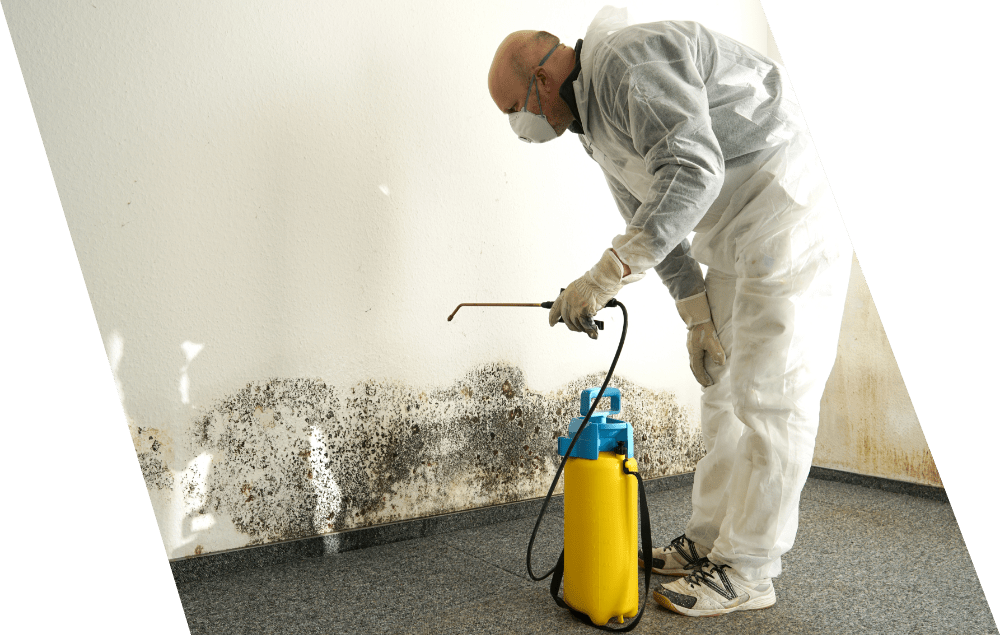
Killing the growth is the quick part of a mould job. Making the wall good again is where most of the work sits, and where most repeat visits are earned. A patch that has been treated, sealed and painted and then reappears within a year has usually failed at the reinstatement stage rather than at the treatment stage, and the giveaway is a stain that comes back in exactly the same outline.
Why paint over a treated patch fails
Mould in plaster is not a surface film. The hyphae run into the pore structure of the plaster and into any organic content in the finish, so a biocide applied to the face may kill what it touches and leave the rest viable. Add salts drawn to the surface by earlier wetting, which stay hygroscopic and pull moisture out of the room air, and a coat of fungicidal emulsion over unsound plaster is holding back very little.
Taking the affected plaster off
Where the substrate is compromised, the finish is cut back well beyond the visible edge of the growth, and anything hollow, blown or salt-contaminated is removed down to the background. The cut is squared up so the new work has a clean stop. This produces a great deal of fine dust in a short time, which is the reason the next stage exists.
Containment and controlling the air
A working area is sheeted and the doorway sealed with a taped zipped screen, and an extraction unit with a HEPA filter is run to hold the room at slightly negative pressure so dust and spores travel out through the filter rather than into the rest of the flat. Furnishings that cannot be removed are covered. At the end, surfaces are wiped down rather than swept, and the filter unit runs on for a period after the work stops. In an occupied flat this is the difference between a contained job and weeks of fine dust in every soft surface.
Choosing a plaster and a finish
On a solid wall a breathable system is normally right: a salt-inhibiting or renovating backing coat and a breathable finish that lets the wall pass moisture rather than sealing it behind an impermeable skin. On a wall that has been dry-lined with insulated board, standard finishes are appropriate because the vapour control layer does the work. A sealed, plastic-based coating on a solid wall traps moisture behind it and moves the problem to the edges of the treated area.
The drying time nobody plans for
Fresh plaster holds a large amount of water and gives it up slowly. Forcing it with a fan heater dries the face while the body stays wet, which causes cracking and a poor bond for the decoration. Gentle background heat, ventilation and a dehumidifier are the right combination, and the wall is not decorated until it is genuinely ready. A mist coat goes on before any full coat, and furniture is kept clear of the new wall for longer than feels necessary.
The trades that come either side of it
Skirtings, architraves, socket faceplates and radiator brackets come off before the strip-out and go back afterwards, which is straightforward work but needs doing properly, and handyman for rented homes in Beckenham covers it. A strip-out also exposes what caused the problem: a weeping compression joint behind a bath panel or a slow leak on a waste connection is a frequent find, and experienced leak repairs in Chislehurst is the trade for that. Where the same conditions exist next door in a neighbouring property, the service in full covers the same service there.
What a reinstatement quote covers
Quotes for this stage are built from the area to be taken off, the backing and finish specified, and whether decoration is included or left to the household. Access and protection are priced in, since containment takes time to set up and take down. Damp-loving insects such as booklice often appear in a cupboard adjoining the affected wall and are dealt with by flea treatment services in West Wickham rather than by the remediation itself. Expect a return visit for the finish once drying is complete, and the sequence of survey, treatment and reinstatement is set out on trusted mould removal and remediation.