Ask which room in a 1930s Ealing semi causes the most complaint and the answer is almost always the one that was added later. Garden rooms and conservatories built on to the back of these houses run hot in July, cold in January, and carry a huge area of glazing at an angle that collects everything the sky drops on it. They are also the room most often left out of a cleaning brief, on the grounds that they are half outside.
Why a glazed roof turns green
A pitched glazed roof stays damp longer than a vertical pane, and on the north side of a house it barely dries at all between October and March. Algae establishes in that film, then traps the fine debris that falls from overhanging branches, and the whole assembly goes from translucent to dim over a couple of winters. The outside face is the one that matters, and it is also the one nobody can reach safely from a step ladder on a sloping lawn.
Cleaning polycarbonate without scratching it
Many of these roofs are twin-wall polycarbonate rather than glass, and it is soft. Abrasive pads, scouring creams and strong solvents all mark it permanently, and once the surface is hazed no washing will bring it back. Warm water, neutral detergent and a soft brush on a pole is the method, working from the ridge downwards with the frame channels cleared first so the run-off has somewhere to go. Internally the same restraint applies, plus drying, because drips leave mineral marks. The wider set of household tasks is described on our nationwide service.
Clay, and what it does at the back door
The ground under much of this part of West London is heavy clay. In a dry summer it cracks and produces a fine pale dust that blows into the house through open patio doors; after rain it turns to a sticky mud that holds on to boot treads and comes off in exactly the wrong place. Neither behaves like sandy soil, which brushes away. The response is a hard mat outside, a washable one inside, and a habit of dealing with the back door zone on every visit rather than when it looks bad.
Steel casements and leaded lights
Original metal-framed windows in these houses are cold, so they run with condensation and the frames corrode where water sits in the bottom rail. Wiping that rail dry each week does more good than any product, and rust spots are reported rather than scrubbed, since abrasion takes off what paint is left. Leaded panels want gentle handling too: the cames are soft, and pressure on a single pane can loosen the whole panel.
Parquet, lino and the stairs above them
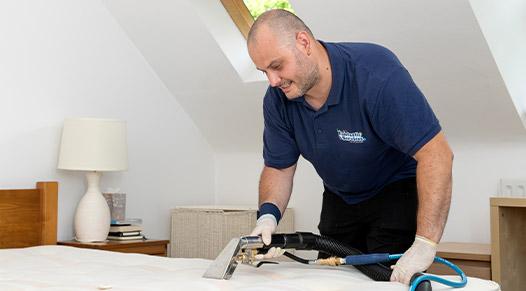
A house of this period often still has its original block parquet in the hall and reception, sometimes under a later covering. Parquet is laid in bitumen, and excess water lifts blocks at the edges, so it is vacuumed and damp-buffed rather than washed. Old linoleum in a scullery is similarly water-shy. The stair carpet between them takes all the traffic from both, and the compacted grit at the base of the pile only responds to extraction, which is arranged through Ealing carpet cleaning service.
Giving back a house with a garden
Letting a semi rather than a flat widens what is assessed at the end considerably: the garage, the shed, the patio, the conservatory glazing and the state of the garden itself all appear on an inventory alongside the kitchen. Tenants are regularly caught out by the outbuildings. The itemised standard that Chiswick end of tenancy cleaning services works to covers those spaces as seriously as the interior.
Shaping the regular visit
Hours are the unit, and a house of this size will not take a full clean in a short visit, so the sensible structure is a fixed core of kitchen, bathrooms, floors and surfaces with the conservatory, the utility area and the bedrooms rotating through the month. Writing the rotation down keeps it honest. Occasional larger jobs, including appliance interiors and inside storage, sit outside the weekly hours and are scoped under the cleaning services team in Ealing.