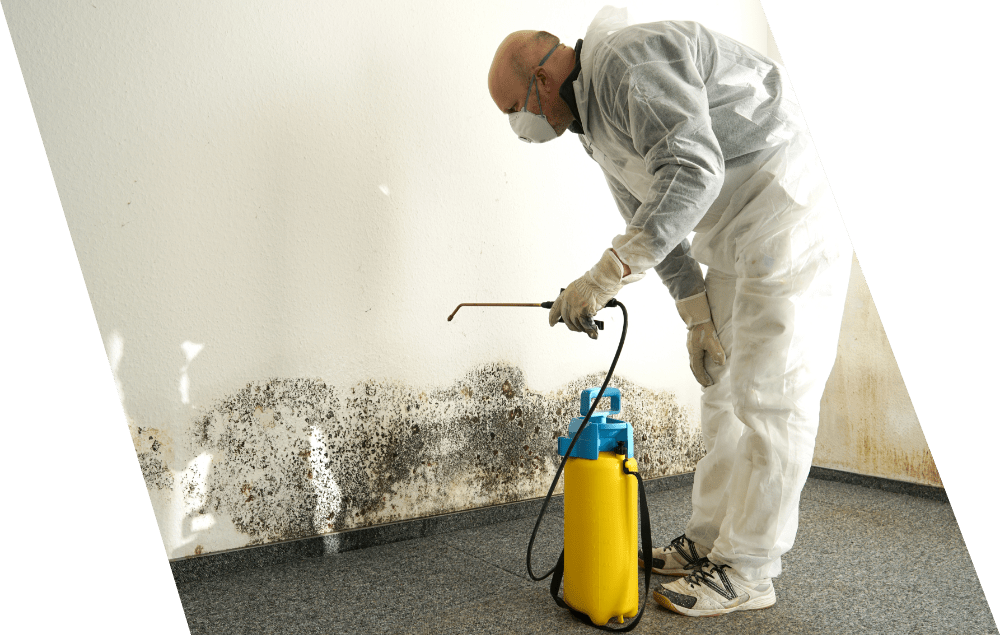
Retrofitted cavity wall insulation is a benefit in most of Chingford and a liability in a few places, and where it has gone wrong the evidence usually arrives as mould. E4 is predominantly interwar cavity-walled semis and detached houses, a large number of them filled with blown mineral fibre or bonded bead under grant schemes over the past few decades. Where the wall was sound the fill does its job. Where it was not, the fill becomes a wick carrying water across a gap that was designed to stay empty.
How wet fill shows on the inside
The pattern is unlike condensation and unlike a leak. Damp appears in patches on the most exposed elevation, sometimes in a rough grid that matches the pattern of injection holes drilled into the mortar joints outside. It worsens after several days of driving rain and does not respond to better ventilation at all. Where fill has slumped within the cavity, the top of the wall is left empty and cold while the lower part stays insulated, producing a horizontal stripe of growth just below ceiling level in upstairs rooms. Readings are high at scattered points rather than in a uniform band.
Looking inside the cavity
None of this can be judged from the outside. A borescope inspection through small holes drilled at several heights on each elevation shows what is actually in there: the type of fill, whether it is damp, whether it has slumped or bridged, whether mortar droppings are sitting on the wall ties, and whether cavity trays were ever installed above openings and at abutments. Where the fill has failed, extraction is a distinct operation with its own equipment, and it is followed by a period of drying before any internal work is considered.
Ties, droppings and the small bridges
Water crosses a cavity at any solid connection. Mortar squeezed out during construction and left resting on a wall tie makes a bridge that will pass water for a century. So does foam or rubble packed around a later extract duct penetration, or a cavity closed clumsily where an extension was built against the house. These are point defects, and they give point symptoms: a single persistent damp spot that migrates nowhere and never dries, often with growth on a tight radius around it.
Clay ground and seasonal cracking
Much of E4 sits on London Clay, which shrinks in a dry summer and swells again in a wet winter. The visible consequence is fine seasonal cracking in render and in mortar joints, particularly on bays and at corners, opening a route for water into the cavity rather than threatening the structure. Repointing perpends, cutting out and filling render cracks and reinstating weep vents is work covered by trusted shelf and curtain fitting in Chingford, and it is the part of the job most often skipped. Wall cavities and roof junctions also give pests a sheltered route into a house, and pest control specialists in Chingford deals with activity found during an inspection.
Houses of the same build next door
The same construction and the same grant-scheme history run through the neighbouring district, where professional mould removal services in Highams Park covers houses of near-identical build. After extraction, drilling and internal repairs a house carries a lot of dust, and experienced home cleaning in Highams Park handles that stage. Investigation method, drying protocols and guarantee terms are on our mould removal and remediation service.
How the work is staged and what to have ready
This is a sequential job and it is quoted in sequence: a borescope investigation with photographs and readings; extraction of failed fill where it is needed; external repair; a monitored drying period; then internal treatment and making good. The investigation is priced by the number of elevations examined and the number of inspection holes, all of which are made good afterwards. Access matters more here than in a flat, since both sides of the house and the rear elevation need to be reachable, which can mean moving vehicles and unlocking side gates. Any paperwork from the original insulation installation, including a guarantee, is worth finding before the visit, since a failed fill installed under a scheme may still be covered by it.