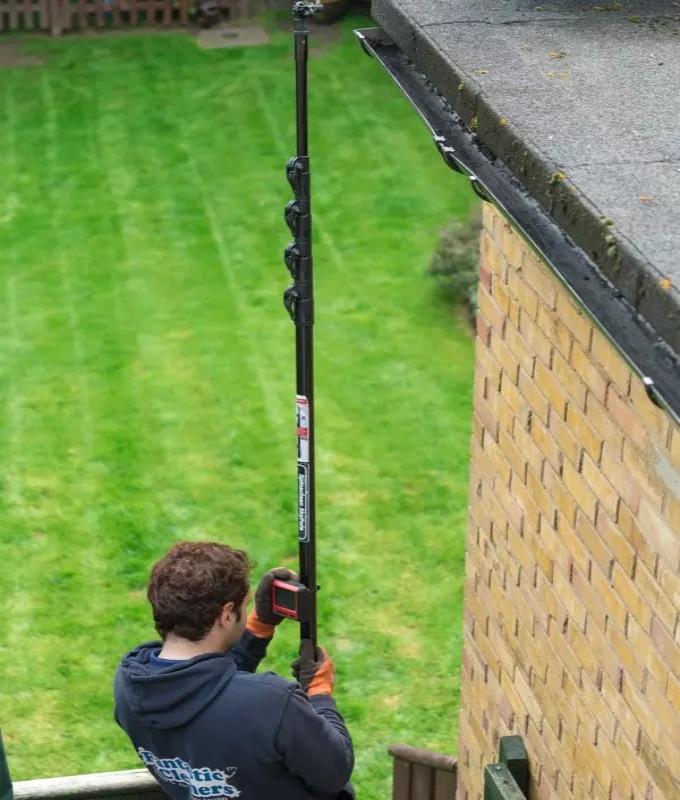
Between the middle of October and the first hard frost, a roof under mature trees will take in more material in six weeks than it does in the rest of the year combined. Streets climbing the greensand ridges here are heavily wooded, and many houses sit below oak, beech and Scots pine that were standing long before the plots were sold. That canopy is the reason a gutter in GU1 fills, and the species mix is the reason it does not empty itself again once it has.
A calendar written by the trees
Different species drop at different times, which is why a single annual clear so often misses the point. Lime and ash go early and light; horse chestnut goes in one heavy fall; oak hangs on until late November and sometimes into December. Pines shed needles steadily through the whole year rather than in a season, and they are the worst offenders, since a needle is small enough to pass a leaf guard and stiff enough to knit into a mat. Spring adds blossom, catkins and helicopter seed, which is a lighter but stickier load. Reducing what lands up there means crown work, which belongs with the garden round in local gardening across Farnham.
Why mesh guards disappoint under conifers
Guards work well under broadleaf trees and poorly under pine. Needles stand on end in the mesh and weave into it, moss then caps the whole surface, and the water simply runs over the top of a gutter that is technically empty underneath. Brush inserts fill with silt and become a wick. Where a guard genuinely earns its place is over a valley outlet or a hopper, as a strainer rather than a lid, and even then it has to be lifted and cleaned rather than left as a permanent solution. On open suburban roofs with no conifers nearby the calculation is different, as under fully insured gutter clearing in Slough.
The compost stage
Left long enough, gutter debris stops being leaves and becomes soil. A bed of silt two or three centimetres deep holds water indefinitely, sprouts sycamore and birch seedlings, and adds real weight: a saturated run pulls brackets out of a fascia board a few millimetres at a time until the fall reverses. At that point clearing alone will not fix the overflow, because the gutter now sits low in the middle and holds standing water no matter how clean it is. Rebracketing and realignment is joinery work of the kind covered by our nearby specialists.
Fascia, felt and the drip edge
The detail that decides whether a full gutter causes damage is the roofing felt at the eaves. Where the felt has perished or was never dressed into the gutter, water backing up runs behind the fascia instead of over the front, soaking the rafter feet and the board. The visible sign is a dark band on the soffit or a green streak on the wall directly below the tile line. Anyone clearing should be looking at the felt lap and the tilt of the bottom course while the gutter is empty.
Long drives and where the ladder goes
Houses set back behind gravel and soft verges create a practical problem: a ladder needs firm level footing and a pole vacuum needs a route to the eaves, and mature planting frequently occupies the strip where both would stand. Working around a canopy overhanging the roof also limits how far a platform can be pitched. Planning that on arrival wastes the slot, so access is discussed when the job is booked, along with gate widths and whether the rear is reachable without going through the house. Glass beneath the same canopy greens over just as quickly, which is the work in trusted sash window cleaning in Guildford.
Two visits, and what each one is for
Under this much tree cover the sensible pattern is twice yearly: a late autumn clear once the oaks have finished, which is the important one, and a lighter spring visit to take out seed and blossom before summer storms wash it into the downpipes. Quotes follow the metres of run, the number of storeys and the access method, and the general principles behind the service are set out on gutter cleaning services nationwide.