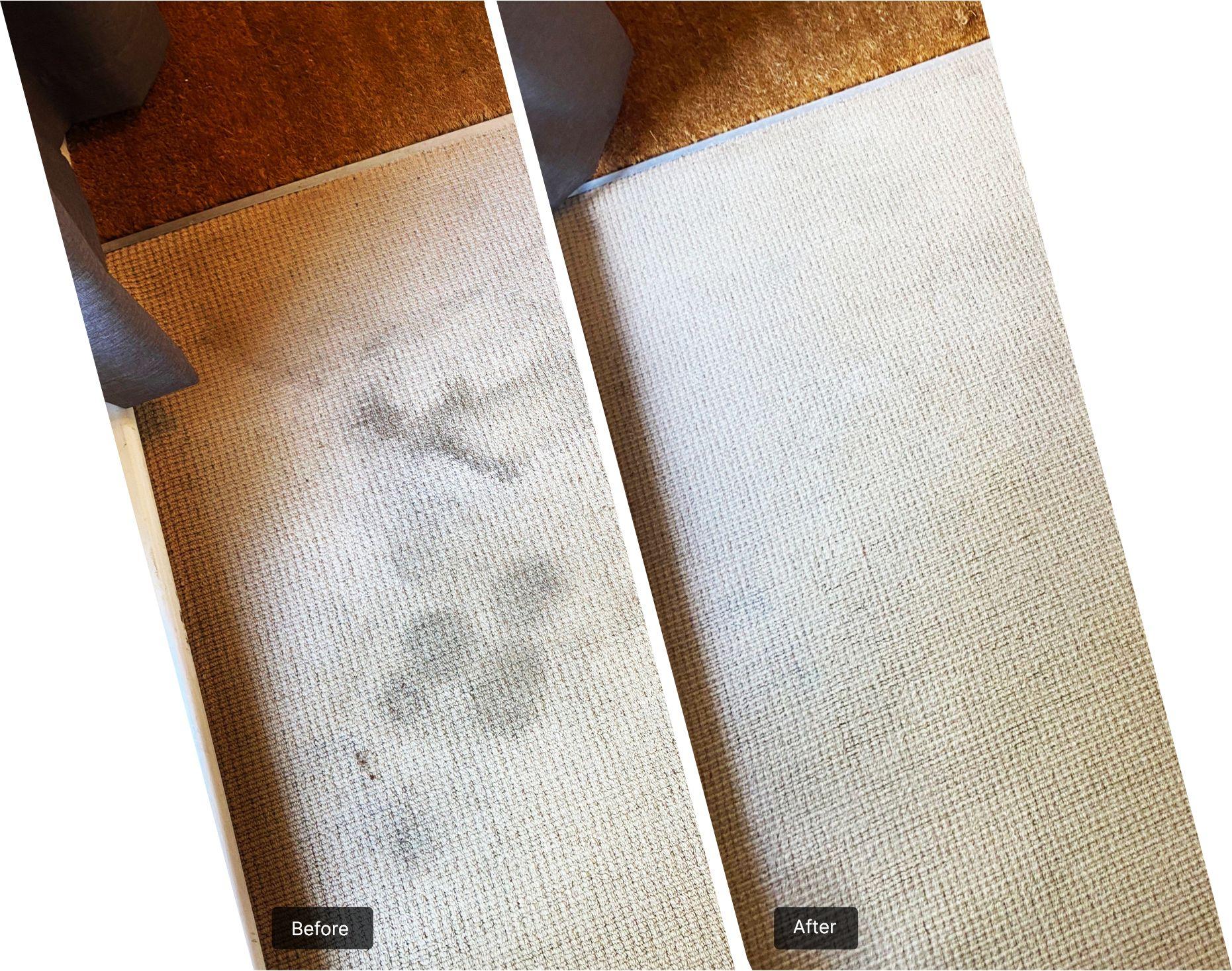
River silt is the defining soil in SW15. It is nothing like garden grit: the particles are fine, slightly greasy and grey-brown, and they penetrate to the base of a pile rather than resting between tufts. Anyone who walks a dog along the foreshore path, runs before work or comes home from a boat carries it into a hall in quantity, and it dries to a pale film that a domestic vacuum lifts only partially.
Fine particles need a different first pass
Because silt sits deep, the dry stage has to be more than a token run-over. A brush machine is worked slowly enough for the bristles to reach the base of the tuft, and the head is taken across the lane in both directions so the pile opens from each side. Speeding that stage up simply leaves the material in place, where the pre-spray turns it into a suspension that the wand then has to remove in full — a slower and much less complete outcome than lifting it dry.
Matting earns its keep at the door
Most of what damages a hall carpet could have been stopped in the first three paces. A scraper mat outside, an absorbent mat inside and a decent length of walk-off matting beyond it will hold a large proportion of both water and solids. Length matters more than quality: a short mat gets one footfall per shoe and clears almost nothing. Mats are also the one thing in the hall that should be taken outside and beaten rather than vacuumed in place.
Traffic lanes, and lifting a pile that has laid over
A lane looks darker partly because it is soiled and partly because the pile has been pushed flat and is reflecting light differently. Cleaning without addressing the second half leaves a shadow. Grooming with a pile rake immediately after extraction sets the tufts upright while they are still damp, which improves both appearance and drying, since air moves through an open pile far better than a laid-over one.
Mansion flats and their communal routes
A good deal of Putney housing is purpose-built flats with a carpeted communal stair and landing, where dozens of residents share one floorcovering and nobody feels responsible for it. Those areas justify a different cycle from a private hall: frequent low-moisture maintenance with spot attention, rather than an annual deep clean that is overwhelmed within weeks. Sequencing around residents, and drying before evening returns, is part of the planning.
Damp kit on a bedroom floor
Sports bags, wet trainers and rowing or running kit left on a carpet overnight do a specific kind of damage. Synthetic fabric holds water against the pile, the area beneath stays saturated for hours, and the result is a ring with a darker edge where soil has migrated outward, often accompanied by a persistent stale odour that survives ordinary vacuuming. The cure is treatment at the fibre and backing rather than deodorising the room, and the prevention is a boot tray by the door instead of a habit of dropping a bag in the same spot.
The sofa that has taken the same soil
Silt and river damp reach fabric furniture through open windows and off clothing, and an upholstered arm collects it in exactly the way a stair nosing does. That work is a separate discipline with tighter moisture control and is covered by upholstery cleaning throughout Putney. Where a tenancy is ending, floors and soft furnishings are usually taken together as part of trusted check-out cleaning in Putney.
What happens on the day
Areas are counted rather than timed, with the hall, stairs and landing priced as their own run because they take the longest. Controlled parking applies across most of the district, so a bay or visitor permit sorted beforehand keeps the start on time. Neighbouring districts inland have a coarser, drier soil profile and are covered on professional carpet cleaning services in Tooting, wider household work sits under professional domestic cleaning in Tooting, and the fibre-by-fibre background is on fully insured carpet stain removal.