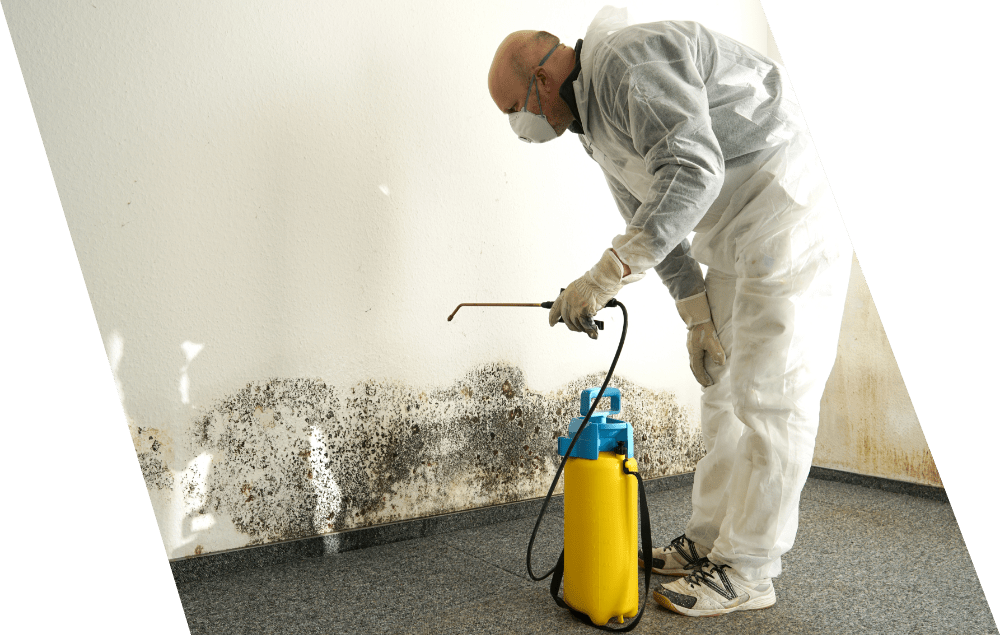
One question has to be answered before anything is treated: is water arriving, or is it condensing? Everything else follows from that, because a wall being fed by a leak will keep growing mould no matter how well it is washed, and a wall suffering condensation will not be helped by a plumber. The elimination sequence used in Cricklewood properties is the same every time, and it takes about an hour to work through.
What the shape of the patch says
Liquid water and condensation leave different marks. Water arriving from a source spreads outwards from a point, has a defined edge that is often darker than its centre, and frequently shows a tide line where evaporation has concentrated salts. Condensation produces speckled colonies rather than a stain, has a boundary that follows temperature rather than gravity, and sits on the surface rather than soaking into it. A patch that is worst at its middle and fades outwards is being fed. A patch with a sharp cold-line edge is not.
Testing against the weather and against use
The next step is to relate the problem to a timetable. Does it worsen within a day of heavy rain, which points at rainwater or the external envelope? Does it worsen after a bath or after laundry, which points at plumbing or at moisture production? Does it appear in November and clear in April, which points at condensation? Does it stay the same all year, which points at ground moisture or a continuous leak? Households usually know the answer once the question is put in those terms, and it narrows the field faster than any instrument.
Depth readings and what they settle
Surface moisture alone cannot distinguish the two causes. Readings are therefore taken at depth as well as at the surface, using a probe where necessary, and compared. Moisture concentrated in the outer few millimetres with a dry substrate behind it is condensation. Moisture rising with depth, or higher in the core than at the face, means water is in the wall and travelling. Comparative readings on an unaffected wall in the same property give a baseline, without which any single number is meaningless.
Ruling out the plumbing properly
Where the evidence points at water, the plumbing is eliminated methodically rather than by guesswork. Fittings and joints nearest the affected area are inspected first, then the runs that pass through or above it, remembering that water travels along horizontal surfaces and reappears well away from its source, sometimes in the next room. A meter check with everything shut off is a simple and decisive test for a continuous supply leak. Locating and repairing what is found belongs with plumbing for homes in Cricklewood, and once the repair is done the drying period starts from that date rather than from when the mould was first noticed.
Two causes at once
The awkward cases have both. A slow historic leak wets a wall, the wall becomes a permanently cold surface because damp masonry conducts heat away, and condensation then forms on it as well, so treating either cause alone leaves half the problem. This is common in the mansion blocks and older terraces here, where pipe runs are long and previous repairs are undocumented. The order in these cases is fixed: stop the water, dry the fabric, then address the conditions, and the framework for that is set out under affordable mould removal and remediation.
How the investigation is arranged and charged
An investigation is booked as its own appointment, because the findings determine what the treatment needs to be and what it will cost. It helps to know when the marking first appeared, what the weather was doing, what has been repaired in the property before, and where the stopcock is. Furniture should be clear of the affected wall and access available to the floor above and to the adjoining room, since that is frequently where the source turns out to be. Making good after any opening up is a job for handyman services in Cricklewood; where a wet void proves occupied, trusted mice and rat control in Swiss Cottage handles that; and what the service covers follows the same elimination order in the housing to the south east.