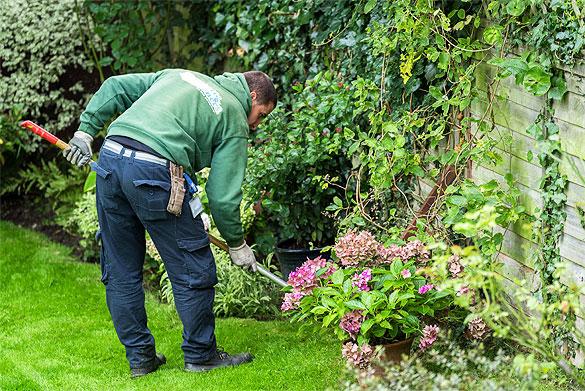
Gardens close to large areas of open parkland in TW9 get visitors that suburban gardens a few miles away never see, and the evidence usually arrives overnight: roses browsed to a stump, a newly planted hedge stripped to the height of a shoulder, tulip bulbs lying on the surface beside neat conical holes. The response most people reach for, a spray or a sonic device, rarely changes anything. What works is knowing which animal did it and putting a physical barrier between it and the plant.
Reading the bite mark
Deer have no upper incisors, so they tear rather than cut, and browsed shoots end in a ragged, stringy break. Damage stops at a consistent height, which gives a visible browse line through a border, and bark is sometimes stripped in ribbons or rubbed away where a buck has frayed a young stem. Rabbits leave a clean angled cut like secateurs, always low down, and they bark-strip at the base in hard weather. Squirrels dig small neat holes, take bulbs and fruit, and strip bark from smooth young branches in strips near the top. Establishing which is at work takes a minute and saves a season.
Barriers are the only thing that reliably works
For deer, the only complete answer is a fence tall enough that jumping is not worth it, with gates kept shut, and in most London gardens that is neither practical nor wanted. Individual protection is the realistic alternative: mesh cages around vulnerable shrubs through winter, netting over a new hedge for its first two or three years, and tree guards on anything young. Rabbit exclusion is easier, needing wire of a fine enough mesh taken a little way into the ground and turned outward at the base so digging under it fails.
Guards on young trees, and the ones that kill the tree
A spiral guard protects a stem from rabbits and strimmer damage but has to be checked annually and removed before the trunk swells into it, because a guard left on a growing stem strangles it as effectively as any animal. Mesh sleeves need a stake so they do not chafe. Any guard sitting in long grass becomes damp shelter for the things it was meant to keep out, so the base is kept clear.
Bulbs, pots and the animal that remembers
Squirrels find newly planted bulbs by the smell of disturbed soil, so the most useful measure is to firm the ground, water it and lay wire mesh over the area for a few weeks until the scent has gone and roots have taken hold. Tulips and crocus are taken far more readily than daffodils and alliums, which are largely ignored. Pots are the worst affected, because the soil is soft and concentrated, and a square of mesh under the surface solves it permanently. Anything that has followed the same route into a roof space is no longer a garden matter and is dealt with by the service in full.
Planting choices, honestly stated
No plant is deer-proof; a hungry animal in February will eat things it ignores in June. What exists is a spectrum of preference. Aromatic, hairy, leathery and toxic foliage is generally left alone, which covers lavender, rosemary, euphorbia, hellebore, ferns, box and daffodils. Roses, tulips, young fruit trees and anything freshly planted and soft sit at the other end. Planting the favoured things where they can be protected, and the ignored things at the boundary, is more effective than any repellent.
The times of year it gets worse
Pressure is seasonal. Late winter, when there is little else to eat, brings bark stripping and browsing of evergreens. Spring brings damage to soft new growth, and a dry summer pushes animals toward watered gardens. Protection therefore goes on before the season that needs it rather than after the first losses. Droppings and trodden mud across a terrace come with the territory, and the surface is cleaned by Fantastic Services, while the amount of it that ends up indoors on boots is dealt with by the cleaning services team in Richmond.
What an assessment involves
A visit of this kind is a walk round with a note of what is being eaten, at what height and how recently, followed by a plan that puts protection on the small number of plants that genuinely need it rather than caging the whole garden. Guards and netting are quoted on the number of plants and the materials, and installation is usually combined with an ordinary maintenance visit. Rounds in the neighbouring streets are covered by garden clearance in North Sheen, and the way regular visits are arranged is explained on our garden maintenance team.