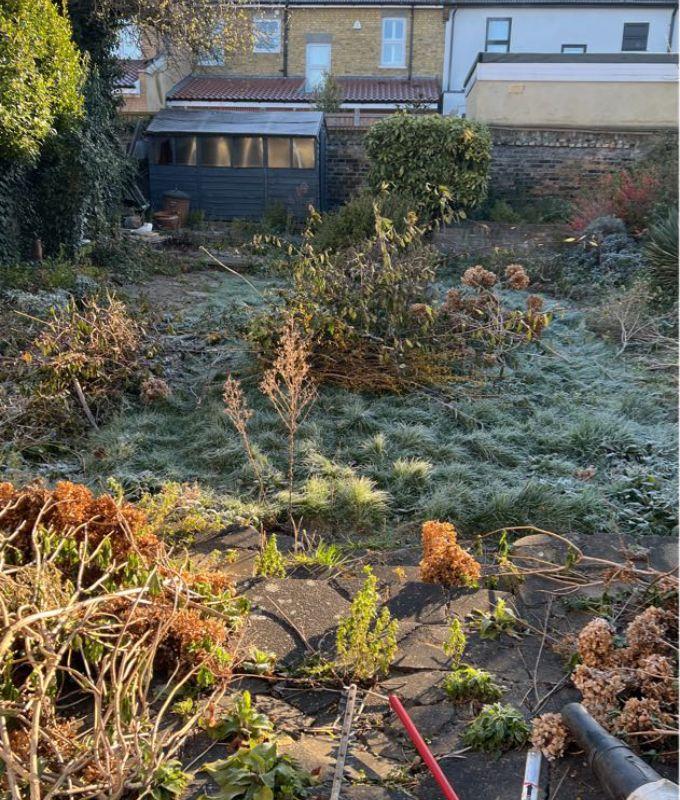
New planting in Kew fails in July far more often than it fails in January, and it is almost never the plant's fault. A shrub put in with a rootball still wrapped tight, backfilled into a rich pocket of compost in an otherwise heavy soil, and given a daily sprinkle from a watering can has been set up to die in its first dry spell. Establishment is a skill of its own, separate from planting design and separate from routine maintenance, and it decides whether a border looks convincing in two years or has to be done again.
Planting depth and the rootball
A plant goes in at the depth it grew at, with the top of the rootball level with the surrounding soil, not sunk into a dish that will fill with water and not proud where it will dry out. Container-grown stock that has been standing at a nursery too long has roots circling the pot, and those roots will keep circling underground unless they are teased out or cut through on the outside of the ball. The hole is dug wider than it is deep, because roots spread sideways far more than they descend.
Backfill with what is already there
Filling around a new plant with bagged compost rather than the excavated soil creates a sump: water runs into the softer material and sits there, and roots stay within the comfortable pocket instead of venturing into the surrounding ground. The better method is to backfill with the soil that came out, broken down and mixed with a modest amount of organic matter, then firm it in stages so there are no voids, and put the improvement on the surface as a mulch instead.
Watering by volume, not by habit
New planting needs a large volume infrequently rather than a little often. A thorough soak that wets the full depth of the rootball and the soil around it, once or twice a week through the growing season, drives roots downward; a daily sprinkle keeps moisture in the top two centimetres and trains them upward, which is fatal in the first hot week. Trees benefit from a slow-release bag or a pipe set beside the rootball so water gets to depth. This regime continues for at least two growing seasons for shrubs and longer for trees, and it is the thing most often stopped too soon. Establishment watering is also the task that sets the rhythm of the seasonal round described in how it works.
Planning for a dry summer
Restrictions on hosepipe use arrive in dry years with limited notice, and a planting scheme that depends on a hose is vulnerable. Planting in autumn rather than late spring gives a plant the whole winter to root out before it meets any heat, bare-root stock in the dormant season establishes faster and costs less than containerised equivalents, and a thick mulch ring kept off the stem does more to conserve moisture than any amount of watering. Gardens upriver on heavier ground hold moisture far longer and are covered by lawn mowing in Richmond.
Support that comes off again
A tree stake is there to stop the rootball rocking, not to hold the stem up, so it is set low, no more than a third of the height, with a single tie and a spacer. A stem allowed to flex thickens and strengthens; one strapped rigidly at head height stays weak and snaps when the stake is finally removed. Ties are checked twice a year and eased as the stem thickens, and the stake comes out after two seasons. Leaving it indefinitely does more harm than never fitting one. Young stems are also gnawed at the base over winter by rodents working along a boundary, which is a matter for professional pest control in Kew.
What goes in before the plants
Where a scheme needs levels changed, a wall or steps built, a path laid or drainage put in, all of that happens before planting rather than around it, and it is a different trade with different equipment, covered by landscaping services in Twickenham. Planting into a bed that will be dug up again in the spring for construction wastes a season and a lot of stock.
Aftercare as a booked arrangement
The sensible way to buy establishment is as a defined aftercare period: scheduled visits through the first two growing seasons covering watering checks, mulch topping up, tie adjustment, weed control around the base and replacement of anything that has clearly failed, priced by the visit. Paving churned with mud and compost during planting is washed down at the end, and a surface that has been dull for years is restored separately, under fully insured pressure washing in Kew.