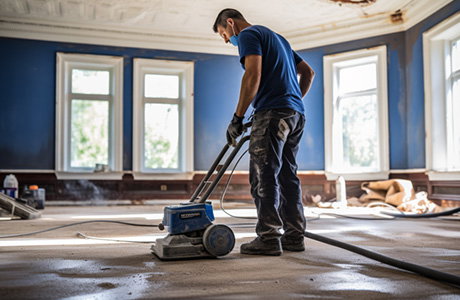
Kitchen replacement is the most common refurbishment in GU21, and it is deceptively messy. Nothing structural needs to happen for a fitted kitchen to leave a room in a state: old units come out with the tiles and the plaster behind them, a stone mason cuts and polishes a worktop on site or in the drive, cabinets arrive flat-packed in a mountain of cardboard, and appliances are commissioned with their protective film still half attached. The result is a room full of expensive surfaces, each wanting a different treatment.
Stone worktops and what not to put on them
Quartz, granite and sintered surfaces all pick up a haze of cutting slurry and polishing compound during installation. Acidic cleaners etch natural stone, and abrasive cream dulls a polished finish permanently. The safe sequence is a neutral solution, a soft pad, plenty of rinsing and immediate drying, with any cured silicone at the upstand softened and cut back with a plastic blade rather than a metal one. Sink cut-outs and the underside of the overhang hold slurry that nobody sees until it sets.
Cabinet carcasses, drawer runners and hinges
Units are cleaned inside as well as out. Sawdust from cutting plinths and end panels drops into the base of every carcass, drawer boxes collect fixings and offcuts, and soft-close runners stop being soft-close once grit is in the mechanism. Runners are brushed out dry, hinges are wiped without solvent getting into the damper, and the top edge of a wall unit - unreachable and invisible - is done from a step rather than at arm's length.
Appliances that have never been used
A new oven carries manufacturing oil that smells alarming on first heating, and installation dust will bake onto it. Cavities, shelves and racks are cleaned before commissioning, film is taken off stainless doors and the adhesive removed, and the extractor's grease filters are checked, because they frequently arrive already coated with the fine dust of the fit-out. Integrated dishwashers and washing machines get their filters and seals checked for grit and plaster before first use.
Tiling, grout and splashback glass
Grout haze sets to a fine film across a tiled surface and is invisible until the light moves. It is removed within its window with a pad and a suitable solution, and once it has cured properly it takes an acidic treatment that must be kept off any adjacent stone. Toughened glass splashbacks are worse for showing smears than any window, and they are finished dry with a clean cloth rather than left to air.
The rest of the house after a kitchen job
Fine dust from removing old tiles and plaster travels further than most people expect, and the living room carpet next door usually takes as much of it as the kitchen floor. Extraction there is worth doing once the kitchen is finished, and that service sits with carpet cleaning specialists in Woking. Where a household wants the standard held afterwards rather than re-created every few months, a regular arrangement is available through cleaning services specialists in Woking.
Glass, both sides
Kitchen windows and rear doors take splash from cutting outside, and the external face is usually well past what a cloth from inside will reach. Larger properties and upper storeys need pole-fed equipment and are handled by Guildford exterior window cleaning.
Booking the clean at the right moment
The best day is after the fitter's second visit, once handles are on, silicone has gone in and any replacement door has arrived - not before, because each of those brings its own mess. Scope covers the kitchen, the connecting rooms and the route the trades used. Costing follows crew hours rather than a fixed figure, and the site needs water, power and no remaining packaging. Coverage further out is listed under flexible after builders cleaning services in Virginia Water, and a fuller description appears on trusted post-build cleaning.