Staircases take the heaviest wear in any house and receive the least attention in most cleaning routines. In SW16 that problem is magnified by the building stock: large late-Victorian villas divided into flats, with long straight flights, winders at the turn and a half-landing that everyone crosses. A staircase in one of those buildings can carry more footfall in a week than a bedroom floor sees in a year.
Wear concentrates on the nosing
Almost all stair damage happens on the front third of the tread and over the nosing edge, where the foot lands and pivots. The pile there is compressed against a hard timber edge and abraded from above, so fibre is lost rather than merely soiled, and the colour reads lighter because the tuft has been worn short. Recognising that distinction avoids the false expectation that a clean will even out a stair that is genuinely worn through.
A wand is the wrong tool on a stair
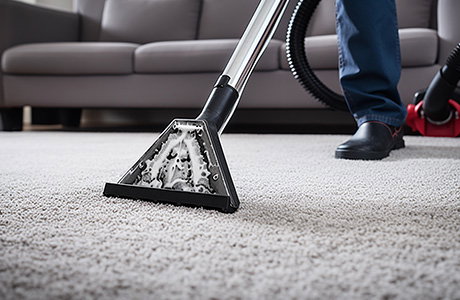
Stairs are cleaned with a hand tool, worked from the top down, with the pre-spray applied sparingly and agitated by hand brush into the nosing and the angle where tread meets riser. Flooding a stair is a real hazard, since gravity carries solution down to the bottom step and into the hall carpet, and a soaked riser will stain along its lower edge as it dries. Short overlapping strokes with firm dry passes are what keep moisture under control.
Winders, spindles and the awkward inches
The turn is where a carpet is hardest to clean and where soil is worst, because the tread narrows and everyone treads on the same few inches. Around spindles and against the string, a hand brush and a narrow tool do the work a large head cannot, and the pile is finished by hand so the direction matches the rest of the flight. On a half-landing, furniture and boxes come off the carpet first; anything left in place produces a visible outline.
Safety while the flight dries
A damp stair is slippery, and in a converted house other households need to use it. Work is timed so the flight is back in service before people come home, drying is assisted with air moved up the stairwell, and a run of protective matting is laid where the stairs cannot be closed. Nobody should be walking a wet flight in socks, which is worth saying out loud rather than assuming.
Who arranges a communal flight
In a converted villa the stairs beyond a flat's own front door are usually the freeholder's responsibility, funded through a service charge and organised by a managing agent rather than by any one resident. That changes the practicalities: access has to be agreed, a date circulated, and the work scheduled so the flight is not the only route out of the building while it is wet. Leaseholders who want the communal carpet dealt with generally get further by raising it with the agent than by arranging a visit individually.
Runners, rods and fully fitted flights
A fitted stair carpet is cleaned in place and the gripper is not disturbed. A runner held by rods can be released, cleaned on a flat surface and refitted, which reaches the edges and the treads beneath it properly, but the rods and clips are old in many of these houses and are handled accordingly. Where boards show at each side, the exposed timber is cleaned dry so no solution sits against the finish.
Booking a flight or a whole property
A staircase is counted as its own area, priced by the number of treads and whether there are winders and landings, rather than folded into a room rate. Clearing shoes, post and storage from the flight beforehand makes a noticeable difference to the finish. Whole-property turnarounds put the stairs last, in the sequence used within end of tenancy cleaning cover across Streatham, while ongoing communal upkeep fits within Streatham cleaning services team. Neighbouring districts are covered on carpet cleaning services in Wandsworth, fabric furniture on a local professional, and the general method on carpet and rug cleaning prices.