How long will it be wet is the question nearly every household asks, and the honest answer is that it depends on considerably more than the machine. Two identical carpets cleaned the same way in the same street can be touch-dry in two hours or still damp the next morning, and the variables are airflow, relative humidity, floor construction and how much solution was needed in the first place.
Why drying time varies so widely
A carpet holds water in three places: the pile, the backing and the underlay. Extraction takes most of it out of the first two and very little out of the third, so the last stage of drying depends on moisture migrating upward and then evaporating. That process is governed by how much drier the surrounding air is than the carpet, which is why a mild damp day dries a floor more slowly than a cold bright one. The underlying method is documented on professional steam carpet cleaning.
Most of the water leaves with the wand
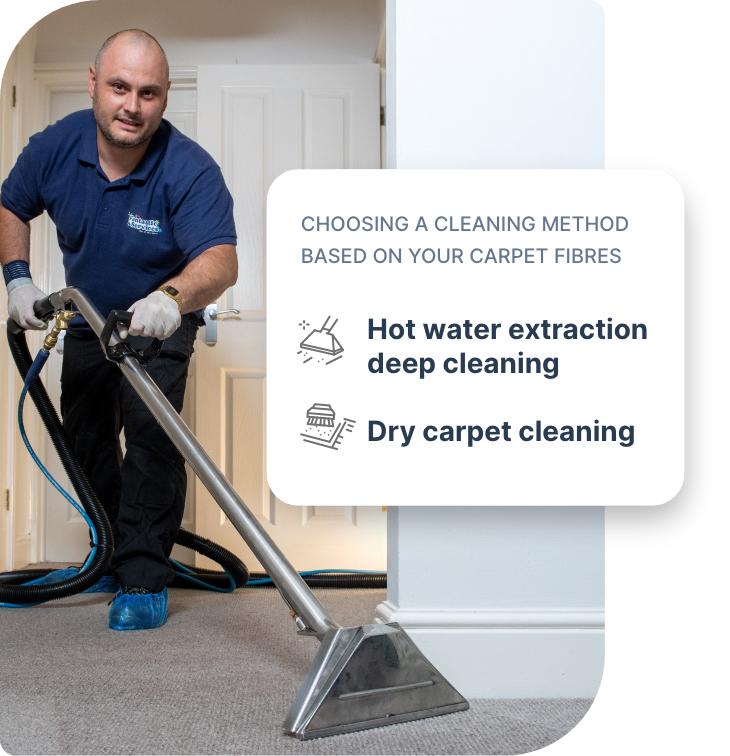
The single biggest influence on drying is how thoroughly the technician recovers on the day. Dry strokes, made with the solution valve closed and the wand drawn slowly, remove far more than any amount of subsequent airflow, and they cost nothing but time. A job finished in a hurry with the last pass still wet will take twice as long to dry and is more likely to wick a stain back.
Humidity matters more than temperature
Heating a closed room raises how much moisture the air can carry but does not remove any of it, so the water simply moves from the carpet to the air and then to the coldest surface in the room. Useful drying needs exchange: humid air out, drier air in. A window open a few centimetres on two sides of a property achieves more than a radiator on full, a point that comes up constantly on jobs in steam carpet cleaning services in Bracknell.
Air movers and where they are aimed
An air mover works by sweeping a thin layer of saturated air off the pile surface, so it is set low and angled to travel across the carpet rather than pointed down into it. One machine per room, repositioned partway through, is normally enough in a domestic property. In an empty house they are left running and collected later. Between deep cleans, routine care that keeps soil load down is handled through home cleaning in Bracknell.
Winter work in a house that cannot be aired
Between November and February opening windows is unpopular and sometimes pointless, because outdoor air is already close to saturation. The alternatives are reducing the moisture applied, increasing dry passes, running a dehumidifier in a closed room, and accepting that fewer rooms can be done in a day. Work following a refurbishment is scheduled with the same caution, in the order set out under same-day after builders cleaning services in Newbury.
What a moisture meter is actually reading
Judging dryness by hand is unreliable, because the surface of a pile feels dry long before the backing is. A non-invasive meter passed over the floor compares a cleaned area against an untouched one in the same room, which is more informative than any absolute figure, while a pin meter pressed into a concealed edge reads the backing and underlay directly. Readings taken at the same points at the end of a visit and again the next day show whether drying is progressing or has stalled. That evidence counts for most on ground floors and in properties standing empty, where nobody is present to notice a problem.
Planning a day around drying
Morning appointments are preferred so the carpet has daylight hours and the heating cycle to work with, and rooms are done in an order that leaves the most-used spaces finished first. A booking covers pre-vacuum, pre-spray, agitation, hot extraction, dry passes and airflow, with a moisture check before the technician leaves. Pricing is by room and measured area. Tenancy timings are coordinated within our Newbury team.