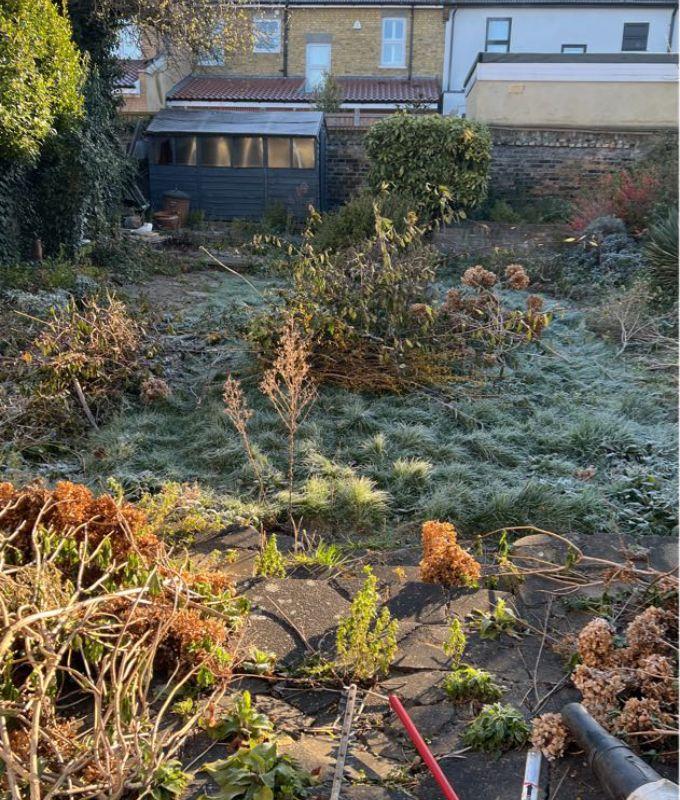
Gardens that run up the valley sides above the Wey rarely contain a flat section longer than a few strides. A slope changes every part of the work: where a mower can go, how water and soil behave, what can be planted at the top compared with the bottom, and how long it takes to move a barrow-load of anything from one end to the other. Around Godalming this is the defining constraint on a great many plots, and a maintenance plan written for level ground simply does not transfer.
Working safely on a bank
Pedestrian mowers are worked across a slope rather than up and down it, because a machine pulled backwards uphill is how feet end up under a deck. Beyond roughly fifteen degrees a wheeled mower stops being the right tool at all, and a brushcutter on a harness takes over. Wet grass on a gradient is genuinely dangerous, so work gets rescheduled rather than attempted. Footing, boots and the direction of travel matter more here than the size of the machinery.
Soil that will not stay put
Bare ground on a slope moves in heavy rain, and the greensand and clay mixtures around the valley shed a surprising amount of material into the bottom of a garden over a winter. Anything that keeps roots in the surface holds it: dense ground cover, shrubs planted through a biodegradable mat, grass left slightly longer on a bank than on a level lawn. Mulch on a steep bank washes off unless it is coarse, so bark chips are chosen over fine compost.
The moisture gradient from top to bottom
A sloping garden is effectively two gardens. The top dries first, drains hardest and bakes in summer; the bottom collects everything that runs off and stays cold and wet late into spring. Planting the same scheme along the whole length guarantees half of it disappoints. Drought-tolerant planting belongs at the top, moisture lovers at the foot, and the frost that drains downhill collects there too, which is why a tender shrub does better halfway up than in the sheltered-looking hollow.
Terraces, walls and what holds them up
Most of these gardens have been terraced at some point, and the retaining structures are doing serious work. Bulging courses, weep holes blocked by soil or planting, and a wall that has lost its drainage behind it are all worth spotting early, since water pressure behind a retaining wall is what brings it down. Clearing vegetation off the face and keeping the drainage clear is garden work; rebuilding or replacing a structure is not, and what the service covers takes that on.
Steps and paths that turn slippery
Every level change needs steps, and steps in a shaded, damp valley garden grow algae on the treads within a season. That is the most likely place for an accident in the whole plot, particularly where the treads are worn stone or timber. Cutting back overhanging planting improves drying and slows the regrowth; restoring the surface itself is machine work that professional patio jet washing in Farnborough handles. Handrails and even nosings matter more on a garden where everyone carries things up and down.
Moving material up and down
On a steep plot the cutting is quick and the carrying is not. Arisings go downhill where possible, with material dropped in stages rather than hauled in one go, and a route is chosen that avoids crossing a planted bank. Where there is no vehicle access at the top of the garden, everything travels through the house or round the side, and the mud that comes with that is why households on these slopes keep professional cleaners services in Godalming running through the winter months.
How visits are planned on a slope
Maintenance is charged by the time on site and the number of technicians, and a sloping garden honestly takes longer per square metre than a level one, mostly in movement rather than in cutting. Visits are grouped into fewer, longer appointments for that reason. Dry conditions matter more than the calendar, so some flexibility on dates helps. Gardens on the flatter ground at Farnham hedge trimming take a different rhythm, and the seasonal framework behind both is set out in garden maintenance for landlords.