Loft conversions in Clapham nearly always add a third flight of stairs, and that flight is usually the awkward one: a winder turn, restricted head height and a new balustrade with spindles that catch dust. It is also the route every bag, hose and machine has to take. The staircase, more than any single room, determines how long a post-construction clean in a converted terrace actually takes.
Winders, spindles and the parts a mop cannot reach
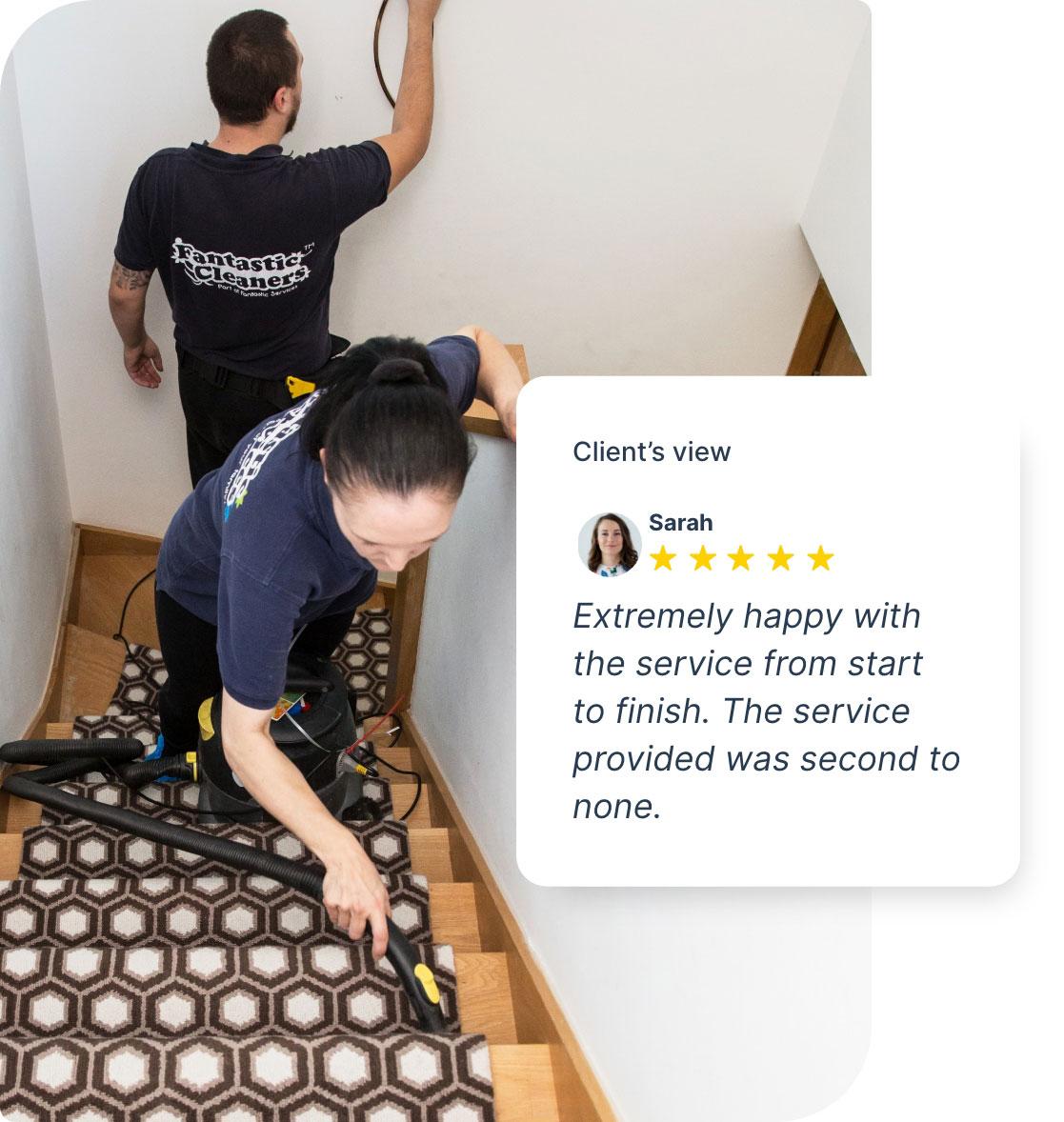
Tapered treads on a turn have no straight edge to work along, and the inner corner of each one collects a wedge of fine dust. They are done by hand with a vacuum and a narrow nozzle before anything damp goes near them. New softwood or board spindles are usually painted on site, so they carry both plaster dust and overspray, and they are cleaned individually rather than run over with a cloth. The underside of a new flight, where it is open to the room below, collects a surprising amount and is done from beneath rather than reached over the balustrade.
Working at the top of a house
Water, machines and waste all have to move up and down three storeys. Fewer trips means bigger loads, and bigger loads mean more risk to walls that have just been painted. Corners are protected, hoses are carried rather than dragged over a nosing, and newel posts take a wrap. The stairs themselves are cleaned twice, early to clear the bulk and again at the very end when everyone has finished walking on them. Landings are the natural place to set equipment down, so one protected staging point is agreed at the start and everything else stays in the van.
Roof windows, dormers and the dust that sits above eye level
A loft room's dust sits on surfaces nobody looks at: the top of a roof window frame, the ledge inside a dormer cheek, the back of exposed purlins, and the void behind eaves storage doors. Eaves cupboards in particular are left full of insulation offcuts and plasterboard scraps. They are opened, emptied and vacuumed rather than shut and forgotten. What a thorough construction clean includes is set out on nationwide after builders cleaning services. Blinds fitted to a roof window before the final clean trap sanding dust inside the cassette and are better left uninstalled until afterwards.
Plasterboard, tape and the sanding film
A loft conversion is mostly new plasterboard, taped, jointed and sanded. The film that sanding leaves is extremely fine and sits on everything below as well as above, drifting down the stairwell into the original house. Cleaning only the new room leaves the first floor to go grey again within days. The whole vertical route is treated as one job rather than as a room with stairs attached. Wardrobes and beds on the floor below are unwrapped and vacuumed rather than assumed to have been protected.
Getting the leftovers out of a narrow house
Insulation offcuts, board ends, packaging and the old loft contents cleared to make room for the conversion all have to come down and out through a hallway. That material is bulky rather than heavy and needs a licensed removal, arranged through the team covering Brixton. Balustrade fixings, door catches and architrave never pinned back are joinery and belong to our handyman service in Clapham.
How long a three-storey clean takes, and why
Time is driven by the number of levels and the amount of detail rather than by floor area, which is why a narrow three-storey terrace can take longer than a wider two-storey house of the same size. The visit is quoted accordingly, and an accurate description of how many rooms were affected keeps that realistic. New stair carpet fitted before the final clean traps the sanding film immediately and is extracted by our nearby specialists, and neighbouring districts are covered on the same basis through after builders cleaning services in South London.