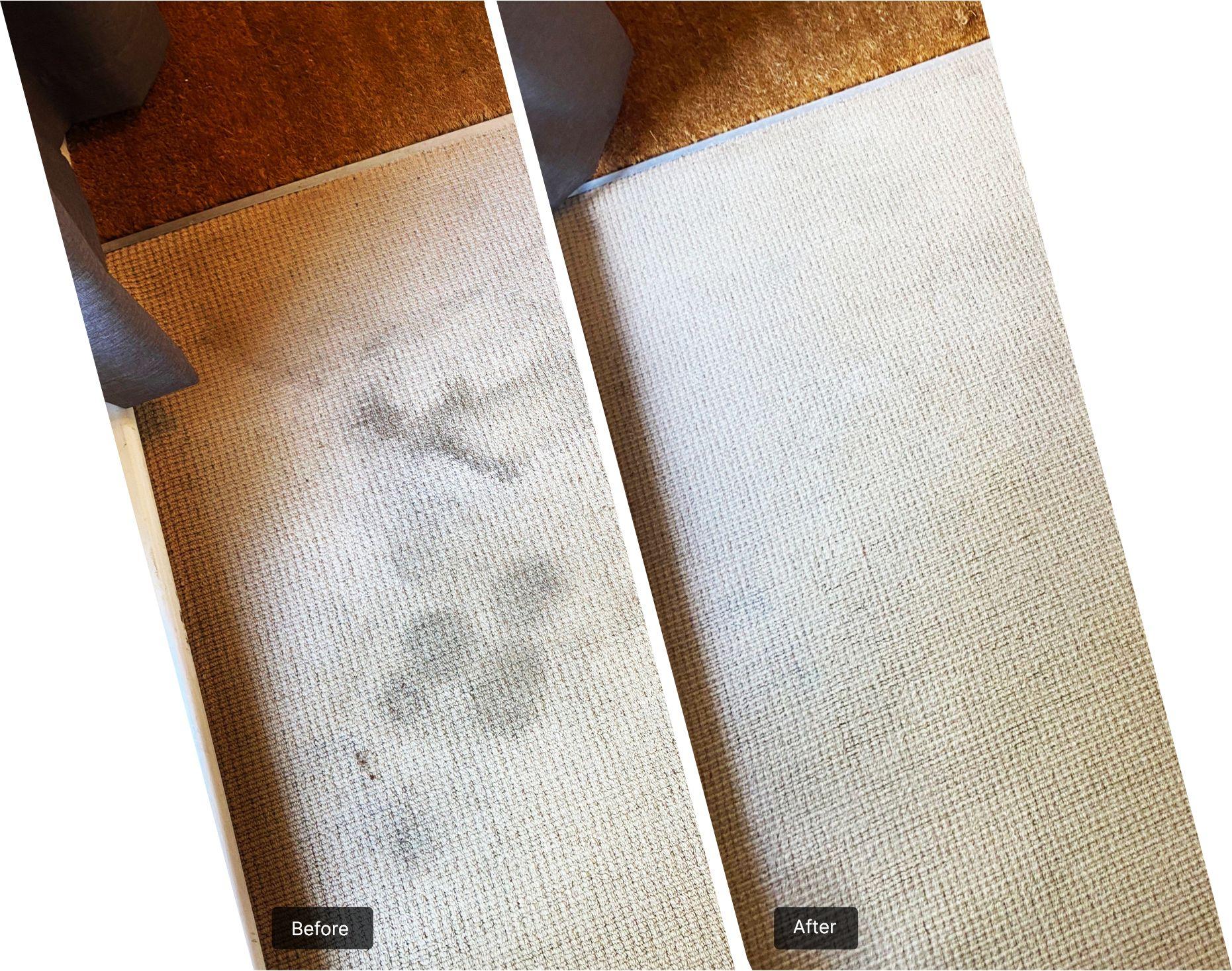
Sisal is the fibre that catches people out in Richmond. A great many TW9 houses have a natural floor covering somewhere in them, usually in a hall or on a staircase, and almost everyone who owns one assumes it can be cleaned the same way as the wool twist in the bedroom. It cannot, and a single wet attempt is enough to ruin it permanently.
Telling a plant fibre from a wool one
Sisal, seagrass, coir and jute look superficially similar to a flat-woven wool and are often fitted in the same places. Under a lens the difference is obvious: plant fibres are coarse, irregular and run in visible bundles, while wool has a scaled surface and a crimp to it. A burn test on a hidden strand settles any remaining doubt: wool smoulders, smells of burning hair and leaves a crushable ash bead, while plant fibre flares, burns with a clean paper smell and leaves a fine grey ash. Getting that wrong is expensive. Getting the identification right is the whole job, because the correct method for one is the destructive method for the other.
Why water ruins seagrass and coir
Plant fibres are hygroscopic and they are dyed, woven and stretched dry. Wet them and they swell, shrink unevenly as they dry, brown as natural sugars migrate to the surface, and can pull away from the gripper at the edges. The correct treatment is dry: thorough vacuuming, then a dry compound or a solvent-based spotting agent applied sparingly and brushed through, with no rinse stage at all. Spills on these coverings are blotted immediately and never flushed.
Old Wilton and Axminster in period rooms
Woven wool carpet in the larger houses here is often decades old, with the pattern anchored into the weave rather than printed on. It cleans beautifully but it wants moderate solution temperature and an acidic rinse; push the pH up and the scales on each fibre lift, which dulls the surface and sets it felting. Older dyes are also less stable than modern ones, so a discreet colourfastness test at a skirting edge comes before anything else.
What a conservation area actually restricts
A great deal of the local stock is listed or sits within a conservation area, and while interior carpet cleaning is not itself controlled, the surroundings impose real constraints. Original skirtings and door architraves cannot simply be masked with aggressive tape, hose runs must not be dragged over historic floorboards without protection, and windows that open only a few inches limit ventilation. Working slowly, with pads under the machine feet and protection on any threshold the hose crosses, is not fussiness but basic care.
Rugs over boards want lifting, not soaking
Where a rug lies over original timber, cleaning it in place traps moisture between rug and board and risks staining both. The rug comes up, is worked separately on a protected surface or removed entirely, and the floor beneath is allowed to dry before it goes back. The same principle applies to furniture: anything wooden standing on a damp carpet gets a foil pad under each leg, as wood stain leaching into wet pile is one of the few faults that cannot be reversed.
Arranging the visit and what happens afterwards
Pricing runs by room and by staircase, with natural-fibre areas quoted separately because they need a different process and a different operator time. Clearing ornaments, curtains lifted clear of the floor and a parking space identified in advance all shorten the appointment. Seating fabric is usually assessed at the same time, since the work described on the upholstery cleaning team in Richmond shares the test-first approach; where a let is changing hands, extraction slots into the sequence covered by end of tenancy cleaning services across Richmond. Comparable Edwardian stock upriver is discussed on carpet cleaning across Teddington, wider household upkeep sits with local cleaning services across North Sheen, and the fibre guidance behind all of this appears on our nationwide service.