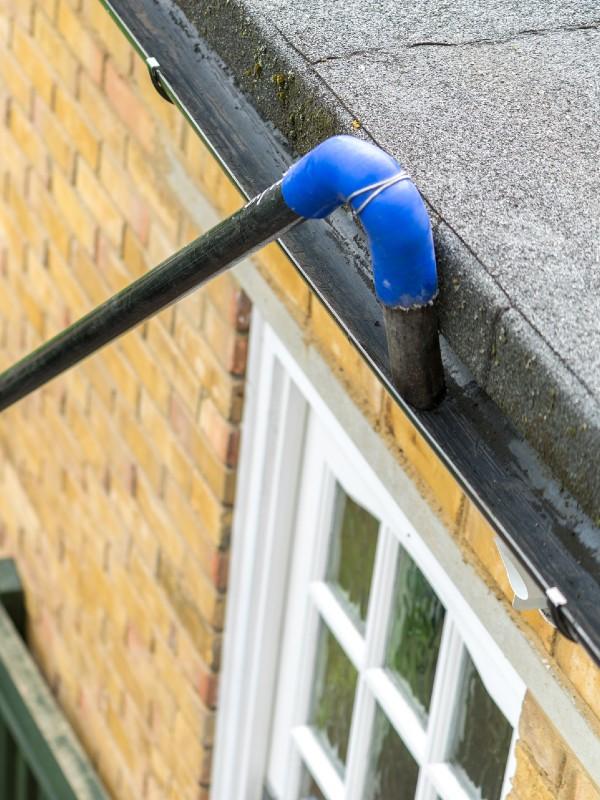
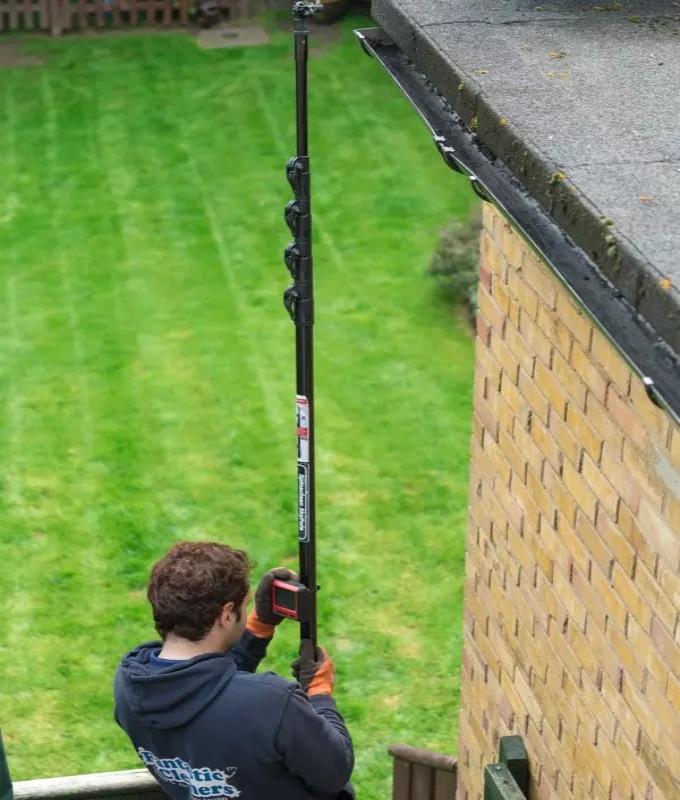
Estates built in the last twenty years fill their gutters just as reliably as Victorian streets do, which surprises owners who chose a new house partly because there were no trees anywhere near it. The material is simply different. On an open development at the edge of the town, what arrives is grass seed heads, dust off surrounding farmland, wind-blown litter and moss that establishes on a north-facing tile within a few winters. It arrives horizontally, it is fine, and it settles at the outlet rather than spreading evenly along the run.
Deep-flow profiles and the clips that hold them
Modern housing is fitted with deep-flow or square-line plastic sections carrying considerably more water than a traditional half-round, supported on clip-in brackets screwed to the fascia. The capacity is welcome; the clips are the weak point. They are moulded plastic, they become brittle with ultraviolet exposure, and they break when a gutter is leaned on or when a section is twisted to release a blockage. Clearing a deep-flow run properly means working along it from above without applying load to the front edge, and replacing any clip that has gone white and chalky.
The first years after handover
A newly built house frequently arrives with debris already in the roofline: mortar droppings from the ridge and verge, offcuts of membrane, plastic packaging, and a scatter of screws. None of it blows away. Mortar in particular sets into a hard lump at the outlet and is easily mistaken for a moulding. A clearance in the first couple of years is as much about construction residue as anything natural, and it is worth doing before a plot's warranty period runs on, so that genuine defects in fall or bracket spacing are found while they can still be raised. Construction residue inside the house is a different specification, described in Fantastic Services.
Dry verge, ridge vents and felt overhang
The details at the edge of a modern roof differ from an older one and they fail differently. Dry verge units clip over the end tiles and occasionally lift in wind, letting debris into the batten void. Ridge and eaves ventilation must stay clear or the roof space suffers condensation. Most importantly, the breather membrane should overhang into the gutter; where it has been cut short or has curled back, water backing up runs onto the fascia and then down inside the soffit, which reads as a leak in the wall rather than a full gutter.
Older brick housing nearer the centre
The railway-era terraces closer in are a different proposition: cast iron ogee gutters on brackets driven into brickwork, shared downpipes between neighbouring houses, and rear elevations reached through a narrow passage. Cast iron rewards being kept and repainted, but it is heavy and its bolted joints harden and leak. Clearing it is hand work and the inspection matters as much as the clearance, since a cracked section found in October is a cheaper problem than the same section discovered in February.
Open aspect, wind and picking a day
Very little shelters these estates, and work at height stops when the wind gets up. Autumn, after the surrounding fields have been cut and before the winter gales, is the productive window for a full clear, with a lighter look in spring if moss is heavy on a shaded slope. On an open plot the access is usually straightforward, which keeps the job short. The same exposure leaves field dust on the glazing, which is the job in our local team. The equivalent work on protected stone housing to the north takes considerably longer, as described under what the service covers.
What a visit covers and how it is costed
Clearance takes in every run, the outlets and the downpipes to the gully, with the waste bagged and taken away and photographs of each elevation provided afterwards. The quote is built from the perimeter of the roofline, the number of storeys and whether a tower is needed. A rental changeover often groups roofline work with the interior job in end of tenancy cleaning cover across Swindon, and the general service description is on Fantastic Services.