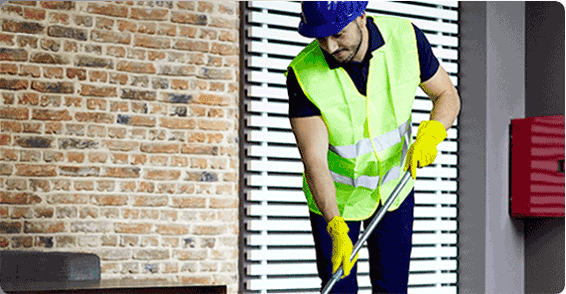
One clean is rarely enough after a substantial build, and the trade's habit of talking about a single visit does nobody any favours. Work in Swindon ranges from tight railway-era terraces near the centre to large estates on the edge of town, and in both the same pattern holds: a first clean to bring the site down to a state where snagging and final decoration can happen, then a second once those are done. Compressing the two into one is how finished rooms end up needing doing again.
The first pass: getting the bulk out
A rough clean is unglamorous and heavy. Loose debris is removed, floors are scraped where mortar has set, protective coverings come up, and high-level dust is taken off ceilings, coving and the tops of doors. It is not a finishing job and does not pretend to be. Its purpose is to let decorators and second-fix trades work on a surface that will take paint and sealant without contamination. Protective board lifted from a new floor usually leaves tape residue and a rim of trapped grit at every joint, and both come up at this stage rather than at the end.
The second pass: what finished actually means
The final clean is detail work: paint specks off ironmongery, sockets and switches wiped with their surrounds cleared, window reveals and sills done, glass polished, hard floors washed and dried, cupboard interiors and shelving cleaned, and the whole property checked in daylight from a low angle. It is slower per square metre than the first pass and it produces the result people actually judge a build by. The standard applied at this stage is set out on our after builders cleaning service.
Terraced houses with no rear access
In the older streets there is often no side passage, so everything in and out, dirty and clean, travels through the front door and along a narrow hall. That hall is therefore cleaned last and protected throughout. Front doors opening directly onto the pavement mean waste cannot be staged outside, so it is bagged and loaded straight into the van rather than accumulated where people walk. Coal cellars and under-stair cupboards in these houses are commonly used as a dump during a build and are emptied before anything else on the ground floor is touched.
New-build estates and the handover clean
On newer estates the work is often an extension or a garage conversion on a house only a few years old, where every finish is current and easily marked. Powder-coated frames, vinyl flooring and matt emulsion are all less forgiving than their older equivalents. Products are matched to the finish, and pads that would be fine on old gloss are kept away from modern paint entirely. Warranty conditions on some finishes specify what may be used on them, and that is read rather than guessed at.
Glass, render and the outside of the building
Where render or brickwork has been cut, the fines land on glazing and set hard. Internal faces are done in the final clean; external glass, especially above ground level, needs pole-fed water and is a job in its own right, covered by Swindon window cleaning specialists. Cleaning the outside before render has fully cured is avoided, since the surface is still fragile and a strong jet will mark it.
What separates the two visits in practice
The gap between the rough clean and the final clean is set by the programme rather than the calendar: it ends when the last person with a drill, a brush or a tube of sealant has left. Clients are asked to confirm that rather than assume it. Floors laid during the works stay protected until then. Carpet fitted early takes the worst of it and is restored by carpet cleaning cover across Swindon, and the same two-stage approach is used in the surrounding towns, including builders clean services in Devizes.