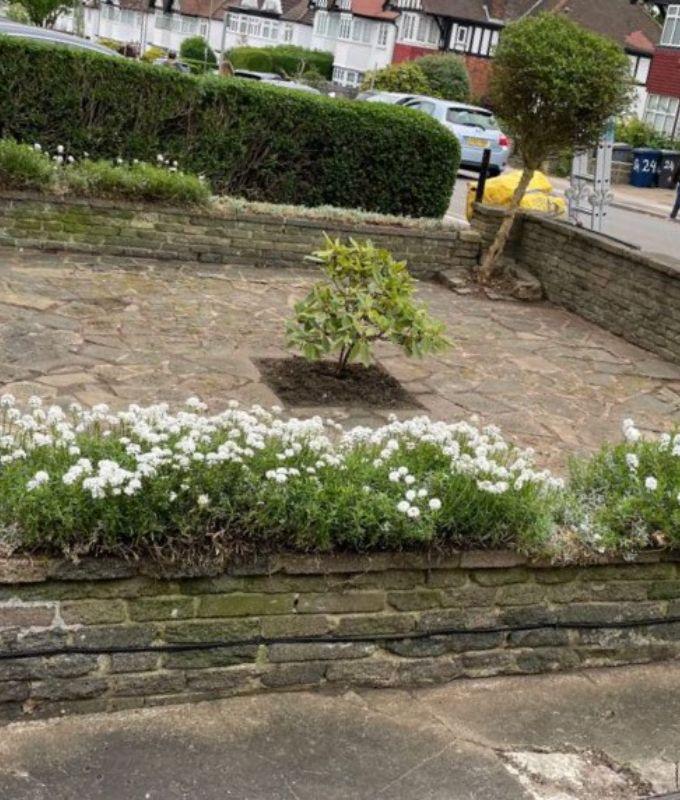
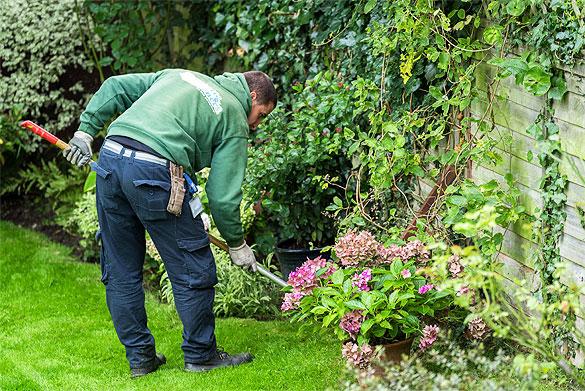
Front gardens across TW3 have been asked to take on a great deal. In a single strip a few metres deep there may be parking for a car, storage for three or four wheelie bins, somewhere to chain a bicycle, a meter cabinet and the path everybody in the house walks four times a day. Where a terraced house has been converted or is shared between several households, all of that is multiplied. Planting has to survive in what is left, which is usually a narrow margin along a boundary and whatever will grow at the base of a wall.
Designing around the bins, not despite them
Bins need a level standing within easy reach of the pavement, room for lids to open fully, and a surface that can be swept. Screening them with slatted panels and a climber trained on wires works far better than a hedge, which needs a metre of depth nobody has. What planting survives in a front garden is the tough, upright, fairly dry-tolerant sort: evergreen structure that does not mind being brushed past, low grasses, and bulbs that come up through gravel.
Surfaces that carry weight and still let water through
A frontage with a car on it needs a surface that stands up to turning wheels, and the two failures are equally common: a cheap hardstanding that sinks into ruts within two winters, and a fully sealed slab that sends every drop of rainwater into the street. Permeable block paving, gravel over a stable base with edge restraint, and a run of slabs with planted margins between them all avoid that. Oil staining and the grey film that builds on a hardstanding are restored separately, which comes under a local pro near you. Where more than about five square metres is being surfaced, a permeable construction or a route for water into a planted area within the property is what keeps the work within permitted development.
What the road does to the planting
A front garden on a busy road lives in a permanent film of traffic grime, and the effect on plants is real: leaves stay dusty and photosynthesise less, evergreens look grey by February, and winter salt thrown up from the carriageway burns anything soft near the kerb. Glossy-leaved evergreens shrug it off best, and salt-scorched growth is cut back rather than fed.
The hedge on the boundary line
Where a front hedge survives, it earns its keep: it filters dust, muffles the road and hides the bins. It also has to be kept back from the pavement, because growth overhanging a public footway is the householder's responsibility, and back from the corner of a drive so that the view along the pavement stays clear when a car pulls out. Cutting twice a year, once in late spring after nesting has been checked and once at the end of summer, keeps a dense face without hard cutting. Rear gardens in the neighbouring district carry more of the planting and are covered by our specialists in the area.
Frontages that have become a store
Front gardens in shared and rented houses collect things: a broken mattress left by a departing tenant, old bikes, bags of household waste that missed a collection, sometimes building spoil. None of it can go out with the weekly bins, and leaving it invites more. Clearing it in one visit, with a licensed carrier taking the load such as man and van across Twickenham, resets the frontage far more effectively than a gradual effort. Once it is clear, a defined bin standing and a swept path tend to keep it that way.
Food waste at the front of the house
Bins at the front, close to the party wall and often on a gravel bed, are a reliable draw for rodents, and in a terrace the boundary is no barrier at all. Keeping the standing swept, food waste caddies closed, and vegetation cut clear of the base of the wall removes the cover and the spill, but where there are burrows in the gravel or runs along the wall line, treatment is work for pest control throughout Hounslow.
What a frontage visit involves
Front garden work is usually short and frequent, priced by the time on site: hedge face kept back, path edges cut, weeds out of the joints, bin area swept, planting fed and cut back in season. Parking is the one practical complication, since a permit street with a full kerb makes unloading slow, so a space on the drive or advance warning of restrictions genuinely shortens the visit. How this fits alongside the rest of the year's work at the back of the house is set out in more about this service.