Nothing has changed EN1 interiors more in the past decade than the side-return extension. A narrow strip of outside space beside a bay-fronted Edwardian terrace becomes part of a widened kitchen, and the new roof almost always carries a lantern or a run of rooflights. The build is short compared with a full renovation, yet it leaves a very particular set of problems behind: a new aluminium threshold packed with grit, glass that has never once been cleaned since it was glazed, and old rooms coated in fines that came through a doorway nobody bothered to seal.
Thresholds, tracks and sliding gear
The low track beneath bifold or sliding doors is the most neglected detail on a finished extension. Mortar crumb, brick dust and discarded packers end up in the channel, and the first time the doors run, the rollers grind all of it into the track. Solids come out by hand and with a narrow nozzle before any water goes near, then the channel is dried so its drainage slots stay open. Left as found, expensive gear wears out years early.
Lanterns are cleaned from above and below
Roof glazing shows everything. Emulsion mist, mortar splash and haze from cutting all land on the upper face, and because the pane sits at a shallow pitch nothing ever runs off it. The underside collects skim dust and the fitters' finger marks. Both faces are done before a tower or scaffold is struck, because afterwards the outer face becomes a separate job with its own access kit. New-build plots in after builders cleaning prices in Hatfield present the reverse problem: acres of factory glazing still wearing protective film and rating labels.
The rooms nobody was working in
Dust travels the length of a terrace because the layout funnels it - long hallway, straight staircase, a stairwell acting as a flue. Bedrooms two floors above a kitchen build end up with a film on picture frames and inside wardrobes left ajar. A survey that stops at the new room misses most of the job, so the walk-round takes in the whole house and scope is written from what is genuinely dirty rather than from which rooms had trades in them.
Grit in the hall runner and on the stairs
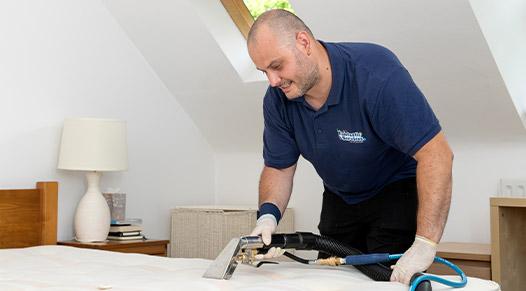
Hall and stair carpet takes the worst of any building job, since every trip to the skip crosses it. Boots carry sand and brick grit down into the fibre where it cuts the pile from inside, and vacuuming after the event only retrieves the loose fraction. Deep extraction is the honest answer, and on a winder staircase it means a hand tool and a great deal of patience. That work is covered by carpet cleaning for landlords in Enfield.
Snags a cleaning crew finds but will not touch
Teams notice things: a door catching on a new floor, a loose handle, a radiator bracket never screwed back, sealant missing at the end of a worktop. None of it belongs to a clean, and a sensible crew reports it rather than attempting a repair. Adjustments of that sort fall to handyman prices in Enfield, and having them done before furniture returns saves handling everything twice.
Putting the kitchen back into the house
Families who lived through a side-return build usually have half their contents stacked in a bedroom or a garage. Carrying appliances, crockery and furniture back through a finished hallway is where a lot of late damage happens, so it belongs after the clean, with protection laid down. Where there is more to shift than a car will hold, a van with a crew handles it under experienced small moves in Cockfosters.
What the visit covers and what to have ready
A post-works clean here is usually specified room by room: the extension itself, the rooms that connect to it, glazing inside, and the stairs. Rates follow hours and the size of the team rather than a fixed figure per room, so it helps to say plainly how long the trades were in and whether the place has been lived in throughout. Scaffold should be down, waste collected and the floor protection lifted. Broader inclusions are described on nationwide after builders cleaning services.