Building dust settles, is disturbed, and settles again. That single behaviour is why a property that has just had a kitchen replaced or a bathroom refitted cannot be brought up to a letting standard in one pass, and why the visit that follows a refurbishment is a different job from the visit that follows a tenancy. A great deal of the rental stock in GU11 is Victorian terraced and post-war housing being upgraded between lets, so the two jobs meet constantly.
Why construction dust behaves differently
Plaster, render and cut masonry produce particles far finer than household dust, light enough to stay airborne for hours and alkaline enough to leave a bloom on glass and chrome. Sweeping or dry-dusting simply returns it to the air, where it drifts into the next room and lands on surfaces already finished. It also gets into places ordinary dust does not: the tops of door frames, the inside of light fittings, the fins of radiators, window tracks, the coils behind a fridge.
The order that actually removes it
Extraction comes before wiping. A vacuum with sealed filtration removes the material rather than redistributing it, worked from the highest surfaces downwards, with the floor done last and then done again. Damp work follows only once the bulk has gone, because a wet cloth on a plaster film makes a grey slurry that dries as a streak. And the property is left, aired and revisited, because whatever remained airborne will have landed overnight. Anyone who promises a single pass has not worked in a building that has just had walls cut into.
Paint, sealant and adhesive on finished surfaces
Refurbishment leaves specks of emulsion on glass, silicone smears on tile, adhesive residue where protective film has been peeled off a new appliance, and pencil marks on skirting. Each wants a different approach: a blade at the right angle on glass, a solvent that will not craze plastic on an appliance fascia, and patience rather than abrasive on a painted surface. Getting this wrong scratches something new, which is worse than leaving it.
Where the two jobs divide
A post-works clean and a tenancy clean overlap but are not interchangeable. The first is about removing the residue of the trades; the second is about returning a lived-in property to its inventory condition, which means inside cupboards, behind white goods, in extractor filters and under beds. Where a refit has just finished, running the works clean first, as described on our nearby specialists, and the letting clean afterwards is the sequence that produces a property ready to photograph.
Appliances, new and otherwise
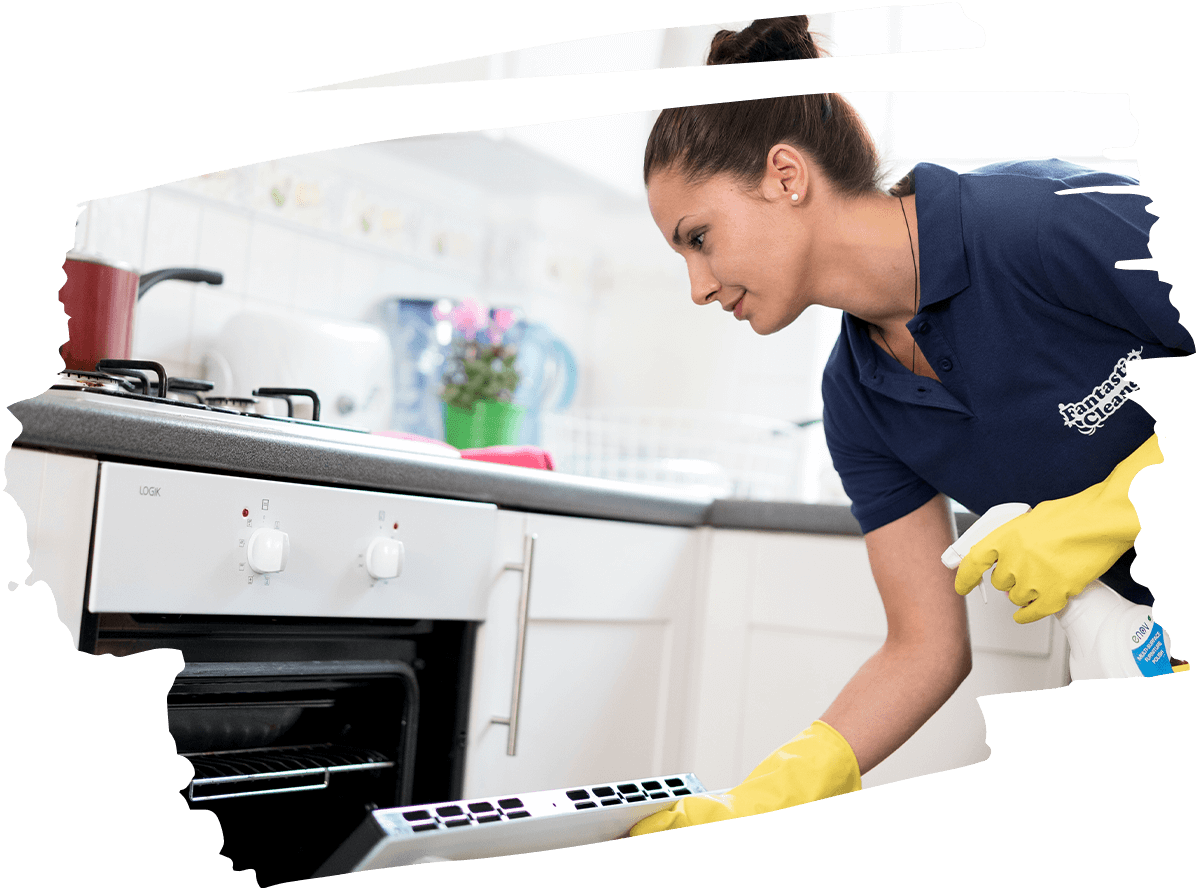
A newly installed oven arrives with protective film, transit packaging inside the cavity and a manufacturing residue that smokes on first use. An oven that has survived several tenancies has carbonised deposit that no general clean will touch. Both are handled as a separate item with their own products and contact time, which is what experienced deep oven cleaning in Aldershot covers.
Floors after works
Carpets that have been walked over by trades hold a fine mineral dust deep in the pile, and it is abrasive. Vacuuming lifts the surface but extraction is what takes it out, and it is done after every other surface in the property has been finished and the airborne load has dropped. That work is scoped and priced separately, as set out under carpet cleaning throughout Ash.
Arranging the visit and what it covers
Pricing follows the size of the property, the number of bathrooms and the extent of the works, since a full refit and a single bathroom are not comparable. Trades should be finished and their materials removed, power and water live, and protective sheeting left in place until the crew arrives so nothing is disturbed prematurely. Comparable work in the towns to the south is described on end of tenancy cleaning across Bordon, and the standard applied across the service is set out on our end of tenancy cleaning service.