Two spits down in the garden of a recently finished house, the spade usually stops. What it has hit is the reason the lawn is patchy, the reason the new shrubs sulked through their first summer, and the reason water stands in one corner after rain. Beneath the thin skim of topsoil spread over a WD5 new-build plot there is generally a compacted subsoil pan, a scatter of mortar droppings, brick ends, offcuts of pipe and the odd bag of hardened cement. Nothing planted into that is going to prosper, and no amount of feeding on the surface will change it.
What is actually under a new garden
During construction the plot is a working site, driven over by heavy plant in all weathers, which compresses the ground to a depth of a foot or more. At handover a layer of imported topsoil is spread over it, often only a few inches deep and sometimes of poor quality, and turf is laid on that. The join between the two layers is abrupt, so roots grow sideways along it and water sits on it. Waste from the build is frequently left in place rather than removed, particularly around the edges of the plot and where the site compound stood.
Diagnosis before any planting
Three test holes, at the worst patch, the best patch and somewhere neutral, tell the story in an hour. Topsoil depth is measured, the interface is examined for a hard grey band, and anything buried is noted. A hole filled with water and timed as it empties shows whether the ground drains at all. Working out the extent of the problem before spending money on plants is the step that gets skipped, and it is why the second planting on these gardens often fails in the same places as the first.
Breaking the pan
Decompaction is the part that cannot be shortcut. The compacted layer is broken mechanically or by hand across the whole affected area, not just in planting positions, because relieving one hole in dense ground creates a sump that fills with water and drowns the plant in it. Work is done when the soil is moist but not wet, since digging saturated ground simply remoulds the pan lower down. Buried rubble comes out as it is found, and the volume from a plot of this kind regularly exceeds what a household collection will take, so a separate disposal route is arranged before the work starts.
Building soil rather than importing it
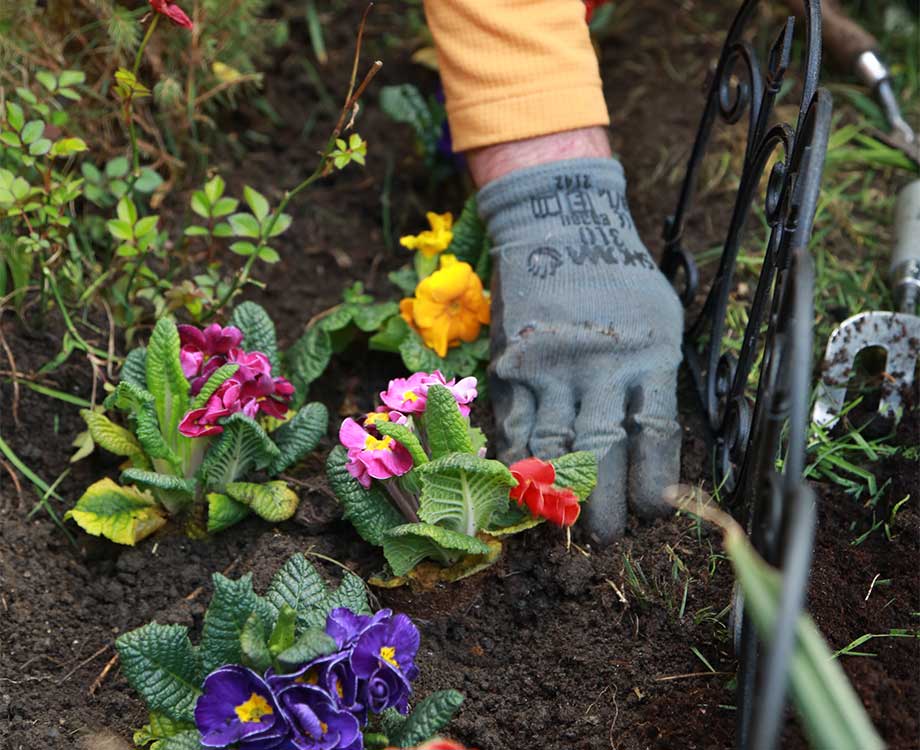
The instinct is to buy in more topsoil. Usually the better answer is to improve what is there, because another layer over an unbroken pan repeats the original mistake and raises levels against the damp course. Generous quantities of well-rotted organic matter incorporated into the broken ground, plus a surface mulch afterwards, gets structure and biology working. It takes two seasons to show properly, which is a difficult thing to be told and an honest thing to say.
Beds, planting depth and the first year
Beds are prepared as whole areas rather than as individual holes, edges are cut deep enough to keep grass roots out, and planting is done at the depth the plant was grown, with the root ball teased out of its pot shape so roots leave the compost rather than circling in it. Watering through the first full growing season is not optional on ground like this, even in a wet summer, because a new root system in disturbed soil is entirely dependent on it.
Turf laid on the wrong base
A new lawn that went down on unprepared ground will never be much good, and the choice is between managing the symptoms with frequent aeration and accepting that it needs lifting and relaying once the base has been sorted out. Where the surface is merely uneven it can be top dressed level over a couple of seasons. Where it is thin turf over rubble, the honest answer is to start again.
Getting the first season right
Ground preparation of this sort is quoted by the area treated and the disposal volume rather than by planting numbers, and it is best programmed for autumn so the winter does some of the settling. Where building work has only just finished, the interior usually needs after builders cleaning across Abbots Langley before anyone moves furniture in, and general household cleaning afterwards is handled by the cleaning services team in Abbots Langley. New paving and paths left with mortar residue are dealt with by fully insured pressure washing in Watford once the ground work is done. Established gardens further down the valley are covered by same-day gardening in Borehamwood, and the framework for ongoing visits is set out on what our garden maintenance includes.