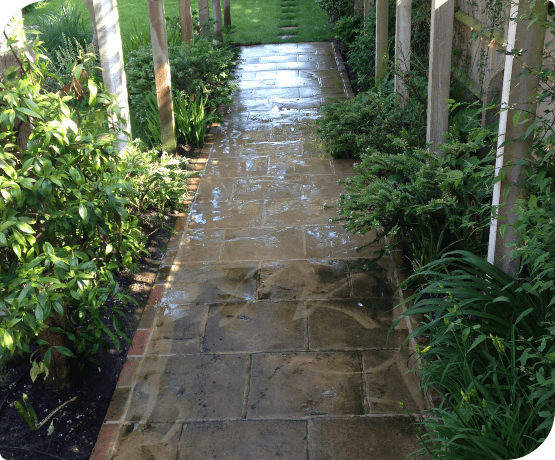
Watford's housing runs from Victorian terraces near the centre through large inter-war estates to newer developments on the edges, and almost all of it has some hard surface at the front: a block-paved driveway, a concrete or flagstone path, a patio at the back. On Hertfordshire's heavy soils, and under the tree cover that runs through much of WD17, those surfaces go green within a couple of years. By the third or fourth autumn a shaded path is genuinely slippery.
What is actually growing there
The black staining on paving is not dirt. It is a combination of algae, lichen and biofilm rooted into the surface pores, plus in some cases tar-spot residue from overhanging trees. That matters because a rinse removes the loose material and leaves the organism behind, which is why a surface cleaned with a domestic pressure washer looks good for one season and then returns quickly. A professional clean combines mechanical removal with a biocidal treatment that kills the growth at root level, which is what extends the interval between cleans.
Matching the method to the surface
Pressure alone will destroy some materials. Block paving loses its jointing sand and starts to move; old York stone and soft brick erode; concrete imprinted surfaces lose their sealant and colour; timber decking splinters. Technicians use a rotary flat surface cleaner for large paved areas, which applies even pressure and avoids the striping a lance leaves, and drop to lower pressure with chemical dwell time on softer or older materials. On block paving, re-sanding the joints afterwards is part of doing the job properly — leaving them open invites weeds straight back and lets the blocks shift.
Drainage and where the water goes
A driveway clean produces a lot of dirty water, and in a terraced street it has to be controlled rather than allowed to run into a neighbour's property or straight into a surface water drain carrying silt and biocide. Technicians manage run-off and clear the immediate gullies afterwards. If a drive has standing water after rain, cleaning it will not fix that — it is a falls or drainage problem and needs addressing separately.
Timing it with the rest of the outside
Pressure washing throws debris and spray onto everything nearby, so the sensible order is to cut the garden back first, then wash the hard surfaces, then clean the windows. Booking the garden work first through Watford gardening specialists means the borders are not full of blasted grit afterwards. Where a patio clean is part of a wider spring reset, households often add cleaning services throughout Watford for the interior at the same time.
Around Watford
The same teams cover the WD and AL postcodes, so path and paving cleaning in St Albans runs on the same basis. In properties coming out of building work, there is usually a heavier one-off job indoors as well as out — our nearby specialists handles the interior side of a post-project clean nearby.
Frequency, price and booking
Most Watford driveways and patios need doing every two to three years, sooner on a heavily shaded north-facing surface and longer if a sealant has been applied. Pricing is by area and surface type rather than by the hour, so you know the figure before the technician arrives, and an access requirement — an outside tap and a power point, or the technician bringing their own water — is confirmed at booking. Methods, surfaces covered and current rates are on pressure washing for homes and businesses.
Technicians arrive insured and with commercial equipment rather than a domestic washer, and live availability for Watford is visible online.
What to expect on the day
Move cars off the drive and pots and furniture off the patio beforehand, and close windows on the elevation being worked on. A typical driveway takes two to four hours depending on area and how heavily soiled it is; a patio is usually quicker. Surfaces stay wet for a few hours afterwards and look darker until they dry out fully, so judge the result the next day rather than the same afternoon. Where jointing sand is replaced on block paving, it needs a dry spell to settle.
If you want the surface sealed afterwards, it has to be fully dry first, which means a second visit rather than the same day. Sealing is worth considering on block paving and imprinted concrete and rarely worth it on natural stone.