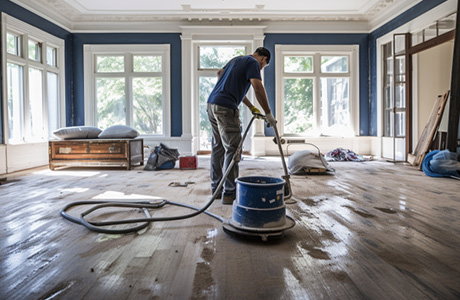
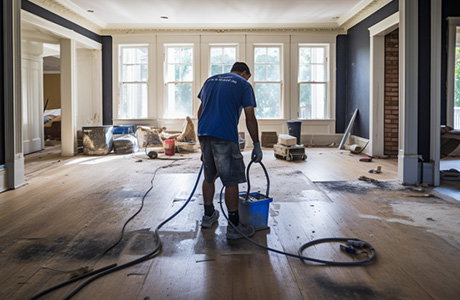
Clay is the material that defines building work across HP20. The Vale's heavy soils hold water, move with the seasons and turn to a thick, sticky paste on a site in winter, and that paste comes indoors on every boot and every wheelbarrow tyre. Combine it with the wet trades that go into a modern ground floor - screed, self-levelling compound, adhesive, grout - and the residue on a newly finished floor is not dust at all. It is a mixture of mineral slurry and clay that sets hard and does not respond to a mop.
Laitance, screed film and why mopping fails
A sand-and-cement screed or a levelling compound leaves a weak, powdery skin on the surface as it cures. Wetting it turns that skin into a slurry which is then spread evenly across the whole floor and left to dry as a haze. The correct approach is mechanical: dry removal first, then a rotary machine with an appropriate pad and a controlled amount of water, lifting the suspension with a wet vacuum rather than letting it dry in place. Anything else is redecoration of the problem.
Adhesive, grout and the joints in between
Tile adhesive squeezed up between tiles sets proud and cannot be cut back once fully cured without marking the glaze. Grout haze is easier but has a window. Both are handled with a plastic blade and a pad matched to the tile, working a small area at a time and rinsing constantly, because a rinse bucket carrying grout simply redeposits it in the joints that were just cleared.
Clay underfoot and the route through the house
Clay is greasy rather than abrasive, and it films a hard floor instead of scratching it. On a carpet it works into the backing and dries to a pale crust. The practical defence during works is matting at the threshold and a defined route with board protection; afterwards the route needs treating as its own job, because the concentration of soil there is many times that of any room.
Seasonal ground and external reinstatement
Ground that has carried a mixer, a stack of blocks or a dumper through a wet season will be compacted and smeared, and cement washings will have run into whatever fell away from it. Paths and patios take a low-pressure wash rather than a lance held close, since a strong jet on jointing sand simply excavates it. Lawn edges churned by wheelbarrow traffic are cleared of debris but left for a gardener, not scraped.
Floor coverings that took the worst of the winter
Where carpet stayed down through the works, the fibre holds both clay and fine construction dust, a combination that resists vacuuming completely. Hot-water extraction with a pre-spray suited to mineral soil removes it; brushing and hoping does not. That service is arranged as professional carpet cleaning services in Hemel Hempstead.
The kitchen at the end of a wet job
Where a new floor has gone into a kitchen, the appliances have usually been pulled out and pushed back, and the debris behind and beneath them has been there throughout. Oven cavities and extractor filters take airborne grit on top of existing grease, and the mixture hardens at the next use. That interior work is booked as our nearby specialists because it needs soaking time rather than a wipe.
Planning the visit around drying times
Screeds and compounds need their curing period, and cleaning a floor before it is ready both damages the finish and wastes the visit, so the date follows the floor rather than the diary. Scope covers the rooms that had wet trades in them, the access route and any external hardstanding. Charging is based on crew size and hours, which matters here because mechanical floor work is slow. Neighbouring coverage sits with same-day after builders cleaning services in Hemel Hempstead, and the wider outline is on experienced builders clean.