Underfloor heating changes the arithmetic of cleaning a carpet, and a lot of the newer housing in GU51 has it. A warm floor dries a treated carpet faster, which sounds like an advantage and is, up to a point. Past that point it dries the carpet unevenly and from the wrong side, drawing moisture and dissolved soil downward into the backing and then back up again as the system cycles. Getting good results over a heated floor is mostly about controlling the heating rather than the machine.
Running the system around the work
The practical approach is to bring the floor temperature down before the visit and leave it moderate afterwards rather than switching it off entirely or turning it up to speed drying. A cold slab causes condensation under the carpet; a hot one bakes the surface dry while the underlay stays wet and drives wicking. Steady, modest warmth with air moving across the surface is what dries a floor evenly. Systems on a timer need to be overridden for the day, which is easily forgotten and awkward to correct afterwards.
Ripples that appear after a clean
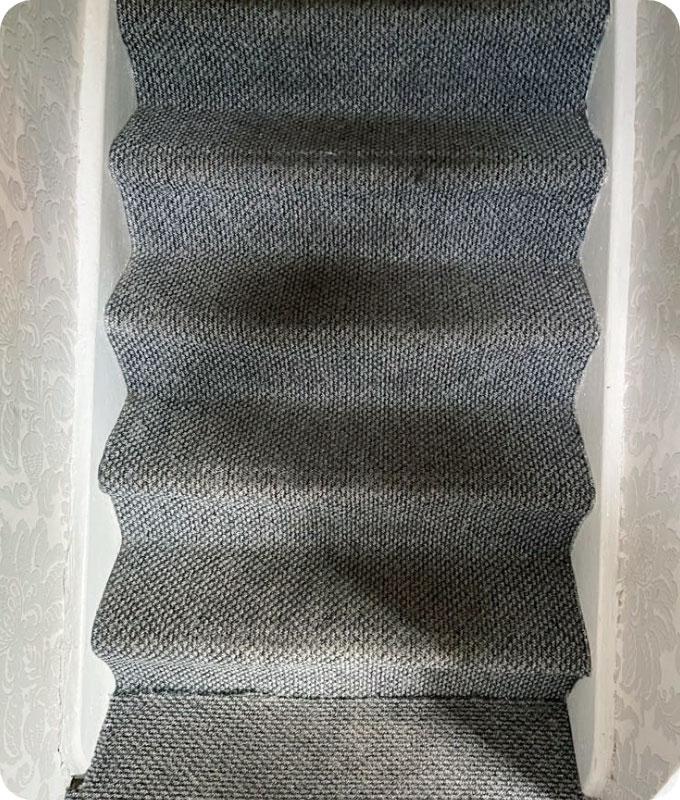
A carpet that develops waves days after cleaning has usually been badly stretched from the outset. Fitting without a power stretcher leaves the carpet slightly slack, and any moisture and warmth cycle afterwards will show it up. The cleaning did not cause the fault; it revealed it. The remedy is re-stretching by a fitter, not further cleaning, and it is worth knowing that before the two things get confused. Old carpet whose latex has already hardened may not tolerate re-stretching at all.
Tog values and what belongs over a heated floor
A heated floor has to get its warmth through whatever is laid on it, and the combined thermal resistance of carpet and underlay is the limiting factor. Dense, low-pile constructions and thin, high-density underlay let heat through; thick felt and deep pile do not, and the result is an expensive system that never warms the room. Where a floor covering is being replaced, it is worth checking the specification rather than assuming. How different constructions behave is set out under our national carpet and rug cleaning service.
When carpet is only part of the problem
Modern houses are airtight, and a floor that smells is often reflecting the condition of the whole dwelling rather than the carpet alone: kitchen grease, bathroom humidity and poor ventilation together. Cleaning the pile addresses one contributor. Where the household wants the whole property reset at once, that is normally handled as deep cleaning cover across Fleet, with soft flooring done as part of the sequence.
Handing back a modern house
Newer properties are inspected closely at the end of a tenancy because the benchmark is recent and the wear is easy to see against it. Floors are cleaned once the property is empty, dried fully with the heating running gently, and photographed dry. That stage normally sits directly behind what the service covers in the handover sequence.
Older housing a short drive away
Suspended timber floors and cold voids a few miles away change the drying strategy completely, since there is no warmth from below and a good deal of air movement, which is why the method used for Sandhurst carpet cleaning specialists differs even though the carpets are often identical.
Preparing for the visit
Turn the heating down the evening before rather than on the morning of the visit, since a slab holds warmth for hours. Say at booking whether the ground floor is heated, because it affects both timing and method. Cost is calculated from measured area, fibre and condition, with stairs by the flight. Clear the floor, allow access to sockets, and plan on the system being brought back up gradually once the pile is dry at the base. Wider household work can be added through cleaning services for period property in Yateley.