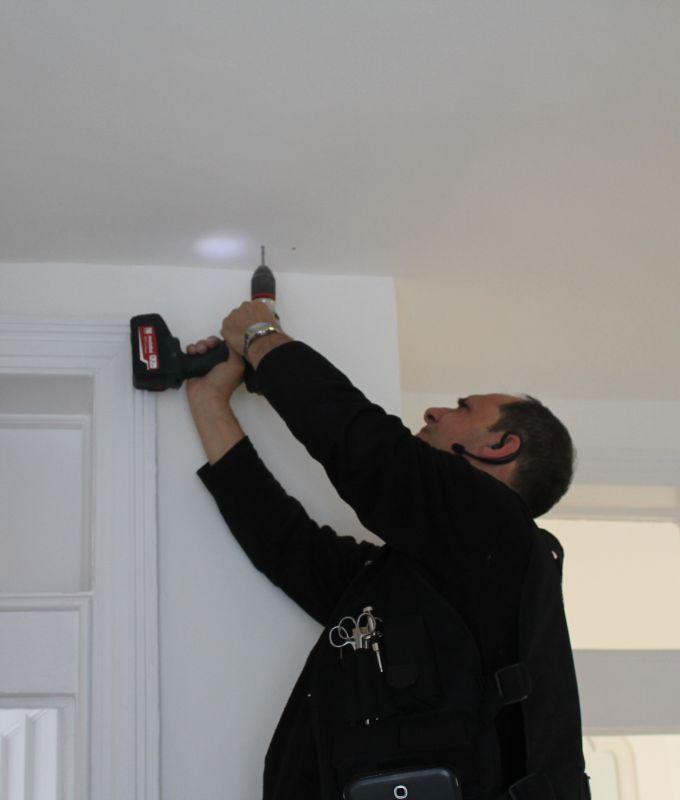
Half the failures in fixing something to a wall are decided before the drill is switched on, because nobody established what the wall was made of. The housing in BR1 covers everything from solid Victorian brick to 1930s cavity construction, post-war blockwork and flats above the shops with stud partitions and dot-and-dab linings, and each of those takes a different fixing. A knuckle and a bradawl answer the question in about fifteen seconds. Skipping that step is how a bookcase ends up on the floor with two plugs still in its brackets.
Telling one wall from another
A solid masonry wall sounds dead and drills with steady resistance. A stud partition sounds hollow between regular vertical lines about four hundred millimetres apart. Dot and dab is the awkward one: plasterboard bonded to blockwork with adhesive dabs, so the drill goes through board, then a cavity of ten to thirty millimetres, then block. A standard plug set in that cavity crushes the board when it is tightened. The answer is a longer screw and plug reaching the block behind, or a fixing designed for the cavity, rather than more torque.
Flat-pack that stays square
Most self-assembly furniture fails at the back panel. A wardrobe or unit built out of square will have its thin backing board nailed on to hold the error permanently, after which the doors never line up. Building on a level surface, checking diagonals before the back goes on, and tightening cam locks in sequence takes a few extra minutes and fixes it for good. Tall items need securing to the wall regardless of how stable they feel, and in a home with young children that is not optional.
Screens, brackets and where the load goes
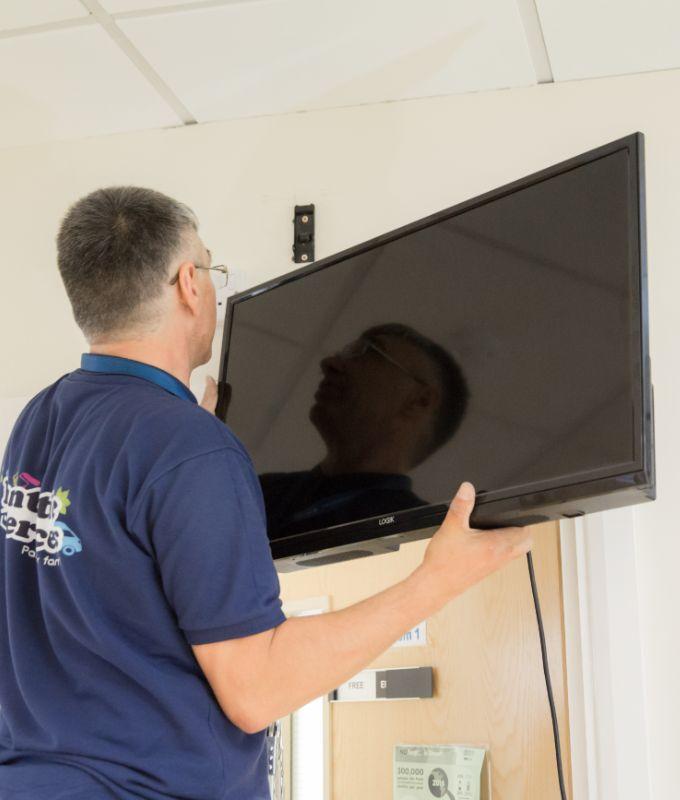
A wall-mounted television is a cantilever, and a full-motion arm can multiply the pull-out force on the top fixings several times over. On masonry the bracket is straightforward; on a stud wall it must catch two studs, which sometimes means a plywood spreader behind the plasterboard or a repositioned bracket rather than the exact spot requested. Cable routing through the wall crosses into other trades, since anything that adds a socket or alters a circuit falls under Part P and belongs with experienced socket and light fitting in Bromley.
Bays, lintels and long curtain poles
Bay windows in the local semis and Edwardian terraces have a lintel above them that may be timber, concrete or steel, and each drills differently. A pole spanning a wide bay needs a centre bracket regardless of what the packaging claims, and interlined curtains weigh far more than most people estimate. Where the reveal is shallow, fixing into the face above the window rather than the reveal itself gives more meat to work with and avoids the risk of hitting the lintel bearing.
Flats over the high street
The maisonettes above the shopping streets present their own logistics: a narrow staircase from a side door, no lift, restrictions on noise outside agreed hours, and sometimes a lease clause about drilling into party walls. Board and timber has to be cut to a length that turns the stair. None of that stops the work, but it decides what can be brought in whole and what is made up on site, and it is worth agreeing before materials are ordered. Where a flat has just been refurbished, the residue left behind is the separate specification in flexible after builders cleaning services in Bromley. Work of a similar character in the district to the north is described under Hayes shelf and curtain fitting.
Planning a visit
Charging is by time, in half-day or full-day blocks, so a list of small jobs done together costs less per item than calling someone out for each. Having the items, the brackets and the fixings on site matters, although fixings supplied in a flat-pack box are usually the first thing to be replaced with something appropriate to the wall. Anything touching water supply or waste sits with emergency plumbing in Chislehurst, and the wider scope of what this trade covers is on local TV wall mounting.