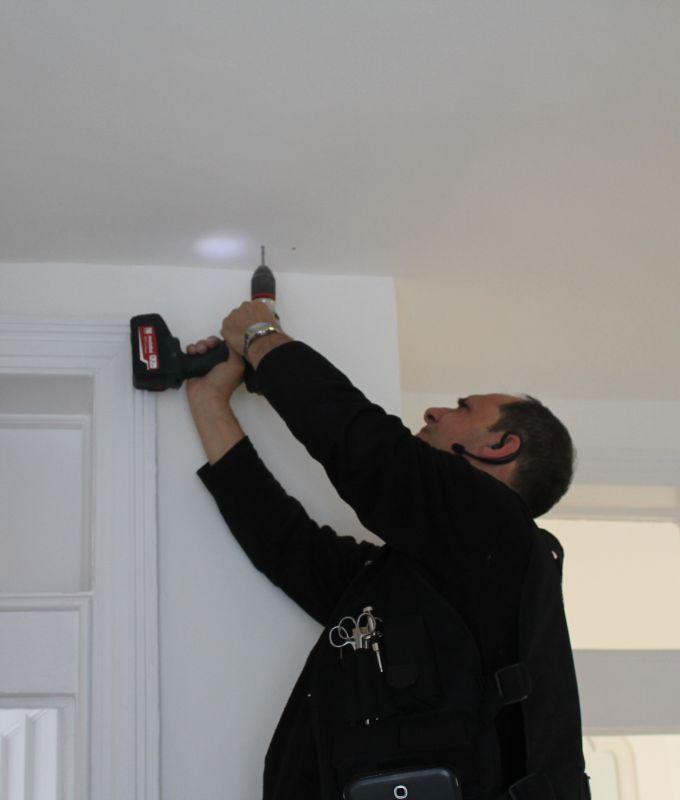
Few cities rearrange their rented housing as abruptly as Oxford does. A large share of the stock inside OX1 is let room by room rather than as a whole house, the tenancy year turns over inside a short window, and many of those properties sit under licensing conditions that never apply to an ordinary family home. Maintenance in this postcode is scheduled against inspections and deadlines at least as much as against wear.
Licensing changes what counts as finished
Where a property is licensed as a house in multiple occupation, the council attaches conditions covering escape routes, detection and the number and condition of shared amenities. A repair that would pass unremarked in a private home can fail here on a measurable point: a gap outside tolerance, a component missing from an assembly, an amenity that no longer serves the number of occupiers recorded on the licence. A technician working on a licensed house is checking against a written specification rather than simply making something function again. Photographs of each completed item are worth keeping, since an inspection may follow many months later.
High occupancy breaks things in a pattern
Six or seven adults sharing one kitchen and two bathrooms produce a wear profile that repeats across the city. Handles work loose because a door is opened twenty times more often than in a family house. Catches give up. Table and chair joints open. Shower enclosures sag out of square, waste outlets clog, and the floor covering in front of the sink wears through long before anywhere else. Anticipating that list rather than reacting to it is what keeps a property in condition, because the same eight or nine items recur year after year and replacing them during the vacant weeks is far cheaper than a call-out in mid-term. Keeping an occupied house presentable through term is a different rhythm altogether and falls under Oxford professional cleaners.
Working inside old fabric
Much of the central stock is built of limestone rubble or soft brick, finished internally in lime plaster, and altered repeatedly over two centuries. Fixings behave unpredictably as a result: an anchor that bites hard in one wall spins uselessly in the next, and driving a screw aggressively into friable stone can dislodge a patch of finish on the far side. The method is to drill slowly with the hammer action switched off, clear the dust from the hole properly, and choose an anchor that spreads load rather than one relying on friction. Where a wall proves genuinely unreliable, the fitting is better carried on a timber ground spanning to something solid.
The changeover fortnight
Everything concentrates into a few weeks in late summer, and order matters more than speed. Strip out first, then repairs that generate dust or spray, then anything wet that needs to cure, and cleaning last. Running that sequence backwards is the commonest and most expensive mistake. Where a house has had contractors in for a conversion or a bathroom replacement, fine dust settles into every horizontal surface and inside cupboards, and shifting it is a separate discipline covered by the local team rather than something a final tidy absorbs.
Streets, permits and getting materials indoors
Central Oxford is a difficult place to unload. Controlled parking covers most residential streets, several routes carry restrictions at certain hours, and a number of terraces have no rear access at all, so a replacement door or a long length of timber comes through the front door and up a staircase with winders. Planning the delivery is part of planning the job, and any visit involving something long, heavy or awkward is better timed for a quiet part of the day. Very little of this constrains the work covered by Hook handyman service, where driveways and off-street loading are the norm.
Getting the most out of one visit
A written list ordered by genuine priority is more useful than a walk-round commentary. Safety items come first, then anything that worsens if left, then cosmetic work. Access to every room needs arranging in advance, including any a departing tenant has locked, along with the whereabouts of the stopcock and the consumer unit. Where a specific finish or a matching handle is wanted, supplying the part avoids a second trip. The full spread of tasks a technician is equipped for is set out on the handyman service.