Reading has a large stock of Victorian terraces through the central RG1 streets and substantial mature tree cover across the suburbs, which is close to a worst case for guttering. Narrow original half-round gutters fill with leaf litter from autumn onwards, moss washes down off older clay and slate roofs into the run, and the downpipes on a terrace often discharge into a shared gully that nobody has looked at in years.
What a blocked gutter actually costs you
An overflowing gutter is not a cosmetic problem. Water running down an external wall for a winter saturates the brickwork, and on a solid nine-inch wall that moisture comes through to the inside as penetrating damp — usually showing up as a patch on an upstairs bedroom wall or staining at the top of a chimney breast. Overflow also rots fascias and soffits, undermines pointing, and in the worst cases saturates ground next to the footings. Clearing a gutter is one of the cheapest pieces of preventative maintenance on a house and one of the most commonly skipped.
How the clearance is done
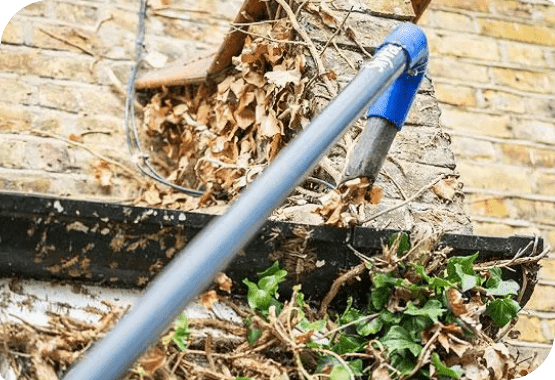
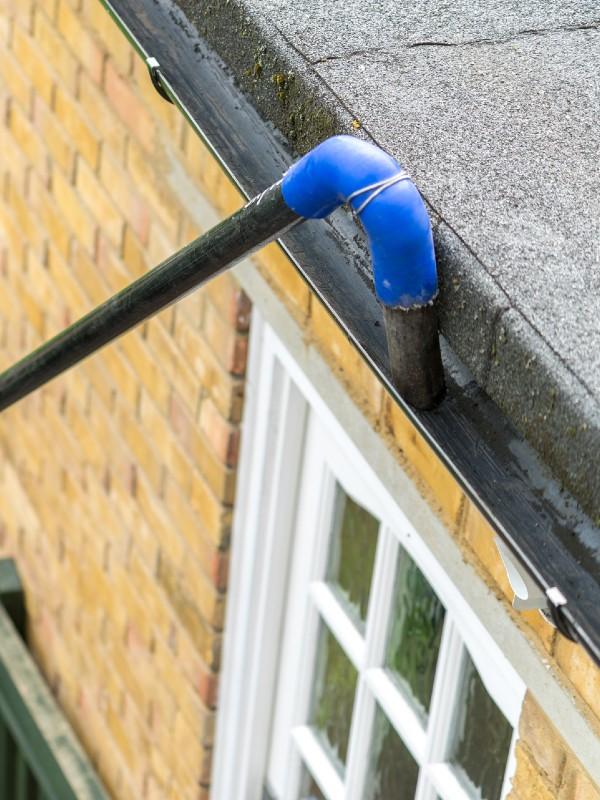
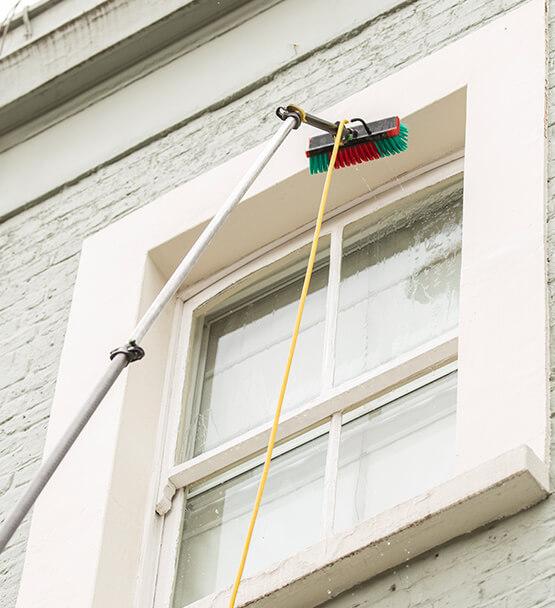
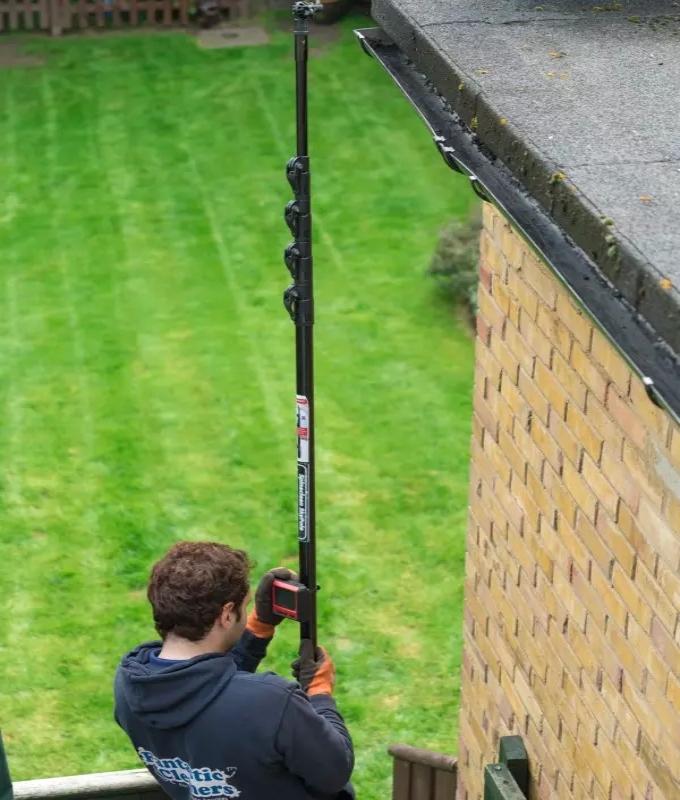
Most residential work is done from the ground using a high-reach vacuum system with a camera on the pole, which lets the operative see and record the state of each section without a ladder against the wall. Debris is drawn out rather than pushed along the run into the downpipe, which is the flaw in clearing a gutter by hand. Downpipes are flushed and checked for flow, gullies at the base are cleared, and you get before-and-after imagery of the sections worked on. Where a roof detail cannot be reached from the ground, ladder or access equipment is used with the appropriate safety arrangements.
What gets spotted at the same time
Because the camera is looking along the whole run, a clearance often turns up problems worth knowing about early: slipped tiles, cracked or sagging gutter sections, loose brackets, perished joint seals, missing mortar at the verge, and vegetation growing out of the gutter itself. None of that is discovered from the ground otherwise.
The rest of the outside
Gutter debris comes down onto paths, patios and drives, so the logical order is gutters first and hard surfaces afterwards — the team covering Reading for the paving and driveway once the roofline is clear. Frames and glass take the worst of the splashing from an overflowing gutter, and the service in full finishes the job properly once the run is flowing again.
Frequency and coverage
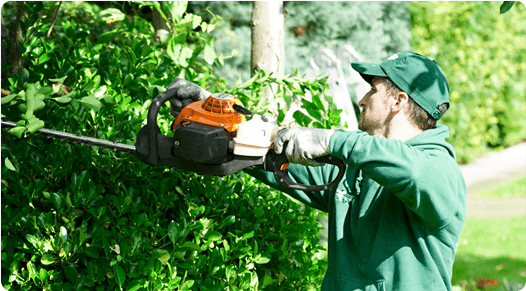
Once a year in late autumn suits most Reading properties. Twice a year — late autumn and late spring — is realistic under mature deciduous trees or where a roof is shedding moss. The same teams cover a wide area across Berkshire, Oxfordshire and Wiltshire: gutter cleaning services across Swindon runs on the same basis further west. Where overhanging branches are the actual source of the problem, cutting them back is the permanent fix rather than clearing more often — hedge trimming in Woodley handles the tree and garden side nearby.
Booking
Pricing is by property size and the number of storeys rather than by the hour, confirmed before the visit. Operatives are insured and trained for working at height. What is included, the imagery you receive and current rates are on gutter clearing, and live availability for Reading is online.
What is not included, and when you need more
A clearance clears and flushes. It does not repair a gutter that has dropped, reseal a leaking joint, replace a broken bracket or refit a section that has come away — those are repair jobs, quoted separately once the condition is known. The camera footage from the clearance is what makes that assessment possible without further access. Similarly, if the roof itself is shedding moss into the gutter every year, clearing more often treats the symptom; the roof needs attention.
Access is from the ground in most cases, so nothing needs moving beyond clearing space for the operative to work along the elevation. Bookings, including same-day where available, are made online and can be amended through your account.