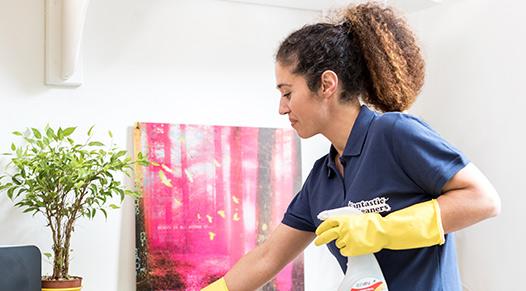
From late spring the internal sills on the garden side of a W4 house develop a faint tackiness that is not dirt in the usual sense. It is honeydew, a sugar deposit that drifts down from aphids feeding in the mature limes and planes that line so many streets around here, and it behaves like nothing else in the house: it attracts dust, it darkens as sooty mould grows on it, and it laughs at a glass spray.
A year with four different problems
The material arriving from outside changes with the season. Spring brings pollen, fine and yellow, which settles on sills, cars and the tops of skirtings. Early summer brings the sticky fall from the trees. Autumn brings leaf fragments and the fine dark mould that grows on wet leaf litter, tracked in on soles. Winter brings mud and salt. A cleaning routine that does not shift with that calendar spends half the year doing the wrong work well.
Sugar deposits need water, not glass cleaner
Honeydew dissolves readily in warm water and hardly at all in a solvent-based glass product, which is why spraying and wiping smears it into a film. Warm water with a little detergent, a cloth that is genuinely wet, then a rinse and a dry buff, removes it in one pass. On painted sills the same applies, with the caution that repeated scrubbing on gloss eventually burnishes it. Outdoor furniture and garden glazing go the same way and are easier to deal with before the mould colonises the sugar.
The entrance does most of the work
Matting is the single highest-return intervention in a house with a garden. A coarse scraper mat outside to take the bulk, then an absorbent mat inside long enough for two or three strides, removes most of what would otherwise end up in the hall and the stairs. Short mats catch the first footfall and miss the rest. Where a house has a side return or a back door straight into a kitchen, that entrance needs the same treatment and rarely gets it. The tasks that make up a household round are described on domestic cleaning.
Soil, paws and the utility room
River terrace ground here holds moisture, and a garden in use produces a steady traffic of damp soil into the house on boots and on dogs. A towel by the back door and a mat that is actually shaken out changes the whole picture. Utility rooms take the brunt and are often left out of a cleaning brief altogether, which is odd given that everything dirty in the house passes through them.
What ends up in the sofa
Soft furnishings absorb the seasonal traffic quietly. Pollen, dust and the oils from animal coats work into the weave, and the result is a sofa that looks acceptable and smells faintly of the household. Vacuuming with an upholstery head weekly holds it; beyond that the fabric needs washing with a method matched to its cleaning code, since water on a solvent-only fabric leaves rings that are worse than the original problem. That work is handled through Ealing upholstery cleaning service.
Carpet after a wet autumn
Leaf mould and fine grit are a bad combination in a pile, because the organic fraction holds moisture and the mineral fraction cuts the fibre. By November a hall carpet in a family house has taken a heavy load, and the sensible point for extraction is once the leaves are down rather than in the middle of the mess. That timing is worth discussing when arranging Chiswick carpet stain removal, since a dry spell makes the drying far quicker.
Adjusting the visit through the year
Charging is by time, so the practical response to a seasonal load is to move the hours rather than add them: more attention to entrances, sills and floors from October to February, more to glass and outdoor-facing surfaces in the summer. A standing arrangement with a written priority list, revisited twice a year, does that almost automatically, which is the pattern Chiswick cleaning services team follows.