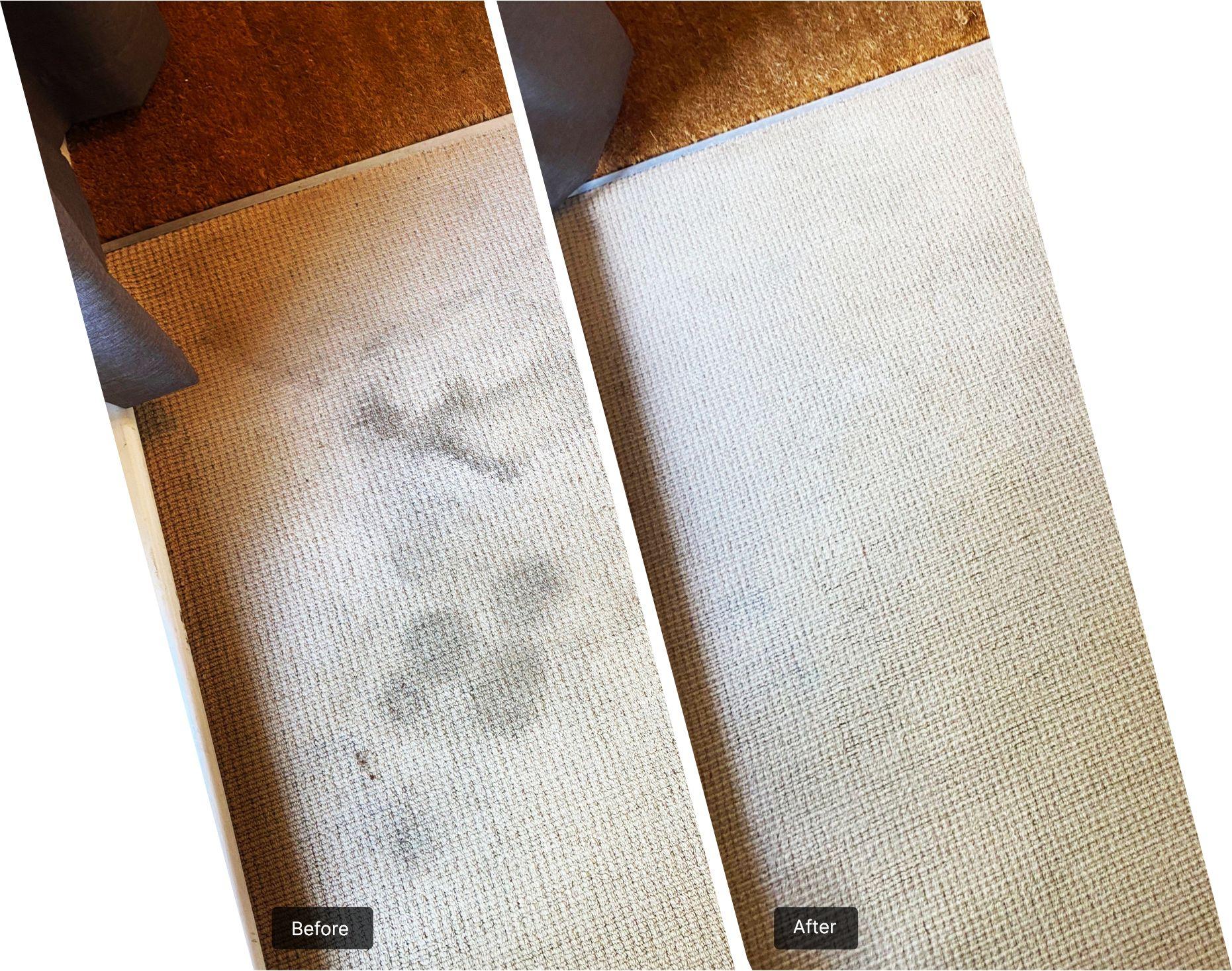
The grey line that appears along the skirting boards in Chiswick terraces is not dirt anyone walked in. It is soot and fine airborne particulate that has been filtered out of moving air by the carpet itself, and it reappears within months of every clean unless the airflow causing it is dealt with.
A carpet working as an air filter
W4 housing is largely late Victorian terrace with suspended timber ground floors, and air moves constantly from the cold ventilated void below into the warmer room above. It travels through the gaps between floorboards, then through the carpet and underlay at the perimeter where the pile is compressed against the gripper. Every particle carried in that air is trapped by the fibre at that point, building a dark, sharply defined band a few centimetres wide. The pattern is diagnostic: soiling walked in is diffuse, filtration soiling has a hard edge.
Pressure difference drives it, and not only at the skirting
The stronger the flow, the faster the band forms. Warm rooms, open fires or flueless appliances, extractor fans running with no make-up air and modern draught-proofed windows all increase the pressure difference between void and room. Terraces where a rear extension has changed how air moves through the ground floor often develop the band on one wall only, which puzzles owners until the airflow is explained. The same mechanism shows under an internal door with a gap beneath it, and along the join between riser and tread on a staircase. Anywhere air is forced through compressed pile, particulate is left behind, and recognising that is what stops people blaming their shoes.
Why it is the hardest marking to remove
Filtration soiling is carbon and fine mineral matter bound into fibre under compression, right at the point where no wand or brush can properly reach. It responds to a strong alkaline pre-treatment with a long dwell, worked with a stiff hand brush along the line, then extracted with a narrow hand tool from several angles. Improvement is usually substantial; complete removal is not always achievable and honest operators say so before they start rather than afterwards.
Slowing it down afterwards
The lasting fix is to reduce airflow through the floor edge. Sealing the gap between skirting and floorboards with a flexible sealant, laying a sheet membrane under new underlay when a carpet is replaced, and making sure any fan has a proper air path all help. Burning candles and using an open fire without adequate ventilation accelerate it dramatically, and households that cut back on both see the band return far more slowly.
Damp is the other thing that hides at a floor edge
A perimeter that is darker and also cold or musty is a different problem, and moisture moving through a wall or a blocked sub-floor vent needs addressing before any textile work. The kind of investigation and treatment described on local mould removal in Gunnersbury comes first in that case, since cleaning a carpet over damp underlay achieves nothing lasting.
Outside surfaces contribute their share
Front paths, steps and rear patios collect the same airborne film, and it walks straight indoors. Washing those down periodically, along the lines of Bayswater pressure washing service or Ealing pressure washing service, reduces the load arriving on shoes and keeps entrance matting effective for longer.
How the work is arranged
Perimeter treatment is quoted by the linear metre in addition to the room rate, because it is slow hand work and pricing it as part of the floor area would be misleading. Furniture along the affected wall needs moving clear, and access to the skirting is essential. Seating fabric is assessed at the same visit as part of Chiswick fabric upholstery cleaning, wider household upkeep runs through trusted home cleaning in Chiswick, similar terraced stock nearby is covered by professional rug cleaning in West London, and the underlying method guidance is on our carpet and rug cleaning service.