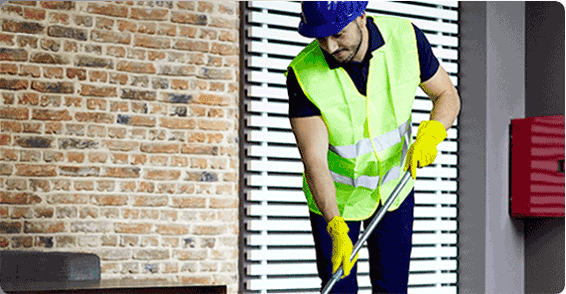
Central Bristol builds upwards and inwards rather than outwards. The work in BS1 is conversion work: former warehouses cut into apartments, upper floors above commercial units turned into flats, offices reconfigured, and Georgian townhouses divided and re-divided. Cleaning after that kind of project means dealing with two hundred years of accumulated grime released by the demolition phase as well as the fresh residue of the fit-out, often in a building where the only way in is a shared entrance and a lift that has to be booked.
What comes out of an old building when it is opened up
Stripping back a converted warehouse releases material that has been undisturbed for decades: soot from long-blocked flues, coal dust in floor voids, bird debris from roof spaces, and the grit that sits on every steel beam and timber joist. It is greasy rather than powdery, and it does not respond to the same treatment as clean plaster dust. Degreasing comes before rinsing, and rinsing before any polishing step, or the residue is simply moved around. National scope notes for the service sit on what our after builders cleaning includes.
Exposed brick, steel and polished concrete
The finishes that define these conversions are all difficult to clean and easy to spoil. Exposed brickwork is porous and will hold any detergent that soaks into it, blooming white as it dries. Structural steel that has been shot-blasted and waxed must not meet an alkaline cleaner. Polished or power-floated concrete is often still holding curing compound, and the wrong product will haze the surface permanently. Each one gets tested in a corner first, which is slower and considerably cheaper than a remedial visit.
Glass in a converted building
Crittall-style windows, tall industrial glazing and new roof lights all end a fit-out covered in plaster splash, silicone and paint mist. Internal faces can be reached; external faces on an upper floor cannot, and a builders' clean does not include working at height on the outside of a building. That part is a separate discipline with its own access equipment and falls under flexible window cleaning services in Bristol, usually booked a week or two after the trades have finished so it is not repeated.
Access, lifts and the loading bay
In a managed block, logistics decide the schedule. Lifts are booked in slots, protective blankets have to go up before anything is carried, loading bays have time limits, and building management frequently restricts contractor hours to the middle of the day. The team size is set around that rather than around the floor area, since four people who can get in are worth more than six who are waiting on a goods lift. Parking in the centre is permit-controlled throughout, so arrival windows are planned rather than assumed.
Flooring at the end of a fit-out
New flats tend to be finished with engineered board, vinyl plank or carpet fitted in the final fortnight while other trades are still moving through. Whatever goes down collects grit immediately and gets walked in. Hard floors are lifted with a neutral cleaner and repeated rinses, never a strong alkaline solution that strips a factory finish; fitted carpet in that state needs the residue pulled out of the pile, which is what professional rug cleaning in Bristol is for rather than another pass with a vacuum.
Outside the centre and beyond the city
Suburban work is a different animal, and the teams cover it: family houses in Westbury-on-Trym home cleaning and the streets to the south in local specialists are mostly extensions and refits rather than conversions, while rural properties out on the Levels around professional house cleaning in Wedmore bring farm access and long driveways into the planning. Larger projects further east, including professional post-renovation cleaning in Swindon, are served from the same operation.
Booking a conversion clean
The most useful thing to supply is a floor plan and an honest stage of completion. Scope divides into a builders' clean during the works and a final handover clean once every trade has gone; on developments they are separate visits and priced separately. Charging runs on hours and team size, with an allowance for building access constraints where these are known in advance. Water and power on site are assumed. Anything that requires a licence, such as asbestos-containing material, stops the job and goes to a specialist.