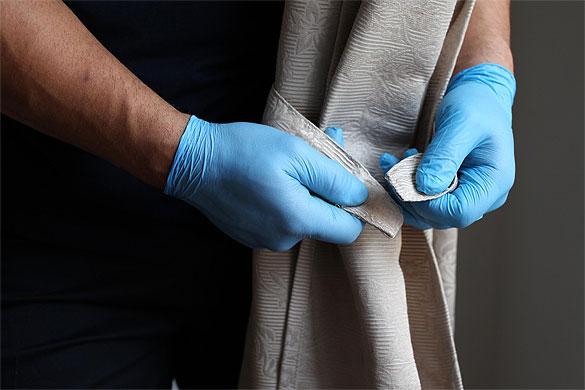
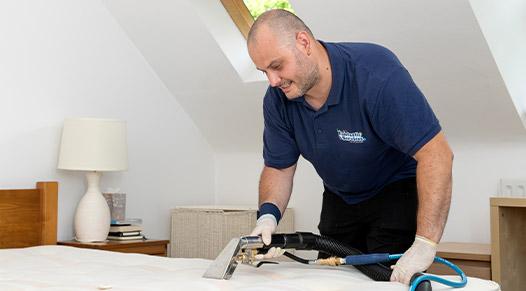
Anyone who has looked closely at a communal corridor in a Southwark block will have noticed a dark line running along the skirting and a darker one under each flat door. That is filtration soiling: air being pushed through the pile at every gap, leaving behind the fine airborne particulate it was carrying. It is not ordinary dirt, it does not respond to ordinary treatment, and it is the single most common complaint about carpeted shared areas in the borough.
What filtration lines actually are
Pressure differences between a heated flat and a cooler corridor force air through the only gaps available, which are the edges of the floor and the gap beneath a door. The carpet behaves as a filter and collects soot, cooking particulate and brake dust from the street. Because the deposit is bonded to the fibre by static and grease rather than resting loose on it, lifting it takes a solvent-based edge treatment, a stiff brush worked along the line and repeated extraction rather than a wand pass.
Why corridors wear in stripes
Shared circulation space takes traffic in a single narrow lane between the lift, the stairs and the flat doors, so the pile compacts along a strip while the margins stay full. Cleaning does not level that difference; grooming the damp pile afterwards goes some way, and a periodic maintenance treatment of the lane alone stops the contrast widening. Rotating the position of any loose matting also spreads the load.
Carpet tiles and what makes them different
Many blocks and converted commercial buildings use bitumen-backed tiles rather than a rolled fitted floor. Tiles tolerate less moisture, because water reaching the backing lifts the adhesive and curls the edges, so low-moisture encapsulation is usually the right method. The advantage is that a badly damaged tile can be swapped rather than the whole run replaced, provided a few spares were kept from the original installation.
The entrance, and the soil that never gets past it
A properly specified matting run at the main door — long enough for several full footfalls, in a well between the doors if the building has one — removes a large share of the soil that would otherwise be distributed along every corridor. Where there is no well and mats sit loose on the floor, they get kicked out of position and achieve very little. This is the cheapest intervention available to a managing agent.
Individual flats behind those corridor doors
Inside a flat the problem changes completely: cooking film, upholstery fibres and household grit rather than corridor particulate. A resident arranging regular housework through domestic cleaning across Southwark will keep on top of most of it, and floors themselves need attention roughly once a year in an averagely busy home. Anything else needed around the flat is grouped under professional home cleaning in Southwark.
Managing agents, schedules and duty of care
Work in common parts is normally arranged by a managing agent against a schedule rather than as a single booking, and the paperwork matters: a named contractor, evidence of insurance and a record of when each floor was last treated. Waste water from the job goes to a foul drain under the duty of care that applies to any commercial cleaning, not into a surface gully in the car park. Fire doors cannot be wedged open for a hose run, so the line is fed through and the door closed onto a purpose-made guard instead. Tenancy handovers in individual flats are a separate matter and are covered by the end of tenancy cleaning team in New Cross.
Arranging communal or domestic work
Common parts are quoted by measured area and by the number of floors served, with edge treatment for filtration lines priced as separate work because it is slow and done by hand. Inside a flat, charging is by room. Access, lift use and permitted working hours are agreed with whoever manages the building before the date is fixed. Residents nearer the station sometimes take a slot listed for local carpet cleaning in Waterloo, and the background notes on tile and broadloom construction sit on what the service covers.