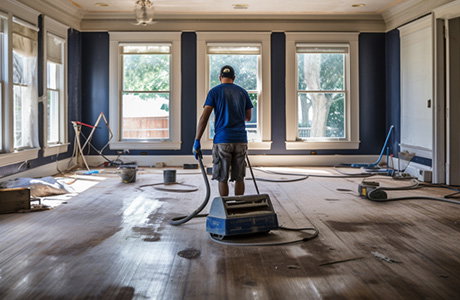
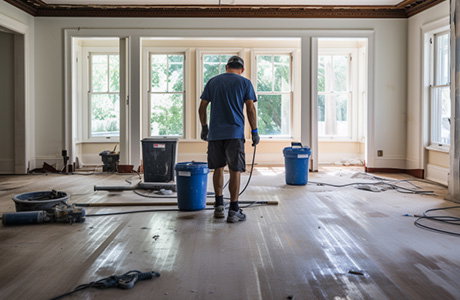
There is a point at which cleaning too early costs more than waiting. New screed gives up moisture for weeks, fresh plaster dries from the surface inward, and render and brickwork push salts outward as they lose water. Maidenhead sits on river gravels with a high water table in the lower-lying parts, and in a property where the ground is damp the whole process runs slower. Booking the final clean before a building has dried usually means paying for it twice.
Efflorescence and the white bloom that keeps coming back
A powdery white deposit on new brick, block or plaster is salt carried to the surface by evaporating water. Washing it off with water dissolves the salts and drives them back in, so they reappear within days. The correct treatment is dry: brushed off with a stiff brush, repeatedly, over several visits if necessary, and only treated chemically once the substrate has stopped moving. Explaining that in advance avoids an argument about workmanship that has nothing to do with cleaning. Salts on a chimney breast or beside a newly formed opening behave the same way, and the timescale is measured in seasons rather than days.
Screed, floor coverings and the moisture test
A sand-cement screed loses moisture slowly, and floor finishes laid too early fail. Cleaning has its own version of the same problem: a wet clean on a slab still drying adds water to a surface trying to lose it, and any dust suspended in that water dries back as a film. Damp-tolerant dry methods come first, and heavy wet work waits until the floor is ready. Where carpet has already gone down, fine dust settles into the new pile and extraction by professional deep carpet cleaning in Windsor deals with it properly.
Fresh paint and plaster that has not cured
New emulsion on new plaster stays soft for longer than it looks. Rubbing at a splash on a two-day-old wall will burnish it, leaving a shiny patch that shows under any raking light. Mist coats mark particularly easily. Where a mark cannot be lifted gently it is left and reported, because a small touch-up is cheaper than repainting a wall that has been polished by a cloth. Filled and sanded patches are treated as paint rather than as plaster, since the filler hardens more slowly than the coating over it.
Low-lying ground and the spaces underneath
In the lower parts of the town, ground-floor voids, cellars and integral garages sit close to the water table. Building debris left in those spaces holds moisture and encourages exactly the problem a homeowner is trying to avoid. Sub-floor areas are cleared of offcuts and bagged spoil rather than swept over, airbricks are proved clear, and anything stored on a cellar floor is lifted off it. The full scope of construction clean-ups is described on after builders cleaning services nationwide.
What to do while the building dries
An interim clean makes a property usable without pretending to be the final one: dust removed at high level, floors vacuumed, kitchens and bathrooms made serviceable, ventilation opened up. It is the sensible option for households living through the work, and it is charged by the time it takes rather than as a whole-property clean. Ongoing help of that kind through a longer project comes under experienced regular house cleaning in Slough, and the same staged approach is used across the river through post-build cleaning in Windsor.
Booking the final visit at the right moment
The trigger for the final clean is the last dust-producing trade leaving, plus enough dry time for the wet trades to have stopped moving. A week's notice is usually enough to secure a date; a date fixed months ahead rarely survives a construction programme. Where a property is being handed to a tenant immediately afterwards, the inventory standard is a different one and is covered by Slough check-out cleaning.