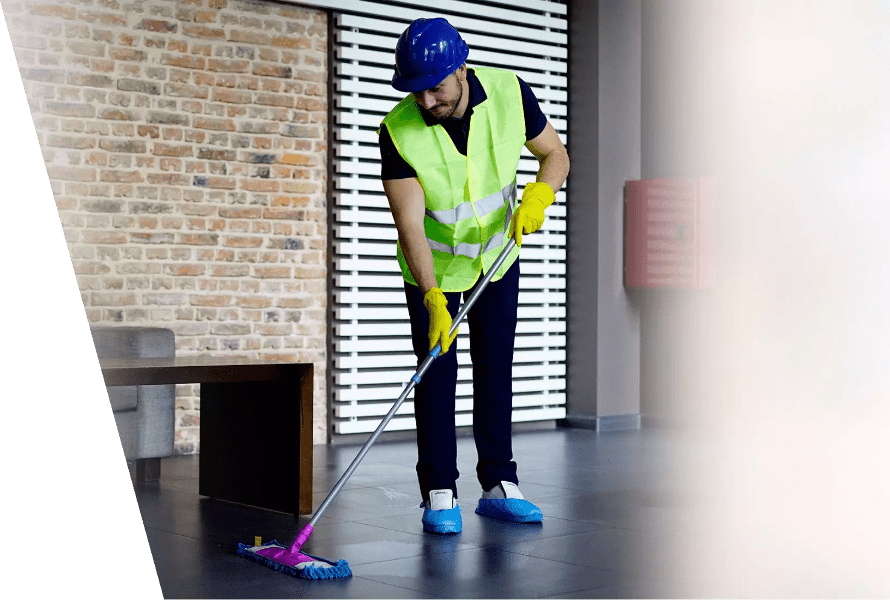
Most HP4 projects are carried out around a family that has not moved out. The rear extension, the loft, the reconfigured kitchen - all of it happens while children are doing homework upstairs and a dog is asleep in the hall. That single fact changes the cleaning job more than any material on site, because the priority stops being a perfect finish at the end and becomes controlling what people are breathing and touching while the work is still going on.
What construction dust actually contains
Cutting or grinding brick, block, concrete and stone releases respirable crystalline silica, and sanding filler and old paint produces its own fine load. The particles that matter are too small to see settling, stay airborne for hours and pass straight through a household vacuum's filter to be blown back into the room. This is not a reason for alarm in a domestic setting, but it is a reason to remove it properly rather than move it around.
Containment that works and containment that does not
A sheet of polythene taped across a doorway is better than nothing and much worse than most people assume. Dust escapes at the floor, at the edges, and every time someone walks through. A zipped door in a sealed screen, negative pressure in the work zone and a defined route with tacky matting at the boundary make the real difference. Where trades have not set that up, the interim cleans matter far more.
Cleaning in stages rather than once at the end
On a project running several months, splitting the work is worth the extra visits. A clean-down after first fix and plastering takes the bulk away before decorating begins, so the painter is not laying a finish over grit. Weekly attention to the boundary zone and the family's living space keeps the house usable. The final pass then deals only with what the last trades left, which makes it faster and better. Neighbouring coverage on the same pattern is listed as the after builders cleaning team in Chesham.
Children, pets and the surfaces they use
The things worth prioritising in an occupied build are not the ones that photograph well: floors at crawling height, the underside of a table, a sofa arm, a dog's bedding, the handles and light switches along the route trades use. Soft furnishings hold fines and release them under pressure, which is exactly what sitting on a sofa does. They are treated with extraction rather than beaten or brushed, and that work falls under carpet cleaning for period property in Hemel Hempstead.
Heating systems spread what the builders made
Running a warm-air or ducted system during works pushes the load through every room in the property, and radiators do something similar by convection, drawing dust up the wall behind them and depositing it on the ceiling line. Radiator fins, the gap behind them and any grille or vent are cleaned as part of the job, because leaving them means the first cold week undoes everything.
Glass, and the point at which it is worth doing
Windows are the one element not worth cleaning twice. Internal glazing is left until the trades have genuinely finished; external elevations, which take splash from cutting and mixing, are better handled once scaffolding is down, and on upper floors that needs pole-fed equipment through window cleaning specialists in Hemel Hempstead.
What a final visit covers and how it is quoted
The last clean is specified around what was actually disturbed - the new space, the rooms that connect to it, the route, and anywhere soft furnishings were stored. Charging follows hours and team size, so a household that has had interim visits generally finds the final one shorter. It helps to have the works area emptied, protection lifted and waste collected beforehand. A fuller description of inclusions sits on our main service page.