Knock the wall out between a Victorian back room and a rear extension, put the hob in the middle of it, and the lounge carpet becomes part of the kitchen. That arrangement is now the standard layout in a great many SW17 terraces, and it produces a very particular soiling pattern: a greasy film that settles evenly across an open-plan floor, several metres from where any cooking happens.
Cooking aerosol travels further than people expect
Frying releases microscopic droplets of oil that stay airborne for a long time and drift on the smallest air current. They land on every surface in the open space, carpet included, and there they form a tacky film that holds dry soil instead of letting it be vacuumed away. The result is a floor that greys uniformly rather than only in the walking lanes, and that greying does not respond to more vacuuming because the problem is adhesive rather than loose.
Recirculating hoods and the film they guarantee
Many rear extensions were fitted with a hood that filters and returns air to the room rather than ducting it outside. A charcoal filter handles some odour and very little grease, and once it is past its life it handles neither. Where a floor is regreasing within months of cleaning, the extraction arrangement is usually the reason, and a ducted hood or a genuinely maintained filter will do more for the carpet than any product applied to it.
Breaking down an oily film
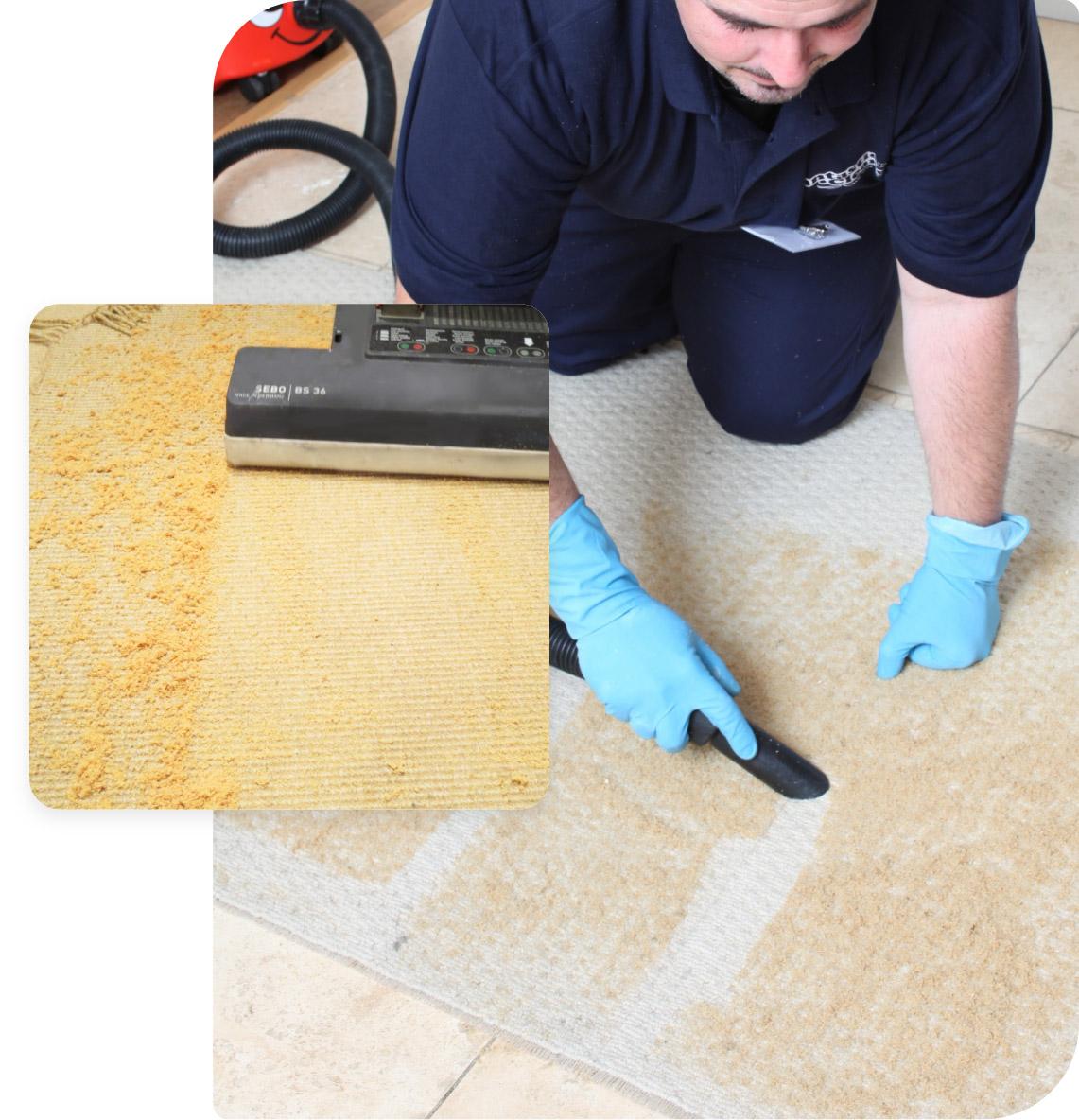
Water-based detergent alone skates over this kind of soil. What works is an alkaline pre-spray with a solvent component, given real dwell time so the chemistry can act on the oil, then mechanical agitation to break the bond at the fibre, then extraction hot enough to keep the emulsified grease in suspension until it reaches the recovery tank. Rushing the dwell is the single most common reason an open-plan floor looks only slightly better afterwards.
The threshold where two floors meet
Open-plan layouts almost always end in a metal or timber bar where engineered board or tile gives way to carpet, and that line collects grit in a way the middle of a room never does. Debris swept along a hard floor is stopped at the bar, footfall then grinds it into the first few centimetres of pile, and the edge of the carpet frays where it has been abraded against the fixing. Cleaning that band needs a narrow hand tool and a brush rather than a wand pass, and a loose bar is worth refixing before it cuts into the backing.
Spice, turmeric and dyes that are not soil
A dropped curry leaves two problems in one mark. The oil comes out with the treatment above; the colour is a different matter, because turmeric contains a natural dye that bonds to fibre and is also light-sensitive. It often fades under daylight over following weeks and can sometimes be reduced further with a controlled oxidising treatment on a suitable fibre, but it should never be promised as an immediate full removal.
The sofa at the far end of the same room
Everything described above lands on upholstery as well, and a fabric sofa in an open-plan room collects grease at a similar rate to the floor beneath it. Seating is treated with lower moisture and its own chemistry, set out under professional upholstery cleaning services in Tooting, and cleaning floor and furniture in one visit avoids the odd effect of a fresh carpet beside a grey armchair. Wider household work is covered through our nearby specialists, and comparable properties nearby are dealt with on domestic cleaning team in Earlsfield.
Planning the visit around an open-plan floor
Pricing follows counted areas, and a knocked-through space is measured as the area it actually is rather than as the two rooms it once was. Dining chairs and anything on castors come off the carpet beforehand; the hob stays off during the visit so nothing new is deposited on a damp pile. Neighbouring districts to the east are covered on professional deep carpet cleaning in Streatham, and the method detail behind the pre-spray and rinse sits on carpet and rug cleaning services UK.