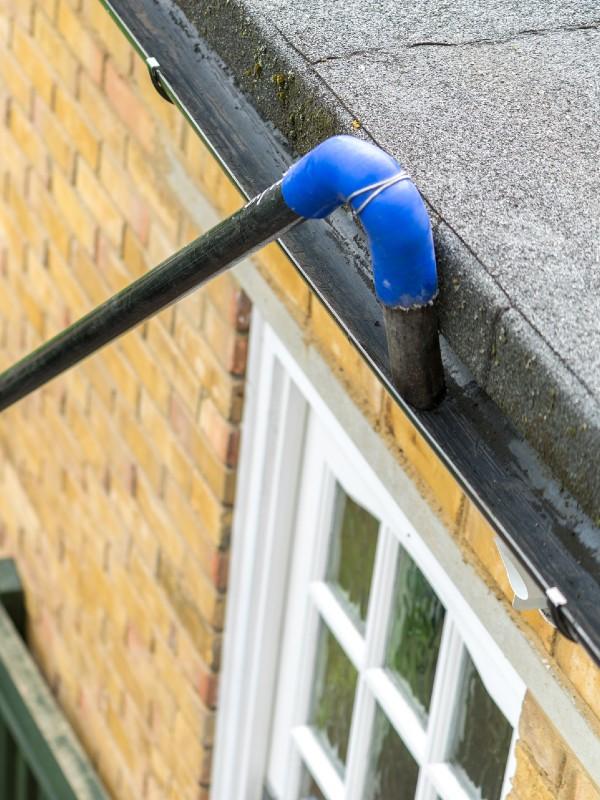
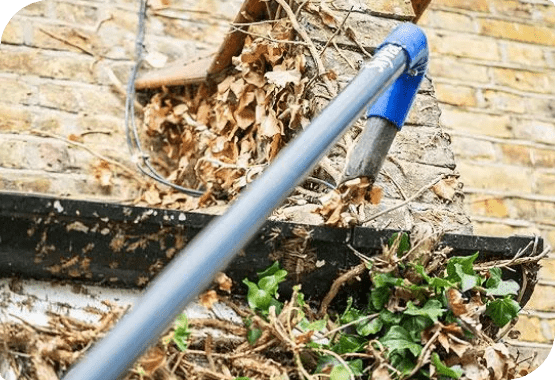
Debris arrives sideways in a coastal town. Inland, a gutter fills from above with whatever the nearest tree drops; on an exposed east-facing shore the wind does the loading, driving sand, grit, torn moss and litter along a roof slope and packing it hard against the far end of a run. The result behaves differently from a leaf blockage. It is denser, it sits low in the channel, and it cannot be flushed loose, which is why a hose left running in a rhone here usually achieves nothing at all.
Salt, and the fixing that fails first
Airborne salt reaches well inland from the firth, and it attacks the fasteners long before it troubles the gutter itself. Zinc-plated screws holding brackets to a fascia corrode from the head, cast iron rusts at the bolted joint where two sections overlap, and a bracket that has lost half its shank will hold until the weight of one wet autumn finds it. Part of any clearance on this coast is working along the run testing brackets by hand and replacing fixings in stainless steel rather than waiting for a section to drop.
Gulls, and the season that stops the work
Roofs near the harbour and the older streets attract nesting gulls, and a nest built on a flat parapet or against a chimney stack sheds an extraordinary quantity of material into the nearest gutter. The legal position is firm: an active nest with eggs or young must not be disturbed, so clearing around occupied sites waits until the season is over. The productive window is autumn through to late winter, and the useful work is deterrence and clearance together, since a stripped and flushed roof is far less attractive the following spring.
Harled walls and what a soaking does to them
Much of the older housing is harled or rendered over rubble, and that construction copes poorly with a persistent overflow. Water tracks behind the render at a crack, spreads sideways and then freezes, so the first visible sign is a patch of blown harling rather than a stain. Once a section has lost its bond it will keep taking water even after the gutter above is fixed. Repairs to harling bring their own dust and residue indoors, which is the specification in our after builders cleaning service in Leven. Stopping the source early is the whole argument for maintenance here, because the wall repair costs many times what the clearance would have.
Terraced rows, wynds and back courts
Access follows the grain of the old street pattern. Frontages sit directly on the pavement with no set-down, and rear elevations are reached through a shared back court or a narrow wynd where a ladder cannot be pitched squarely. Much of the routine clearing is therefore done from ground level with a vacuum on poles, with a tower reserved for dormers and awkward returns. Neighbours sharing a court are told in advance, since the work occupies the drying area for part of the day. Salt film returns to glass quickly on this coast, and that is the separate job in our window cleaning service in Kirkcaldy.
Picking the day
Weather governs the diary more than anywhere sheltered. Anything above single-storey height stops when gusts build, and a wet slate roof is not a surface to be working next to, so coastal jobs are scheduled with a spare day built in. Late autumn, once the nesting season has closed and before the first gales, is when a full clearance does the most good. Gutter work further up the coast on more sheltered stone housing follows a different rhythm, set out under gutter cleaning cover across Edinburgh.
What a visit covers here
A standard clearance takes out the packed material by hand, checks and tightens the bracket line, flushes and rods the conductors, and reports on any corroded joint or loose section found in passing, with photographs. Price reflects the elevations, the height and whether a tower is needed rather than a fixed rate. Households often add interior work such as Kirkcaldy oven cleaning service while the crew is on site, and the standard scope of the service sits on nationwide gutter cleaning services.